Relationships are complicated things. They can bring out the best
and the worst in people. They can make a person do things they never
thought possible, both in good and bad ways. Crimes of passion and
things done out of spite are often associated with relationships gone
wrong. One of the greatest spiteful maneuvers done in a relationship
is actually tied in to Massachusetts history and in fact is seen by
countless drivers on a daily basis. It comes in the from of a home.
A beautiful, stately home, decked out completely in pink. It sounds
delightful and in most cases it would be. However this pink house
does not reside in a suburban neighborhood, or even on a remote
estate. No, this pink house sits in a marshy wetland. Allegedly
built out of spite by a husband for his soon-to-be ex-wife, this is
the story behind the oddity that is the Pink House of Plum Island,
Massachusetts.
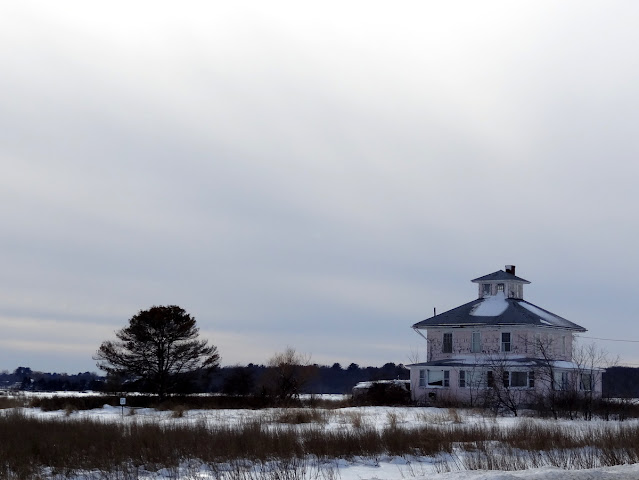 |
| The Pink House of Plum Island(Elizabeth Thomsen/Flickr) |
The urban legend that surrounds the Pink House goes as follows.
During divorce proceedings one of the wife's demands was that she
have a house built that was an exact replica of the one she had
shared with her husband. She never specified where to build it
though which led to the spiteful husband building it upon the marshy
area where it still resides. It was purportedly even built with salt
water plumbing making it virtually uninhabitable.
Whether or not the Pink House was built as a less than charitable
gesture by a divorcing husband the idea of a 'spite house' is very
real. It is a dwelling built with the main purpose being to irritate
neighboring home or land owners. Examples of this practice can be
found in a link to an article on TreeHugger.com at the end of this
post. That being said it has yet to be confirmed as to whether the
house along the Plum Island Turnpike was built from spite or not.
Here are the basic facts of the story.
Young couple Henry Cutter and Ruth Morin wed in Newburyport,
Massachusetts in June 1922 at the home of Ruth's parents on High
Street. They lived in a few places around town in the ensuing years
with Ruth giving birth to a son Henry Jr. in 1923.
Perhaps in a bid to give her grandson a permanent home, Henry's
mother Gertrude Cutter stepped up and purchased a parcel of land in
July 1925. This land, previously owned by prominent Newburyport
widow Abbie Little, sat on the marshy uplands near Plumbush Creek a
little more than a mile from the ocean. It had been used for
harvesting salt marsh hay, hardly a pristine location for a new
family home. Though it must be said that during this time the nearby
waterfront of Plum Island was being built up with homes to attract
families.
On this parcel of land a two-story house was built in 1925 roughly
150 back from the road on the uplands. The home was painted pink,
though it is not known why. It was likely seen as a perfect home to
live in for a young family. However the honeymoon was very
short-lived. Behind the scenes there had already been trouble
brewing between Henry and Ruth. This was only exacerbated after
moving in to the Pink House.
Once settled in Henry would routinely disappear. It was said by
Ruth he would leave for upwards of a week at a time while she stayed
in the house with their son. The Pink House was in a wide-open area,
exposed to the elements. It was prone to having water in the
basement with towels and newspapers being used in the place of
curtains. During a 12-day absence by Henry in November 1925 Ruth
contacted an attorney who advised her to take her son and everything
she believed was hers and leave the Pink House behind. That is what
she did. A separation soon followed along with divorce proceedings
citing desertion as the cause.
Only after leaving the Pink House did Ruth discover the depth of
Henry's deception. It turned out that he had been spending a lot of
time in the company of a Boston businesswoman named Beatrice Bowry.
In addition Henry would get meals from his mother Gertrude's home
while leaving Ruth $2($31 in 2021) for food and necessities for the
week for both her and their infant son.
It took more than a decade for the divorce to be finalized after
which Henry married Beatrice. The Cutter Family maintained ownership
of the Pink House until the sold it in 1947, using it as a summer
home in those years. The Pink House was sold four times in eight
years with brackish water in the plumbing being purported as a source
of trouble for the owners.
Milton and Juliette Stott became the sixth owners in 1960 and
brought some stability to the property. The home remained in the
family's possession until 2011 even though it was not lived in after
the early 2000's. In 2011 the U.S. Fish & Wildlife/Parker River
Wildlife Refuge bought the home and the salt marsh property it stands
upon. In 2016 there was a close call with the home nearly being
razed. Support the Pink House is an organization working to this
day to preserve this unique and now historic home.
Despite the legend that the Pink House was built out of spite by an
angry soon-to-be ex-husband there is not much to support that claim.
Unfortunately the reality of the situation is sadder. Henry Cutter
moved his wife and young son into the house and abandoned them there
with little money while he lived like a king with free food at his
mother's and a new lover on the side.
Regardless of why it was built the Pink House of Plum Island is
truly a sight to see. It has become a very popular spot for
photography, painting, and even bird watching. Located on a marshy
upland along the Plum Island Turnpike it is hard not to stop and
stare at this historic and oddly placed home in wonder.
-------------------------------------------------------------------------


