
It came in with a big splash, faded away and returned again. It made its mark in a 19th century home yet was firmly developed on late-20th century ideas. It spread its wings but they were quickly clipped. This is the briefly spectacular, complicated, and somewhat odd history of the Fiddlebee’s restaurants and night spots.
The story of Fiddlebee’s actually started back in the late 19th century. It was in 1880 that a Victorian house was built on North Street in Hyannis. Back then Hyannis was not the business hub of Cape Cod and Main Street and the streets surrounding it all were dotted with traditional residential homes. At the turn of the 20th century the town’s population was a mere 4,364, a drop in the bucket to the estimated 44,406 of 2019.
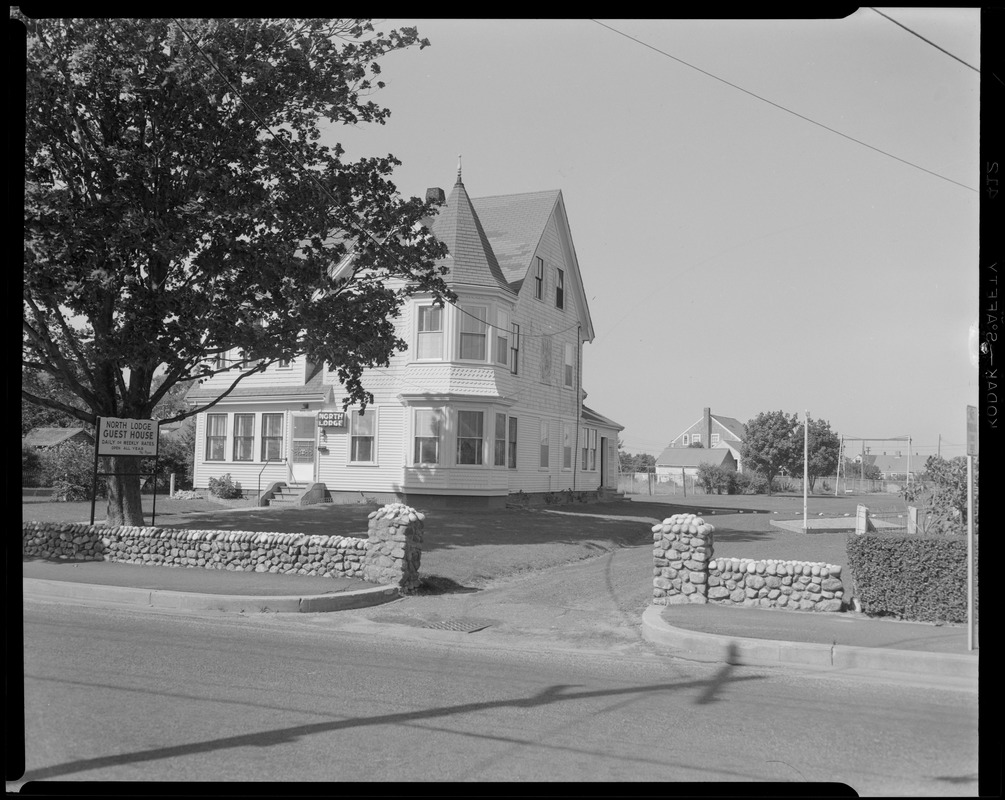
Ralph Tryon's North Lodge(Cape Cod Community College)
As the 20th century moved along times changed. More and more businesses moved into the area around Main Street. Around the middle of the century the Victorian home on North Street became a spot called the North Lodge. This small guest house was owned by Ralph Tryon and spoke to Hyannis’ slow change from residential neighborhood to bustling business center. It was relatively successful from the 1950’s into the mid-1970’s, even coming back from a fire in May 1970.
After closing in 1976 the old Victorian house was primed to be razed. It seemed its only value left was the parking lot which several nearby businesses rented out in 1977. The entire property at 72 North Street was sold in 1978 for $35,000($146,500 in 2021) to be converted into a restaurant. However there are no records showing that this spot ever materialized. It took a man named Harry B. Miller to come along in 1981 and create a new chapter for the Victorian house.
The new restaurant was named Fiddlebee’s. Opening in time for the summer of 1981 it promoted itself as having Al Fresco dining with an outdoor seating area large enough for fifty people. The interior of the Victorian house was also renovated adorned with lots of hanging plants and filled with friendly people.
Fiddlebee’s staked its claim as a family-friendly restaurant with a casual atmosphere. There were daily specials, soups, quiche of the day, fondue, crepes, and sandwiches along with a traditional dinner menu. Although there was a 14-foot bar and cocktail area it wasn’t until its second season that Fiddlebee’s began to lean into the sale of liquor.
This slow change began on February 16, 1982 with a charitable event for the March of Dimes. It was on this date that Fiddlebee’s attempted to concoct the world’s largest cocktail. Fittingly it was to be a Cape Codder. The drink was so large that it had to be stirred with an oar from the second floor of the building. It is unknown how much money the event raised for the March of Dimes.
It was around this time that Fiddlebee’s got a new owner, William Planinshek. It was also around this time that Fiddlebee’s became so popular that it was seen as a calculated risk to branch out. In March 1983 the Buttermilk Bay Motel in Buzzards Bay was purchased and converted into a second Fiddlebee’s. This new location did not siphon any business from the original though. In fact it continued to grow.
The popularity of Fiddlebee’s began to become problematic due to the finite number of parking spaces. Complaints came in June 1984 when patrons of the establishment began parking in the neighboring condominium complex and even blocking the fire lanes. Although not the fault completely of the management it was not a good time to also be looking to created an outdoor patio on the second floor of Fiddlebee’s.
1985 saw more change and expansion. In April 1985 the company took over the venerable Golden Anchor restaurant in West Dennis. This became the third Fiddlebee’s known as Fiddlebee’s Seafood Shanty. During the summer the Hyannis location was approved to have live entertainment and a dance floor. Despite the parking issues the changes were approved as Fiddlebee’s had otherwise been model citizens. It was also during this time that three Fiddlebee’s employees left to start their own barbecue family restaurant on Main Street Hyannis called Harry’s.
Although they began leaning heavily into the bar and night spot atmosphere of Fiddlebee’s they did not lose sight of where they came from. They maintained a connection to the restaurant aspect with a kids menu, apps, seafood, steaks, pizza, and the ever-popular Fiddleburgers. However just as they hit their stride as both family-friendly and a happening night spot things changed.

A Fiddlebee's Ad from 1985
As 1985 turned to 1986 Fiddlebee’s changed its name to Anthony’s Restaurant, serving Italian food. Then in May 1986 the West Dennis Fiddlebee’s also became Anthony’s, owned by Anthony Scialdone. Within four months of its changes the Hyannis location had become Willy’s Northside Cafe, named for owner William Planinshek. This did not stick either. In a fascinating turn of events Fiddlebee’s was reborn in April 1987. This second act was far different though.
They still had their traditional lunch and dinner fare but the entertainment became the main selling point. Some of the most well known local performers came to play there including the Incredible Casuals, Jeff Lowe Band, The Natives, and Freddie and the Maybellines. Early in 1989 Fiddlebee’s got their biggest brush with fame when legendary singer and television personality Tiny Tim performed there twice.
The 1990’s brought different attempts to increase business including 18+ nights and heavy metal music. It succeeded in getting more people in the door, however these changes brought a whole new set of problems. Whether it was a younger crowd, the different music, or just overcrowding of the property itself, Fiddlebee’s saw an increase in violence and thus an increase in police presence.
It came to a head in 1993 with an increasing number of reports of fights including a stabbing in the parking lot across the street. However this was not strictly a Fiddlebee’s problem. Other Hyannis night spots were under increasing scrutiny as the summer of 1993 began. Fiddlebee’s did its part to cooperate with town officials and local police by eliminating the 18+ nights and toning down their musical choices. They tried to give the establishment a more laid back feel.

The former site of Fiddlebee's(Google Maps)
The efforts seemed to work as 4th of July passed with no incidents. Surprisingly it was the restaurant branch, which they had been minimizing in recent years, that got them in trouble. During a routine health inspection several major violations were noted and Fiddlebee’s was closed pending their rectification. The doors closed on August 6, 1993 and they never reopened. It was an abrupt ending to a popular Hyannis establishment.
In the years since the Victorian house has seen its share of businesses come and go. There was The Boat House, Kendrick’s, The Steak House & Sports Bar, and today it is home to Portside Tavern. Despite decades of being used as a guest house and various restaurants the one thing that hasn’t changed is the Victorian house. It may get renovated, re-shingled, and repainted, but overall it still remains the same. The property at 72 North Street has kept one foot in its past while adapting to the future. Fiddlebee’s for all of its fleeting popularity was just another chapter in the story of the old Victorian house.
--------------------------------------------
Previous Blog Posts:


