Pages

Showing posts with label yarmouth. Show all posts

Sunday, April 28, 2024

The Long Road of Yarmouth's Bass River (Smuggler's) Beach


Today much of the coasts of the United States are a mix of public and private beaches. The rich own strips of sand in front of their property while cities and towns purchase plots of land for the average everyday people to use.

The coastlines were not created as public or private. Many steps go into creating a public beach. Things like legal ownership, planning, regulations, zoning, and meetings are parts of what takes an area from an inconspicuous stretch of sand to a beach packed with people in summertime.

Though no two are exactly the same one example of land going from private to public resides on Cape Cod. At the mouth of Bass River, a waterway running in between the towns of Yarmouth and Dennis, there are popular beaches on both sides.

They both went from private to public. On the Dennis(east) side of Bass River sits Davis Beach. Known more commonly as West Dennis Beach this stretch of sand nearly a mile and a half in length was owned for decades by Charles Henry Davis. He had deep connections to Cape Cod including the creation of America’s first traffic circle at the meeting of River and Pleasant Streets in the Bass River section of South Yarmouth.

America's first traffic circle in South Yarmouth.


Davis at one point it was said could walk from Nantucket Sound on the south coast of Cape Cod all the way to Cape Cod Bay on the north side and never leave the property he owned. This included all of what is today West Dennis Beach. The acquisition of this pristine set of sand was simple and straightforward. Davis sold the property to the Town of Dennis shortly before he died in 1951 for the cool sum of $50,000($589,900 in 2024).

West Dennis Beach has a story that is for all intents and purposes simple and clear-cut. Across Bass River in Yarmouth, the beach has a slightly more complex story. It includes bootlegging, giant resort hotels, and more transfers of ownership than one might expect.

Present-day Bass River Beach began as the property of Joseph P. Phelan. Born in Ireland in 1888 Phelan came to America and settled in Fall River, Massachusetts. He was a successful businessman making significant money with his popular Cape Cod Shirt Company that he established in 1926.

Phelan purchased a triangular-shaped plot of land on the western side of the mouth of Bass River in an area known as The Point from Edward Gleason in April 1926. There he had a summer home constructed. In total, it was ten rooms including five bedrooms along with a wooden pier that stretched out into the ocean. The family’s arrival at the beginning of the summer was headline news in the local newspapers. When they weren’t at the home it was rented out with those renters also making the local news.

The beach at The Point grew substantially in size when in the early 1950s efforts were made to dredge Bass River. The spoils were piled onto either side of the mouth of the river.

For a few years, the piles of dredged sediment sat there. They were used as picnic areas, or for kids to play on. Eventually, Yarmouth used their spoils to fill in the marshland abutting the Phelan property. This also served to fill in the creek leading from nearby Run Pond to Nantucket Sound which was a bone of contention with some locals. In total, the Phelan property was thirteen acres of waterfront land.

During the early 1950’s the Town of Yarmouth had begun buying up beachfront property to be designated for public use. This included buying present-day Sea Gull Beach in 1951 for $25,000($300,000 in 2024), as well as the far smaller Englewood Beach for $9,000($106,000 in 2024) in 1952. As the Phelan property was only in use for a few months of the year rumblings began locally about the town buying that as well.


Bass River looking south toward the former Phelan property


In 1958 Joseph Phelan offered to sell the coveted property to the town for $150,000($1.62 million in 2024). Despite there being support for a new public beach the offer was deemed too high and the town passed. Talks of taking the property by eminent domain were voted down at the time. This left Harwich Port real estate broker John J. Taylor to swoop in and buy the land in September 1959 from Phelan for a far more affordable price of $80,000($858,600 in 2024).

The Town of Yarmouth had balked at the high price of the Phelan property. However when confronted with Taylor’s proposal for what to do with the land the town had wished they’d paid the price.

The plan was to subdivide part of the land for houses and leave a large tract of it to be used for a three-story, 180-room, waterfront resort hotel. This was rejected by the town which left the property in limbo.

Besieged with hurdles and roadblocks surrounding the thirteen acres of waterfront property Taylor sold the land to Sidney Tucker and Paul Lampros in August 1961 for $140,000($1.46 million in 2024). Only a few months later in March 1962 the Town of Yarmouth stepped in and took 10.5 of the thirteen acres of land by eminent domain. The Phelan summer home and a few lots of land surrounding it were left private. Tucker and Lampros sued the town in September 1962, arguing the land's value.

The proceedings dragged on in court until May 1964. However, once the jury got the case it took a mere twenty-eight minutes to award Tucker and Lampros a whopping $270,000($2.76 million in 2024) for the former Phelan property. This meant that essentially the Town of Yarmouth had paid nearly double the original asking price Joseph Phelan had offered which was seen as exorbitant.

Despite the long road and extra money paid, Yarmouth had its newest public beach. To cover the cost of the new beach as well as the new parking lot needed the town ultimately decided to start charging for parking during the tourist season. This was the start of buying beach stickers in Yarmouth.

Next up was the important task of naming the stretch of sand. In the local newspapers, it had been referred to as Phelan Beach since it was first offered for purchase in 1958. The name chosen was the on-the-nose name of Bass River Beach. However, locals rarely call it by that name.

In the six decades since Phelan Beach became Bass River Beach the area at the mouth of the river has been known more frequently as Smuggler’s Beach. But why? It is due to the stories of rum-running or bootlegging that took place in the area during Prohibition.


Did bootlegging take place at Smuggler's Beach?


The Smuggler’s Beach name becomes even more appropriate when coupled with the story of the Casa Madrid establishment. Located a few hundred yards from the beach on Run Pond Road the Casa Madrid opened in 1933 as a dancing and eating establishment. Only six weeks into its existence though it was raided by law enforcement and exposed as a speakeasy.

Did the liquor seized from Casa Madrid come from the nearby beach? One cannot say for sure, but the legend of Smuggler’s Beach draws heavily on that possibility.

From a summer home abutted by marshland to a hugely popular public beach the area formerly known as The Point in Yarmouth has taken a long road to get to where it is in the present day. It is an interesting dichotomy between the straightforward route of Charles Henry Davis’ property becoming West Dennis Beach and Joseph Phelan’s property becoming Bass River Smuggler’s Beach.

Friday, April 26, 2024

The Story of Casa Madrid - Cape Cod's Speakeasy


Prohibition was a law that made the production and sale of alcohol illegal in the United States. The 18th Amendment to the Constitution was on the books from January 1920 to December 1933. During this time, however, despite it being illegal there were still ways for people to enjoy their favorite liquors. One of the most well-known is that of the ‘speakeasy.’ These were hidden spots where one could get a drink. Cape Cod was no stranger to speakeasies with perhaps the most famous of these standing inconspicuously in South Yarmouth until only recently. It was known as Casa Madrid and this is its story.

Sunset at South Yarmouth's appropriately nicknamed Smuggler's Beach.


Situated for nearly a century on Run Pond Road this stucco building stood out like a sore thumb among the shingled classic Cape Cod homes. It was constructed in early 1933 for $125,000 ($3 million in 2024) and promoted as a dinner and dancing establishment associated with the Yarmouth Beach Club. The yellow stucco and red tiles were meant to catch the eye of passersby as was the intention of its creator, local realtor Alex Finn, and his partner Oscar Skinner. The Spanish style was considered entirely new for Cape Cod at the time. There were roads leading to the areas around Casa Madrid with the Nantucket Sound beaches merely a few hundred yards south, yet the establishment was surrounded by trees for the most part. Finn promised indoor and outdoor dancing with an enclosed courtyard with early estimates of the building being able to accommodate 3,000 people.


Casa Madrid was meant to be the destination for dinner and dancing on the Cape with entrance via ticket only. It was high class with proper dress required to get in as well. The grand opening of June 30, 1933, was attended by those sent invitations only, mainly members of the Beach Club and other high-ranking locals. Membership had more than its share of perks. There was access to the lockers in the bathhouse, hammocks, swings, handball and squash courts, canoes, rowboats, speedboats, and even a seaplane. The opening was a rousing success and it appeared that Cape Cod had its newest ‘place to be.’


However, a mere six weeks into its run Casa Madrid had its most famous night of all. On the night of Sunday, August 13, 1933, a group of thirty-five law enforcement officers under the direction of Lt. James Hughes and Assistant Attorney General George B. Lourie crashed the festivities at Casa Madrid after being tipped off about potential laws being broken there. Although some of the 300 guests present were eating and dancing when the officers arrived a great many more were found to be drinking at one of three bars inside the building while others were illegally gambling.

News of the raid on Casa Madrid in the Boston Globe, August 14, 1933


The raid was a week in planning and carried out with pinpoint precision. The troopers assembled in Norwell and made their way to the Cape accompanied by several Boston-based newspaper reporters who had been tipped off. Upon entering the establishment some of the patrons at Casa Madrid mistook the uniform-clad troopers as performers, this was obviously not the case. In a clean sweep, the raid seized a truckload of liquor, gambling equipment, and furnishings including a roulette wheel. There was also $7,360 ($176,827 in 2024) in cash on gambling tables, and the raid resulted in the arrest of thirty-four people including owners Finn and Skinner. In addition to those developments, rumors had it that many prominent citizens including Boston Mayor James Curley were in attendance that night, with him escaping through a window before being caught.


By pleading not guilty the club was allowed to remain open. On August 29th Assistant Attorney General Lourie personally led a second raid on Casa Madrid. The police used a sledgehammer to break down the door to a room that they said had previously housed gambling equipment yet found nothing this time. The club was operating within the law with more than a hundred guests eating and dancing. Before leaving the establishment Lourie and his troopers were offered dinner by Alex Finn which they declined. The club remained open through Labor Day when it closed for the season.


On September 6, 1933, the cases against those arrested at Casa Madrid were heard at the Barnstable Court House. Most of the charges were dropped or continued although both Finn and Skinner were fined $50 ($1,201 in 2024) for maintaining a gaming house and selling alcohol. Massachusetts Attorney General Joseph Warner pressured Yarmouth selectmen to shut down the controversial establishment. The charter of the Yarmouth Beach Club was revoked due to its connection with Casa Madrid, as a copy of its charter was found on the club wall during the initial police raid. Near the end of October 1933, the Casa Madrid case was closed with the gambling paraphernalia being destroyed but the money seized being returned to the claimants.

A postcard of Casa Madrid in the 1930s.(Historical Society of Old Yarmouth)


Before the start of the 1934 season, Prohibition was repealed which was seemingly good news for Casa Madrid. However, due to the problems it caused while alcohol was still illegal Yarmouth selectmen initially refused to give a liquor license to the club. They relented in May 1934 when Alex Finn sold his property to Alphonse Rossini. Finn liquidated all of his other holdings on Cape Cod shortly thereafter. Residents pushed to have the liquor license revoked and after a fire destroyed two cottages and damaged two others on the Casa Madrid property in April 1935 it appeared as though the club was doomed to fail.


The property as it appeared in 1998


Casa Madrid was again sold, to Peter Panesis, for the 1935 season. It opened July 3rd to a raucous crowd of over 500 with NBC recording artist Betty Bryant on hand to sing. Despite the first-night success, the 1935 season was a relative loss for Panesis and the property was sold once again. New ownership saw modest success in opening the club up for banquets and dances throughout the remainder of the 1930s. It remained a steady albeit unspectacular presence in South Yarmouth until its initial closing in 1962. Three years later it was reopened by Frank Thompson, of the legendary Thompson’s Clam Bar, as a respectable restaurant with no live entertainment and a 9pm closing time. 1965 went as well as possible, however, Casa Madrid only lasted half of the 1966 summer and in 1967 was opened only one day. By 1969 stringent conditions put on the restaurant by the Board of Appeals on their liquor license renewal, along with general changes to the neighborhood surrounding it, led to Casa Madrid throwing in the towel in 1969.


In the mid-1970s new owners tried and failed to convert Casa Madrid into a musical museum. It saw new life as a teen crisis center beginning in 1989. Despite being a relatively unsuspecting establishment for nearly all of its thirty-plus years in operation the legend of Casa Madrid will always be tied to the infamous raid on it during its days as a Prohibition speakeasy.

The Casa Madrid building itself stood on Run Pond Road until April 2024. It was finally torn down with the fate of the spot where it stood currently unknown.


The former site of Casa Madrid in April 2024.


Friday, December 29, 2023

The Power of My Nana's Life

“Ain’t it funny how time slips away.”

14 years is a long time. It’s 5,113 days. Yet in that time period from December 29, 2009, to December 29, 2023, I never took the time to actually tell this story. It was one of those ‘everybody kind of already knows’ types of things. For me though, as a way to remember, I think now is a good time to share, better late than never.

I had never dealt with death really in my life up until my Nana died. Sure, there were family members who had passed, some of them pretty close. However, there hadn’t been a member of my inner circle that had left. That’s what made my Nana’s death a true watershed moment in my life, and likely why all of this is still so clear 14 years later.

High School Graduation 1996


Looking back with 20/20 hindsight my Nana was declining pretty rapidly during the later summer into the fall of 2009. I visited her usually once a week and had noticed the changes. Her mind was still pretty sharp, but there would be moments of quiet and confusion. Nothing like what I dealt with when my Grampa started declining ten years later but still it would perk up my antennae.

I noticed Nana walking less and shuffling more. She sat in her favorite chair more and was up and about less. There were even times that I’d come to visit and she preferred to stay down the hallway watching television in another room. It was hiding in plain sight but things were turbulent in my own life at the time, so I think I registered what I saw but didn’t talk about it.

Visiting my Nana for my 32nd birthday was the last real moment we had together. At least the way I remember things. It was early November and we sat in the living room at Boxberry Lane, the house I had spent as much time in as any other place on earth.

I can’t remember exactly what we spoke of, likely how much I hated cooking and wanted to be a writer. I am sure we talked about family, old times, and funny stories, those were the things that distracted me from my own life. Even at 32, I felt like I was behind where I should have been in life, but that’s for another day.

I vividly remember leaving in the early afternoon, before sunset. Nana was basically in her pajamas still sitting in her chair. I bent down and gave her a kiss and a gentle hug, told her I loved her, and left. I don’t remember if I saw her again before things hit the tipping point but at my age now I prefer to remember that time as the true end.

One of the last photos of Nana, she hated having her picture taken.


A few weeks later came word that she had fallen at home. Nobody had been there, well except for her cat Mittens. Nana lay on the floor for several hours before my father showed up and she was taken to the hospital. She was still with it enough to make the joke that Mittens had walked around her and stuck her butt in Nana’s face, but once she realized she wasn’t going to be fed Mittens left to go sleep in another room.

It was only a few days before Thanksgiving. I was living at home and the stress was overwhelming. In my mind, Nana would recover and be home as good as new relatively soon. There was no need to go and visit when I could just see her at her house when she got back.

On Thanksgiving, my Uncle Eric led a prayer for my Nana that she would have a swift and full recovery. It was the first holiday that she wasn’t at that I had any memory of. It was different, but once the food and stories started it felt like any other holiday on that side of the family.

I remember as the evening was dying down my Uncle Eric and Aunt Emma asked to talk to me. They had noticed what was going on with me and the stress of my home life. Out of the goodness of their hearts, they offered me their spare bedroom to move into for a while which I gladly accepted.

I didn’t leave home with anger or malice toward my family. I just knew that I needed some sort of change in my own life and had to do something about it. Little did I know moving would be the smallest change coming.

December came and my Nana didn’t return home. She seemed to be improving so it felt like it was just delaying things. Her going home would be the ultimate Christmas present for us all. A friend of the family worked at the rehab center that she was sent to so we all got routine updates on how she was doing. Then something seemingly innocuous happened that ended up being the turning point in this whole story.

They lost her teeth. Yes, it sounds like a bit from a comedy show and I wish it was, but it ended up being far too symbolic. I don’t know if my Nana took it as a sign, or if things were just headed in that direction regardless of outside circumstances. From the moment that her teeth were lost her decline sped up.

In my mind still, it was just delaying her coming home. Things would go back to normal, they always did. Despite being 32 like I said I had never dealt truly with death so I didn’t know the signs. If I had known then, in mid-December 2009, that my Nana wasn’t ever coming home I would have gone to visit her while she was still Nana.

When it became apparent to my Uncle Eric and Aunt Emma that Nana was getting close to the end they brought me and my cousin Patrick to the rehab center to see her. We had not gone and they knew this was likely the only time we’d go.

What I saw when entering her room was something that still haunts me to this day. My Nana was not my Nana anymore. She looked withered and wasted away, almost sunken into the pillows behind her head. Her eyes were closed and when we spoke to her all that we got were whispers barely audible above the room ambiance.

In that moment reality broke through my rose-tinted glasses. In that moment I finally saw that things were not going to go back to normal. When looking at my Nana’s barely recognizable face I felt the child in me wanting to scream and beg for someone to wake me from this nightmare. However, we were all a part of this and we would all have to deal with it.

Patrick and I held on to each other in stunned and horrified silence. Aunt Emma asked us to kiss Nana goodbye so we did. At that moment, as I slowly exited my Nana’s room, never to see her again, memories flooded my head. I didn’t know when the end would be, only that the end was coming. When we all got back into the truck to leave Aunt Emma said we didn’t have to go back again if we didn’t want to. She had seen our faces and knew at the very least we had said our goodbyes.

Christmas Eve 2009 was the first year of a tradition I have kept to this day. My Nana’s favorite place to be was Englewood Beach in West Yarmouth, MA. If ever I went to her house and she wasn’t there I had a pretty good feeling she was at Englewood doing her crossword puzzles and enjoying the scenery.

I knew how much she loved it there so I went to Englewood on Christmas Eve for a little while because I knew she couldn’t. I took a photo of the sunset with the naive thought that maybe I could show it to Nana someday. On Christmas Eve 2023, I went to Englewood for a little while for the 14th straight year. I consider it my sunset date with my Nana so that even after all this time we can still spend time together on Christmas Eve.

Christmas Eve sunset at Englewood in 2019


Christmas passed and I can remember there wasn’t a conversation about Nana’s impending death. I don’t think we really talked about it, but I know it was in our thoughts. We hoped that she would at least make it through Christmas. I also hoped that she would make it past December 30th as that was my Uncle Bob’s birthday and that would have been a terrible trauma to have to cope with every year.

Then the day came. December 29, 2009. I was sitting in a rocking chair, my Dell laptop in my lap as I was posting something irrelevant to Facebook about why I felt I could never find ‘the one.’ My Aunt Emma came in and broke the news that Nana had died. We exchanged a hug but I felt numb and hollow.

I sat back down by myself. I stared out the window trying to feel for anything to hold on to in that moment. On the sloped roof of the house next door, I watched as crows began to gather. One turned to two, three, then four. They all perched in a spot where they would be visible to me. Depending on what you believe crows have very deep spiritual meaning when it comes to death and change in general. I felt their presence, but I also felt my Nana’s.

I was sad, but not for the reasons you might think. I was sad selfishly because I knew part of my life was over. Although I had thousands of memories with my Nana I had always thought there would be one more. I was also sad because I should have been there more when she was nearing the end. It is one of the biggest regrets I’ve ever had in my life. In fact, when my Grampa was rapidly declining with Alzheimer’s in 2019 I made it a point to be there every excruciating step of the way because I hadn’t done it for my Nana. Grampa’s final weeks are a trauma that I still haven’t fully recovered from.

Nana's cat Mittens sitting in her chair the day after she had passed away.


The changes only continued. With Nana gone next to go was the house on Boxberry Lane where we had all gathered for countless holidays, cookouts, and random days of just living. The house was sold before winter turned to spring in 2010. We had one last get-together there. I still remember ordering Giardino’s pizza because she always enjoyed it, and always had coupons. We shared stories, laughed, and cried. It was truly an all-encompassing celebration of life.

I felt then, and still do now, that I didn’t allow myself to fully grieve for Nana. Partially due to wanting to be a rock for the others in the family, and partially due to fear and not wanting to accept life had changed forever. Over the ensuing months, the grief would manifest. I would have numerous vivid dreams with my Nana in them, her face, her voice, the way I remembered.

The fact that I was staying at the time with my Uncle Eric and Aunt Emma was no accident. Emma’s mother Neta who lived there too became a surrogate Nana to me. I was laid off from work for the winter which luckily(or unluckily) gave me ample time to think about what was happening. I can remember many times that I sat and had lunch with Neta and just talked. I didn’t confide feelings of grief, or look for profound answers on the meaning of life. No, I just enjoyed her company. In the years that have passed, I look at Neta as a Godsend. I know I thanked her, but hope I thanked her enough for just being who she was at such an important time in my life.

My final time inside the walls of my Nana’s house was in early February 2010 when I had to get anything of mine that had been stored in her attic. For the most part, I was by myself in the quiet of the house. My father who had lived there into his 50s had used Nana’s death as a catalyst to move to Florida. He also took her cat Mittens with him. He would return mere weeks later, Mittens though, would die at some point during the trip.

The house on Boxberry Lane years after it was sold.


The house was silent as I grabbed boxes to take to my car. I amerced myself in the quiet, hoping that there might be some sort of sign from Nana. It wasn’t to be on that day. However not too long after I had a vivid dream of me entering her house and calling out to her. Clear as day she spoke from the end of the hallway as she often did when she was alive. She said, “I’m okay, I’m alright.” I can hear it still 14 years later.

They say a person dies twice, once when their life ends, and again when their name is spoken for the last time. I have made it a point to keep my Nana alive with things like this, and remembering her on her birthday. I do the same for the numerous others that I have lost since my Nana.

I remember my Grampa, my Nina, my friend from age 7 Matt Medeiros, my friend from high school Pete Machon, our family friend I considered my aunt Brenda, and most recently my Uncle Eric. Their memories are still alive in me.

Today marks 14 years since my Aunt Emma told me my Nana had died. She, my Uncle Eric, cousin Patrick, and Neta all kept me afloat during those times, and I hope that I did the same for them in some small way.

In the years since the family on that side has splintered. With no home base on Boxberry Lane, it became harder to get together. When Uncle Eric and Aunt Emma moved back to Las Vegas the gatherings on the Setterlund side stopped altogether. If I am lucky I bump into my Uncle Bob every once in a while which is always a welcomed interaction. Sadly, the last big family get-together was in the spring of 2023 as we had a celebration of life for my Uncle Eric after he passed in January 2023.

It’s interesting, as I write this I feel like a narrator of a film. These words have my voice, but my mind is filled with scenes of joy and laughter with so many people both here and gone. That is the power of a life. Even after someone is gone they can leave you with smiles, and tears, for endless years. After 14 years that is the power of my Nana’s life.


Tuesday, January 17, 2023

In Their Footsteps: New England History - Cape Cod's First Air Disaster


    In the 2020s air travel is the safest form of transportation on the planet. Millions of people climb aboard a plane and make it to their destination without issue. It has become so commonplace that it might seem unbelievable to think it wasn’t always that way.
    In the 1920s air travel was new and relatively untested, especially in the civilian market. Airfields were slowly being constructed throughout the United States as more and more everyday people desired to soar into the clouds for a time.
    On Cape Cod, the very first airfield had a spectacular beginning, a brief run, and a tragic end. All happening within the same month this is the story of Cape Cod’s first airfield.
The world’s first airline opened on January 1, 1914. Located in St. Petersburg, Florida it was known as the St. Petersburg-Tampa Airboat Line. The very first passenger flight was flown by pilot Tony Jannus. During World War I airplanes began to become more common as ways of fighting battles. Soon after the war ended the race was on to create airfields for passenger flights all across the country.
    Massachusetts began licensing aircraft and pilots in May 1920. It was not very long until the search was on for ideal locations for potential airfields. In the weeks after licensing began a new air travel company was created. Aero Service Company was founded by Charles J. Manuel with its home base being Framingham, Massachusetts.
Manuel planned to begin scheduling passenger flights as well as instruction, aerial photo opportunities, and advertising. He had his airfield in Framingham and Manuel soon found his crew and aircraft.
    Two men were hired as pilots and mechanics. They were George Linwood Hall, 22 years old from Mansfield, Massachusetts, and Carley Gould Weld, 30 years old and originally from Chatham, Massachusetts but now residing in Framingham. A single-engine passenger plane of Canadian make was then purchased by Manuel and Weld together.
    With Cape Cod’s blossoming tourism industry in the early 20th century, it only made sense to develop an airfield on the peninsula. A perfect location was found on South Sea Avenue in West Yarmouth. The new airfield, christened Aero Service Aviation Field, was located on Great Island in the days before it was a private gated community. The first airfield on Cape Cod was created in the final days of June 1920, just as the summer season was kicking off.

    Located just down the road from the legendary Aberdeen Hall on Great Island, and within walking distance of the luxurious Hotel Englewood, the new airfield overlooked Lewis Bay and was seen as being of ample size with an excellent surface and long runway. The Aero Service Company itself was praised upon its opening as having a highly competent crew with substantial experience in the field of aeronautics. This was especially true of the pilot Hall who was an Air Force Lieutenant after training with Canadian Royal Air Force. Weld was equally qualified as he was a mechanical engineer who had received numerous patents in the field of engine improvements.

The legendary Aberdeen Hall on Great Island(Historical Society of Old Yarmouth)


    Opening day for both Aero Service Company, as well as their airfield on Great Island, was July 5, 1920. Hall piloted the airplane with Weld as the mechanic in tow as the craft took off from Framingham and landed in West Yarmouth in 61 minutes. It was headline news at the time and seen as an impressively fast speed. For comparison the highly popular Ford Model T in 1920 had a reported top speed of 28 mph, meaning a drive from Framingham to West Yarmouth in absolutely ideal conditions would take roughly 3 ½ hours.

1920 Article in the Yarmouth Register about the Framingham-West Yarmouth flight.


    Hall, Weld, and their aircraft became instant celebrities on Cape Cod. The pair took up residence at the Hotel Englewood and began immediately taking passengers up into the sky above the Cape several times daily for the cool price of $10($148 in 2023). People lined up to get their chance to climb aboard the airplane, or to just gaze in amazement at the new mode of transportation. At the Great Island airfield, the trips generally consisted of traveling in a square covering much ground from Mashpee to Harwich.
    After their passenger trips were finished daily Hall and Weld would entertain spectators by taking one final flight themselves and performing stunts such as loop-the-loops before calling it a day. Within only a matter of a few weeks, passenger air travel has stormed Cape Cod with numerous reports of the impressive pilots and adoring crowds. The potential dangers never crossed anyone’s mind.
    On the afternoon of July 21, 1920, Mrs. L.F. Jukes of Arlington Heights, Massachusetts took a ride up in the Aero Service plane. She later admitted that she was terrified in the sky. To her, the plane ride felt rocky but she also said she figured that was just the way air travel was and that nothing was likely wrong with the plane. Mrs. Jukes’ was the final successful flight.

A rare photo of the actual Aero Service plane at the field in West Yarmouth in July 1920(Historical Society of Old Yarmouth)

    Around 6 pm with Weld piloting and Hall as the second, a reversal of the typical routine, the men began their typical end-of-the-day demonstration. The plane circled the Great Island runway at a height of roughly 2,000 feet preparing to land as people all around watched. A pair of loop-the-loops were completed and then something went wrong.
    The plane hurdled to the ground with spectators losing sight of it. Some people saw it and headed off to find the crew while others were told about it and joined the search party. The plane went down in a muddy bog near Horse Pond in West Yarmouth. Deep in the woods, it took more than half an hour for the first help to arrive in the form of Romeo Hallett from Hyannis and Eric Sturck from Centerville.
    According to Hallett, the plane turned over ‘nine or ten times, flopping around like a piece of paper.’ Hallett and Sturck found the wreck and waded into the water but the plane was stuck in anywhere from 3-6 feet of water and muck. Weld and Hall, still strapped into their seats, did not survive the crash. Although no immediate cause of the crash was established both wings were broken off and the plane had crashed tail first, likely because the engine had fallen back into the fuselage.

George Hall's death announcement in the Boston Globe

    Lifting the 800-pound aircraft to free the men proved impossible for the growing group of helpers arriving. After midnight as July 21st became the 22nd New England Telephone & Telegraph sent a crew with a truck, ladder, and ropes out to the woods behind Horse Pond. A crowd of over two hundred watched as the bodies of Hall and Weld were carefully removed from the downed plane. The aircraft itself was then hauled from the mud onto solid ground.
    It was a sad and tragic event with no clear-cut answer as to what had happened. Charles Manuel stated that he had personally examined the plane before takeoff with nothing appearing to be wrong. He did however reiterate the fact that Weld had been the pilot rather than Hall who was the registered pilot of the plane. Romeo Hallet theorized that Weld could have believed the bog near Horse Pond to be a clearing and tried to land there not knowing it was soft mud.
    By the mid-morning hours of July 22nd, anything that was not nailed down was being removed from the wreckage. Described in the local newspapers as ‘souvenier hunters’ a guard perimeter had to be established to keep people from stealing parts of the plane. It is unknown to this day whether something that was taken could have better explained those last fateful moments of Weld and Hall.
    For the Aero Service Company, the crash effectively put them out of business. The airplane that crashed was the only one owned by the company. The summer runway at Great Island lasted all of 16 days. It did not dampen the arrival of passenger air travel on Cape Cod though. In March 1921 the Chatham Aviation Field was opened.
    The funerals for both of the lost pilots took place on July 24, 1920. George Hall’s service took place at his parents' home in Mansfield while Carley Weld’s service was at the Forest Hills Cemetery Chapel in Jamaica Plain. It is unknown what happened to Charles Manuel after the crash and subsequent dissolution of his Aero Service Company.
    As for the former Aero Service Aviation Field in West Yarmouth, it, and Great Island as a whole changed dramatically in the following years. The field was absorbed into property owned by Gertrude Behr. She in turn sold it to Nathaniel Springer in January 1924. The summer of 1924 saw the beloved Aberdeen Hall on Great Island destroyed by fire. Soon after Great Island as a whole became the gated private community it remains to this day.
    The Aero Service Company of Framingham and its summer runway in West Yarmouth were both barely a blip in history. Sadly its dizzying highs at the start were tainted by the tragedy that ended the business after only a few short weeks.

-----------------------------------------------------------------------------

Previous Blog Posts:

Lady of the Dunes Documentary Producer Frank Durant Interview Part 2

Lady of the Dunes Documentary Producer Frank Durant Interview Part 1


Friday, August 26, 2022

In Their Footsteps: Cape Cod History - Dorsie's Steak House, West Yarmouth


    This legendary establishment along the high-traffic Route 28 in Yarmouth had a dedication to great entertainment and terrific food. Its status as a place to be was in part thanks to the tireless efforts of its larger-than-life owner. For nearly two decades, George “Dorsie” Carey ran his eponymous steak house in two separate locations along Route 28, creating buzz around town with his entertainment and cuisine. 

    Carey had come to the Cape from Dorchester. And no, this was not how he got the nickname Dorsie. That nickname was bestowed on him by his niece while they were living in the same three-story building in the historic Boston neighborhood. She could not pronounce the name George, and as it usually came out “Dorsie,” the name stuck with him. Carey had another nickname that became the name of a restaurant—“Handlebar Harry”—due to his handlebar mustache. He opened Handlebar Harry’s in Plymouth with his wife, Louise Houston, in 1991.

Dorsie's when it was still the Gay Nineties.


    Dorsie’s began as a much smaller restaurant located at 183 Route 28 in West Yarmouth, near the iconic Mill Hill Club in 1974. Business took off over the next few years. The landlord of the property decided after the 1978 season to increase the rent for the property by 400 percent, from $8,500 per month to $35,000. This shocking increase set off a chain reaction that ended up taking Dorsie’s to new heights.

    Carey searched all along Route 28, from Hyannis to Bass River, in the hopes of finding a new location. One of his regular customers at the restaurant was, in fact, the owner of an establishment called the Gay Nineties located half a mile away on Route 28. After hearing of Carey’s plight, the owner sold the Gay Nineties building to him on a handshake. On the night of July 3, 1979, Carey, his staff, close friends, and some of the Yarmouth Police worked through the night and moved all of the equipment from the original Dorsie’s down the street and into its new home.

Inside Dorsie's


    “We were opened July Fourth,” Carey proudly reflected, “although there was no food service until July Fifth.”

    The hard work of finding the new location paid off.

    The new, larger Dorsie’s had a lot more space for patrons and entertainment. There were three unique function rooms at this location. There was the Cranberry Room, which was located over the main dining room. It was totally self-contained and seated 60 people. There was the Nineties Room, which had an 1890s motif as a nod to the former Gay Nineties Restaurant. This sat 200 people. Finally, there was the Waterwheel Room, which was the primary function room. It sat an impressive 350 people and was complete with its own banquet kitchen.

    There was always something going on as far as entertainment went at Dorsie’s, including an up-and-coming Jay Leno plying his trade in the Waterwheel Room. Leno had been contracted to play another legendary establishment in West Dennis called the Golden Anchor. However, that place was sold before he could perform, so Leno’s contract was given to Dorsie’s. He was given the gate while the restaurant kept what the bar brought in.

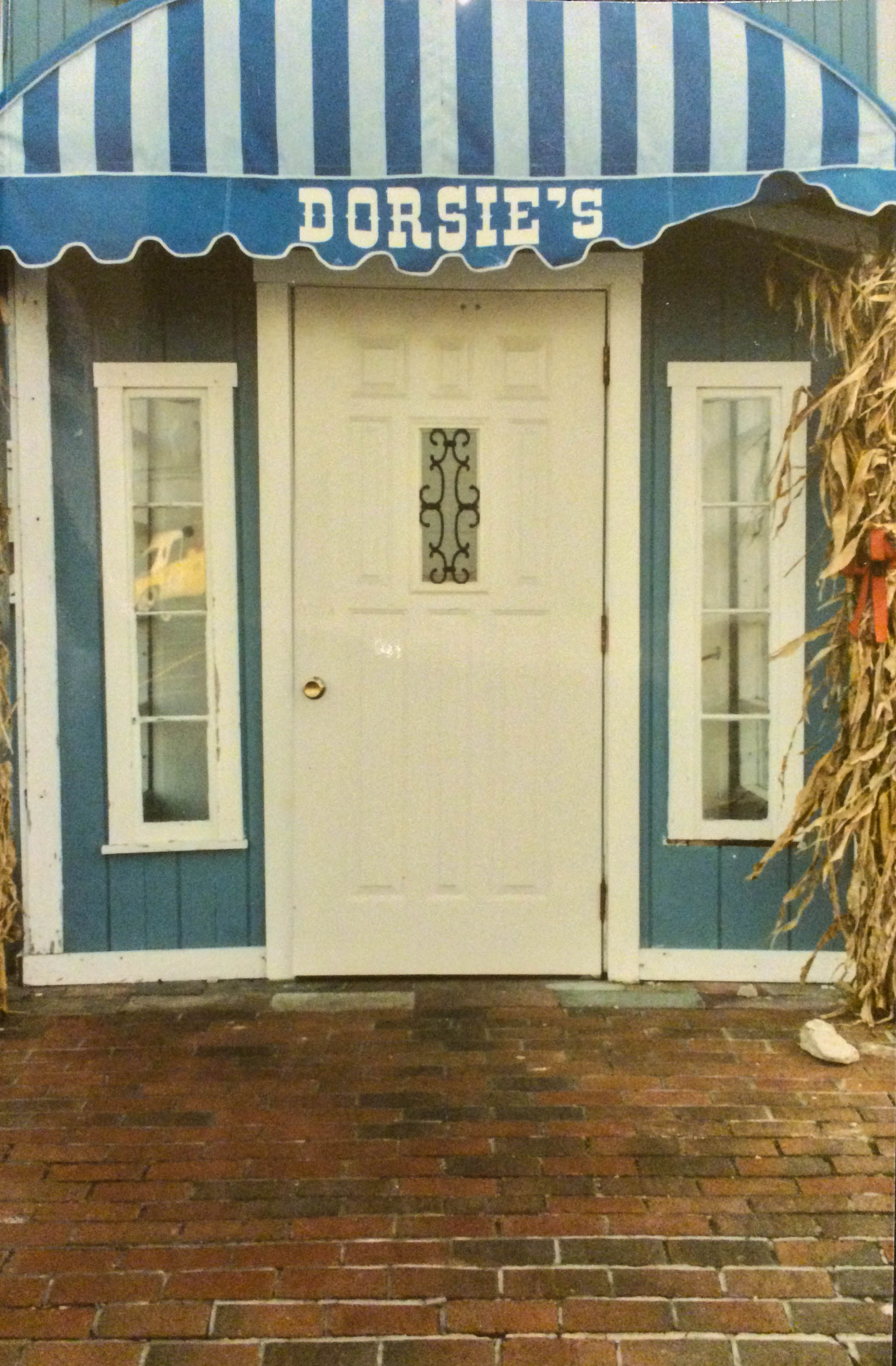
The front entrance


    Diane Dexter, who played piano and sang at Dorsie’s starting in 1981, has fond memories of her time playing there as well as the man behind it all.

    “I worked in their main lounge on a grand piano as a solo act,” she recalled, “playing and singing standards and pop/folk/country/rock songs that were popular at the time.”

    Dexter also recalls the Dorsieland Ragtime Review, a Dixieland band that played in the Gay Nineties Room and was a very popular attraction. As for Carey himself, Dexter remembered that he was “always very good with people.”

    The one thing that put Dorsie’s over the top was its affordably priced food. The establishment did a tremendous liquor business, which Carey wisely reinvested in his menu. Marinated steak tips, steak teriyaki, and prime rib were the biggest sellers, made even better by the fact that the meat would be cut and cooked at the Pit, right out in the dining room. Customers could watch while their food was prepared before their eyes. It only added to the uniqueness of Dorsie’s.

    After years of successfully running his mid-Cape complex, Carey yearned for a change. He got that chance when Cordage Park in Plymouth, which converted buildings into a mall in the 1980s, came calling. Carey sold Dorsie’s in 1990, and it became a Lambert’s Farm Market. In 1991, Carey opened Handlebar Harry’s, which became the anchor of the mall. It was tremendously popular in its own right and ran until 2003.

    Today, George “Dorsie” Carey is retired, but even more than thirty years after Dorsie’s closed its doors, he still has people coming up to him and wanting to reminisce about those good old days. As of 2022, Antiques Center of Yarmouth stands where Dorsie’s once did.

---------------------------------------------------------------------

Previous Blog Posts:

Be sure to check out my website: Christopher Setterlund.com

Zazzle Store: Cape Cod Living

Tuesday, November 9, 2021

In Their Footsteps: Cape Cod History - Yarmouth's Hidden Dance Hall


    More than a half a century ago entertainment options for young people were far different than in the 21st century. Drive-in movies, hanging out at a pizza parlor or other causal restaurant, or simply meeting at friends’ houses were common tropes. However the main form of entertainment revolved around music and dancing. Night clubs and dance halls were the most popular meeting spots for the younger generation in the years after World War II.

    Cape Cod was no different. In the 1950’s Places like the Rainbow Ballroom, Mill Hill Club, Pilgrim Club, Storyville, and more attracted young people with the promise of fun nights of dancing and music. These places were good business ideas which led to people looking to establish their own dance halls to bring in the younger generation. Some of these places were successful like those previously mentioned. Some came in with a bang and quickly fizzled out with a whimper. Others tried several different options in an attempt to find success and this is the story of one such place.

    In the 1950’s Yarmouth’s Higgins Crowell Road was a fairly barren two-mile stretch of road in between Route 28 and Willow Street. These were the days before the police station and two schools were built along this road. An idea was hatched to create a safe spot to entertain teens and young adults with dancing and music in a spot surrounded by woods.

    The project was named Sherwood Forest Recreation Center and was the brainchild of young Yarmouth builder Anthony Alosi. He had already built up several residences on the south end of Higgins Crowell Road and saw potential in a 25-acre parcel of land he had recently acquired. Alosi went to the Town of Yarmouth in April 1957 with his idea of building a dance hall in the area that had only recently been zoned for business or industrial purposes. The fact that it was a newly designated area meant that Alosi had to go through a few hoops to be approved, some in town were still getting used to the industrial zoning distinction of the quiet area on Higgins Crowell Road.

    Alosi’s project was approved. The town saw his intentions as good with the dance hall being alcohol-free. After some initial delays work began on Sherwood Forest in September 1957. Alosi was joined by Joseph Massi in clearing land and prepping for the construction. Massi was to be the leader of the house band that would play at Sherwood Forest upon its opening.

    The winter was spent clearing and prepping the land so that beginning in February 1958 work could begin on the building itself. Sherwood Forest when all was said and done, was a 200x60 foot building reinforced by steel trusses. It had a flat roof and the siding was covered in stucco. The building was to have a maximum capacity of 1,500. Out back was a patio and a fountain while the interior saw a large dance floor and a pair of snack bars on either side of the main entrance. Alosi wanted Sherwood Forest to have a gothic look.

An ad for Sherwood Forest from Yarmouth Register July 11, 1958


    Alosi and his crew worked tirelessly throughout the spring. The establishment had strict guidelines. No one under 17 could attend unless accompanied by a parent or guardian. Women had to wear dresses or skirts, men had to wear button-down shirts with sports jackets and slacks, no jeans allowed. Hours placed it open from 8pm to 1am every day except Sundays.

    Opening night of Sherwood Forest came on July 3, 1958 with a special guest night. It was led by Joe Massi and his fifteen piece band. The liquor-free dance hall opened to the public on July 4th. It was a huge success attended by hundreds of local youth.

    Not willing to rest on his laurels Alosi announced four major events that summer at Sherwood Forest. They were the Tommy Dorsey Band directed by Warren Covington, the Glenn Miller Orchestra directed by Ray McKinley, the annual Yarmouth Police Ball, and a semi-formal ball for Centerville’s Our Lady of Victory church. All signs pointed to a banner summer of safe and fun entertainment.

    However that was not the case. Despite all of the hype and the roaring initial success Sherwood Forest found itself closed in early August due to a lack of customers. Alosi sold the building to the John Hinckley & Son company. The dream of Sherwood Forest was not over though.

    In February 1959 a new idea was brought forth. Staying within the restriction of any establishment being alcohol-free Hinckley & Son proposed that Sherwood Forest become a roller skating rink. The proposition was accepted and the Silver Roll-A-Way was born.

    New owner Walter Juskiewicz took the former Sherwood Forest through a litany of renovations. This included a plastic non-skid skating floor and a new snack bar. A major selling point was that in addition to nighttime skates there would be skating instruction on Saturday mornings from 10am to noon for children ages 4-10.

    Much like Sherwood Forest despite a successful beginning the project did not last. The large spacious building on Higgins Crowell Road was shuttered after one summer. It lay dormant throughout 1960 until another investor saw potential in the building. This time it was Ruth Feeley who operated a successful dance studio in South Yarmouth.

    Feeley planned to turn the property back to a dance hall. She planned on local dances combining live bands and vinyl records. There were also plans for special junior high school nights, fashion shows, and dance competitions. The Prom Ballroom Club opened for business April 9, 1961. After a few successful months the establishment quickly fizzled out. Once the summer ended Feeley’s Prom Ballroom became the third business to fail inside the expansive building. It would not be the last.

    In the summer of 1962 Donald Putignano of Brockton took a swing. He reopened the building this time under the name of the Cape Cod Tropical Ballroom. This fourth incarnation of Anthony Alosi’s structure was able to stamp its name in the annals of Cape Cod history based around one night.

    On July 3, 1963 more than 2,000 people crammed inside the building which was zoned to hold roughly 1,200. The reason? They wanted to see the iconic Ray Charles and his band play. There was little advanced notice given and despite that people came from as far as New Bedford and Provincetown to hear Charles play among the woods of West Yarmouth. It was a legendary night. That being said, it was par for the course, as banner single nights did not a successful business make.

    The Cape Cod Tropical Ballroom did not last. Ironically there was never an issue with disorderly conduct in the area throughout all of its incarnations. It was the lack of profit that caused such constant turnover. The fifth time was not the charm either.

A concert poster from A Go-Go 1966 (Record Mecca.com)


    In June 1965 Charles MacKenney and Jimmy Troy took their shot. The dance hall was reopened as the A Go-Go. It featured more mainstream music for the time, long hair, electric guitars, and still no alcohol. Club membership passes were sold to give patrons a discount in admission from $2.50 down to $1.75. Boston-based band the Barbarians frequented the A Go-Go while outside acts such as Roger Pace and the Pacemakers as well as Joey Dee and the Starlighters graced the stage during that first season. The Animals and The Velvet Underground played there in 1966 and 1967.

    The issues with the establishment came quickly. Averaging 600-700 people during the weekend dances led to issues between rival towns. Alcohol use by minors in the parking lot and at home before coming to the club led to numerous fights inside and outside of the A Go-Go. This in turn led to an increase in the police presence in the area.

    Although relatively successful for a few years the problems at the A Go-Go proved to be too much. It became the fifth business to try and fail at the Higgins Crowell location in a decade. The building remained closed for a few years before a permanent resident came along.

The former location of Sherwood Forest/A Go-Go. (Google Maps)


    Interestingly despite five attempts at entertainment in the building it was the New Testament Baptist Church that gave the property stability. After the building and property was taken by the town by eminent domain in early 1972 a buyer was sought. The church purchased the property in October 1972. Major renovations were done to the property and the organization has called it home for nearly fifty years.

    A decade of turbulence saw five business try and fail in a location that was a blessing and a curse. Quiet and secluded to keep any noise localized, and yet so secluded that it had trouble bringing in customers. Though Sherwood Forest, the A-Go-Go and the others have been lost to history, a mere blip on the radar, the building itself designed by Anthony Alosi is still standing and still entertaining people, albeit in a far different way than he initially intended.

--------------------------------------------------------

Previous Blog Posts:

Be sure to check out my website: Christopher Setterlund.com

Zazzle Store: Cape Cod Living

Sunday, September 13, 2020

In Their Footsteps: Cape Cod History - Bill Cox's Sea Grill

    Finding success in business once is difficult enough. Finding success twice? That is a rarity. William Cox found success at the turn of the 20th century in the hospitality business, retired, and came back to find more success in a different but similar way. This is the story of Mr. Cox, his inn, and his sea grill.

    William E. Cox was born in Boston in 1883 and schooled in Whitman. He made his way to Cape Cod in 1909 and made an impact very early in his tenure. Cox began by taking over the restaurant owned by Charles Baker in September 1911. It was located next door to Louis Arenovski’s popular American Clothing House at the east end of Main Street in Hyannis. Early in 1912, after several months running the restaurant, Cox bought the building owned by Able D. Makepeace located in the same general area. The building had been recently known as the Wyman House and before that the First National Bank. In June 1912 it was announced that the building at 209 Main Street would henceforth be known as the Hyannis Inn.

    Cox’s inn was a success. Its white exterior and sign adorning a majestic elm tree enticed visitors to stop in. He did not rest on his laurels though, going through a few rounds of extensive improvements. These included adding a piazza which later became a sunroom and also beginning work on a three-story addition that would add eighteen rooms to the ten that already existed.

    A terrible fire in January 1914 destroyed much of the rear of the hotel at a loss of $4,000 ($105,000 in 2020). Despite this fire the Hyannis Inn recovered and thrived. As the 1920’s began Bill Cox made two land purchases to aid in the expansion of the hotel. In March 1921 he bought the land behind the hotel that had been owned by L.P. Wilson. This was followed up by purchasing land abutting the hotel owned by Mary Cash in June 1922.

    In February 1926 Cox cashed in his chips with the Hyannis Inn. He sold the property to Paul Wadleigh and James Goss of Swampscott for 100,000 ($1.46 million in 2020) and looked forward to taking an early retirement at the young age of 43. His retirement kicked off in the spring of 1927 by entering the poultry business after moving his family to Eastham. Ironically diagonally across the street from Cox’s new venture another poultry business sprung up at the same time. Run by retired Purdue University teacher Richard Kent his business took off more than Cox’s and it is unknown if that drove the next chapter of his life.

    Perhaps due to his poultry competition, or perhaps due to a desire to get back into a familiar routine Bill Cox decided to come out of retirement in 1932. Early that year Cox purchased a piece of property a stone’s throw from the water on Bayview Street in an area known as Hyannis Park, though it was technically in West Yarmouth. Construction began on a restaurant hearkening back to his roots when he first got to Cape Cod over twenty years earlier.

    Bill Cox’s Sea Grill opened in time for the summer of 1932. With seafood as the specialty and a promise that customers could ‘Eat at the Seashore,’ Cox’s new restaurant opened a success. The prosperity of the new establishment was partly from the food served as Cox used Cape Cod scallops and his highly popular broiled lobster. However his previous successes on the Cape aided the new Sea Grill as well; locals were already quite familiar with William Cox.

Bill Cox's Sea Grill on Bayview Street


    Prohibition in the United States was repealed with the 21st Amendment to the Constitution on December 5, 1933. Bill Cox’s Sea Grill procured a valuable liquor license soon after they were made available. The seasonal establishment began staying open later into the fall and by 1940 it was widely seen as one of, if not the, most popular restaurants on all of Cape Cod. Cox, the public figure, brought in the older crowd familiar with him from his previous endeavors while Cox, the restaurant, made regulars out of the younger generation as well. William Cox, who had found success and retired young, had found success again.

    This time though Cox stayed at the helm of his popular eatery on Bayview Street. As the 1940’s passed on William Cox became something of an icon on Cape Cod, having a longer tenure in successful hospitality than nearly all others. His last season in charge of his Sea Grill was 1958. Cox died of a heart attack on October 1, 1958 at the age of 75. His restaurant was in its final weeks of the season when it lost its creator. His wife and three children finished out the season.

    Bill Cox’s Sea Grill soldiered on for a few more seasons. In 1962 the restaurant was bought by a group including Harold Hayes, Albert Webb, and Angelo Lanza. They renamed it Harborside and the new eatery featured a seafood buffet displayed on a 14-foot dory. The group’s other major cause was building a motel on land adjacent to the restaurant. That was denied by the town and by 1968 the restaurant had been sold and renamed The Captain’s Chair. It remained a popular establishment until closing in January 1996. The building was torn down after sitting vacant for several years, ultimately being replaced by a waterfront duplex.


The site of the former Sea Grill on the left today, 132 Bayview Street (Google Maps)

    William Cox found success twice in the first half of the 20th century. From hotel manager to restaurateur he amassed a loyal group of regular customers and garnered a reputation as a friendly and beloved figure on Cape Cod. His Hyannis Inn brought year-round lodging to the Mid-Cape while later on Cox’s Sea Grill gave countless customers delicious food with a waterfront view. In a business like hospitality where success can be fleeting William Cox had a staying power that few can claim. His contributions to Cape Cod speak for themselves.

--------------------------------------------------------------

My first eBook in 10 years, In Their Footsteps, featuring the interesting stories of Cape Cod's history, is on sale at Amazon.com. 


View my previous blog posts: 


Photo Prints available here: Smug Mug.com

Be sure to check out my website: Christopher Setterlund.com