In
2020 the vast majority of people have a pocket-sized smart phone that
they use as a one-stop shop for most of their social needs. Cell
phones became commonplace over the last 15-20 years. These devices
made landlines virtually obsolete in the 21st century,
going the way of the VCR and 8-Tracks. As technologically advanced
as today’s smart phones are the telephone itself has a rich history
going back more than 140 years. From rotary phones, to operators and
switchboards, there have been innovations and changes deemed
revolutionary at the time that would seem irrelevant today. Every
great idea began somewhere. This is story of the dawn of the
telephone and its introduction to Cape Cod.
Alexander
Graham Bell is most associated with the invention of the telephone as
he received its first patent on February 14, 1876. Several others
like Elisha Gray and Antonio Meucci can lay claim to being at the
forefront of the telephone’s creation. Legend has it that Bell’s
lawyer simply was the first to get to patent office. On March 10,
1876 Bell made the world’s first telephone call from his upstairs
laboratory downstairs to his assistant Thomas Watson on the receiving
end. The first line spoken was simple: “Mr. Watson, come here, I
want to see you.” This landmark achievement occurred in Boston,
Massachusetts.
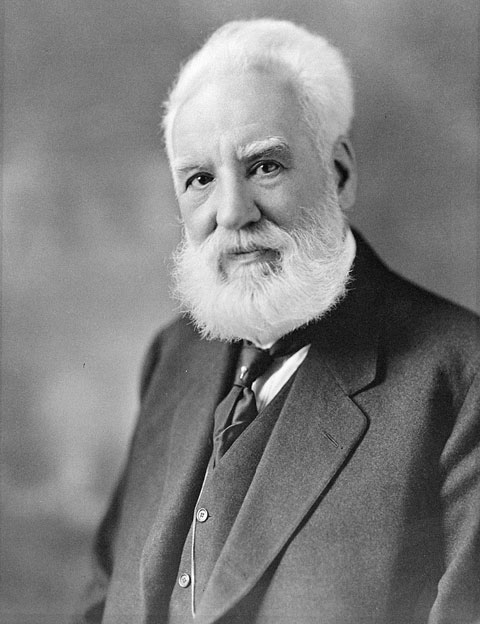 |
| Alexander Graham Bell c. 1914-1919 (Moffett Studio) |
Thomas
Edison added improvements to Bell’s telephone transmitter later in
1876. The first ‘long distance’ telephone call came in February
1877. While the very first telephone line came in April 1877. It
was a residential line connected to the home of Charles William Jr.
of Somerville. The line connected his home on Arlington Street to
his office on Court Street in Boston three miles away. Their
telephone numbers were literally 1 and 2.
It
would not take much longer for the telephone to make its way to Cape
Cod. Much like the Charles William line the first telephone lines on
Cape Cod were ones that connected homes and businesses/offices. The
first telephone line mentioned in local newspapers was one that was
built in March 1878 in Woods Hole for Azariah F. Crowell. It
connected the Crowell Chemical Company factory and office.
Other
business telephone lines followed. These included a pair of
telephone lines running from the Wing Brothers store in Sandwich to
each of their homes which were built in March 1879. In July 1879 a
line was created in Provincetown connecting the Western Union
Telegraph office at the train station to the Gifford House, Custom
House, and the end of Bowley’s Wharf(later renamed Matheson’s
Wharf). This telephone line was for the convenience of those
connected to the United States Fish Commission. This government
agency began in 1871 and was the precursor to today’s United States
Fish and Wildlife Service.
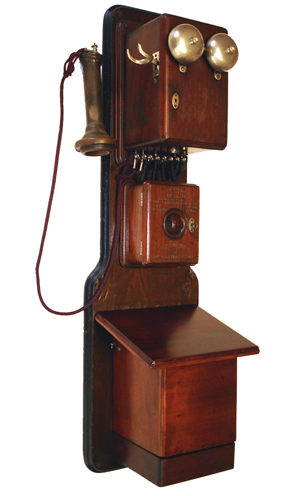 |
| A Charles Williams Three-Boxer Telephone c.1880. (Tom Adams, Tom's Antique Telephones.com) |
Later
in 1879 and 1880 telephone lines were created for Old Colony
Railroad’s Cape Cod division superintendent Charles Nye’s office
in Hyannis to his home on School Street and Thacher T. Baxter’s
general store in West Dennis. The increasing number of private
telephone lines eventually led to the desire for public lines as
well. These were realized when the first public telephone office and
lines were constructed beginning in October 1881. The Bell Telephone
Company set up lines connecting Barnstable, Hyannis, Hyannis Port,
Marstons Mills, Cotuit Port (Cotuit), and Osterville. The telephone
station that was built in Martsons Mills was praised for being open
day and night.
In
March 1882 the Southern Massachusetts Telephone Company began working
to connect Cape Cod to other parts of nearby Massachusetts. The
company, founded by Edmund Grinell, had begun operations out of
Taunton in 1878 with 151 subscribers. Telephone lines were set up
connecting the mid-Cape out to Wareham and eventually New Bedford.
The company's plan also included running the lines eventually through
Yarmouth and into Chatham. By the end of April 1883 Provincetown had
received their telephone lines thus connecting the entirety of the
Cape to each other and as far as New Bedford. It did take a few more
years for every nook and cranny of Cape Cod to become connected via
telephone however. According to their records the Southern
Massachusetts Telephone Company had 1,741 subscribers by November
1884 of those 76 were on Cape Cod. From there it was only a matter
of time before the telephone was a common household necessity.
Though the progress was slow and steady by 1903 8% of American homes
had a telephone, 35% by 1920.
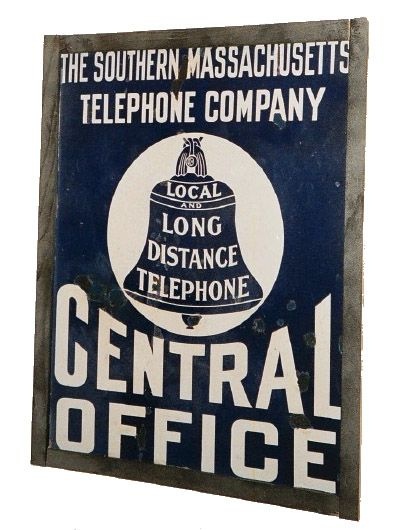 |
| A restored sign for the Southern Massachusetts Telephone company. (Collectors Weekly.com) |
Cape
Cod used the Bell Telephone Company and Southern Massachusetts
Telephone Company for the remainder of the 19th century.
The latter even brought the first public pay telephone to Cape Cod at
the grocery store of Benjamin Sears in West Yarmouth in 1902. In
1913 the Southern Massachusetts Telephone Company had its name
changed to New England Telephone & Telegraph, though in reality
NET&T had owned the Southern Massachusetts company since 1890.
In the decades since, and through many mergers and purchases the
former Southern Massachusetts Telephone Company became part of the
Verizon banner.
Now
in the third decade of the 21st century the pocket-sized
smartphone is an indispensable necessity for most. For many it is
hard to imagine a day without it. However to better appreciate what
exists today one can only think back to 140 years ago when telephones
were a rarity, a luxury. Every story began somewhere and for Cape
Cod the story of the telephone began with private lines for Azariah
Crowell, the Wing Brothers, Thacher T. Baxter and others.
--------------------------------------------------------------


 , Ebenezer Philips, made his fortune here in the late 18th century. Philips learned the process of drying fish from the local Naumkeag Indians which led to greater shelf life for the fish. Swampscott became world famous in 1808 when Ebenezer Thorndike invented the lobster pot
 which revolutionized lobster harvesting.
 with large rectangular stones around a center stone circle. The longitude and latitude of the area is noted as well as lines where the seasons would change. Upon closer inspection there were also words inscribed on the sides of the center stone including the words ‘Be Inspired By Love,’ which was a nice touch.
 Elihu Thomson was a prolific inventor with more than 700 patents to his name. He also served as president of the Massachusetts Institute of Technology (M.I.T) from 1920-1923 before his death in 1937.


