He was a lifelong Cape
Codder. He was a war hero. He was a hard working and well respected
member of the community. So why was he brutally gunned down on his
front lawn? More importantly, why has this case remained unsolved
for nearly a century? This is the story, as it is known, of the
unsolved murder of Falmouth’s Clarence Parker.
Clarence A. Parker was born
in Falmouth on January 15, 1893 to Willoughby and Lillian Parker. He
was educated through the Falmouth school district before taking up
work at H.V. Lawrence’s greenhouses in town. Parker from a young
age was a handsome, jovial, and popular man. The type of person that
the community was proud to call one of their own.
When World War I broke out
Parker was drafted into the Army. He was assigned to Fort Devens in
Ayer, Massachusetts. Before leaving to go to war Parker married
Janet Howitt. Their ceremony was pushed up to September 19, 1917.
The couple would go on to have a daughter Alis
and a son Gordon, while living at
62
Walker Street close to Clarence’s parents.
Parker returned to Cape Cod
in July 1919 after serving as Private at Camp Baranquine in France.
He spent much of the 1920’s building on his positive reputation,
holding town offices such as deputy clerk. The biggest break for
Parker came in March 1927 when the Atlantic & Pacific Tea Company
(A&P) opened its second Cape Cod store. The first had been in
Hyannis but the second was on Main Street in Falmouth and the grocery
store chain wanted Parker as their manager.
 |
| How A&P Looked in the late 1920's. |
A loving husband and father,
a main member of the American Legion Auxiliary and a popular
respected manager of the local A&P, Clarence Parker didn’t have
any shortage of friends. That was why what happened in the early
morning hours of September 7, 1930 so shocking.
Shortly after midnight on
Sunday morning September 7, 1930 Parker closed up the A&P. He
had brought a leg of lamb wrapped in brown paper home with him.
After pulling his car into the garage Parker walked across his lawn.
It was at about 12:20am that a single shot rang out. Janet heard the
shot from inside and opened the front door to find Clarence face down
only a few feet from the door. He was dead.
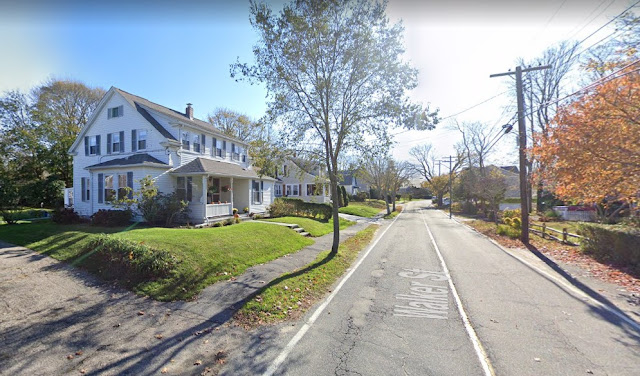 |
| The scene of the crime. Parker's former house on Walker Street on the left. (Google Maps) |
The unknown assailant took
the leg of lamb and ran off through the backyard leaving their
revolver behind. The theory was that it was robbery. The assailant
thought that Parker had brought the store’s money home to be
deposited when in fact he had done that the day before. This was
cemented when the leg of lamb was found in a nearby field opened,
likely dumped when it was proven to not be money.
Ann Richardson, owner of the
Elm Arch Inn, could only describe a ‘hatless’ man running across
her property after the shooting. The assailant was believed to have
escaped in a car parked on Shore Street.
 |
| Shore Street where the getaway car might have been located. (Sturgis Library) |
A beloved member of the
Falmouth community had been coldly killed steps from his front door.
The rage from the townspeople was palpable. In total $4,000($65,700
in 2021) worth of rewards were offered including $2,500 from A&P.
It was seen as an example of how highly regarded Parker was.
Another example was the overflowing services at Parker’s funeral.
It was hoped, and expected, that the Falmouth Police would solve the
heinous crime quickly. What came was a series of leads that would be
debunked.
The first was only a few
weeks later. An abandoned Chrysler car was found near Silver Lake in
Kingston. It had suspicious markings on a story about the murder
from the New Bedford Standard Times. However it was confirmed by
State Police that the car had been stolen from Stedman Buttrick of
Concord, Massachusetts after the murder would have taken place. In
addition the car was out of gas and the battery was dead when found.
Next came a salacious
editorial piece from the Brockton Enterprise. It said that
Parker’s murder was connected to illegal rum running. Going
further by surmising that Parker had knowledge of rum gangs
activities but after refusing to join them was murdered to keep him
quiet. Falmouth Police Chief Herbert Lawrence dismissed the rumors.
By the end of 1930 there had
been no arrests. The reorganization and enlargement of the Falmouth
Police Department was demanded and expected due to the perceived
failure. Chief Lawrence resigned at the end of 1930 citing poor
health.
The investigation remained
ongoing throughout 1931. Lt. Joseph Ferrari of the homicide bureau
of the State Police said they were still investigating but it was
baffling the lack of clues as to the killer’s identity.
In August 1932 convicted
Mashpee murderer Sylvester Fernandes, before his death in the
electric chair, purportedly gave the name of Parker’s killer to
District Attorney William Crossley, he then tried to substantiate it
but it was fruitless. For two years there had been little in the way
of progress or even clues in the murder of Clarence Parker.
The closest lead, and
likeliest scenario, came to light in November 1932. Boston District
Attorney William Foley got new lead from arrested Boston gangster
Morris Cohen of Dorchester. Cohen said that a young man named Murton
Millen was a running with a well known liquor racketeer. It was
while they were attending a liquor meeting in Falmouth that Millen
purportedly went to rob Parker.
He lurked in the shrubs of
Parker’s home on Walker Street and waited. Cohen said that Millen
then shot him a few feet from his door with cold-blooded precision.
Parker died almost instantly. However the robbery was a failure due
to it being lamb and not money in the brown paper. It seemed to tie
in with previous theories of a failed robbery and an out-of-town
killer made sense as Parker was exceedingly popular. This theory had
doubt cast on it by Lt. Joseph Ferrari as he saw Millen as too young
to run with liquor gangs. With cold water thrown on the latest lead
the case went cold for several years.
 |
| Clarence Parker's grave in Falmouth. |
New leads came to light in
September 1936 almost 400 miles north in Montreal, Canada. Several
members of local law enforcement went north to interrogate someone
who was in Falmouth at the time of the murder. This led to seven
more people being interviewed in Hyannis as a part of these new
developments. Sadly despite all of the bluster nothing came from the
interrogations. The case went cold and Clarence Parker became just a
name on a headstone in Oak Grove Cemetery.
It has been 91 years since
Clarence Parker was coldly gunned down on his own front lawn. It has
also been 85 years since any meaningful leads were investigated. The
case has gone cold and will likely remain unsolved. Whether it was a
young rum runner and a botched robbery, or something not yet
explored, the bottom line is that a young husband and father, and
popular member of the community, was killed and the murderer has
never been identified.
---------------------------------------------------------------
Previous Blog Posts:

.png)


