For generations it has been a
holiday right of passage for those living in Southeastern
Massachusetts. Simple beauty, family fun, filled with wholesome
memories, Edaville has been visited by countless thousands of
families during its existence. Developed in the vision of its
creator this Massachusetts staple has come back from several
tragedies to now be going strong into its eighth decade. This is the
story of the creation and perseverance of Edaville.
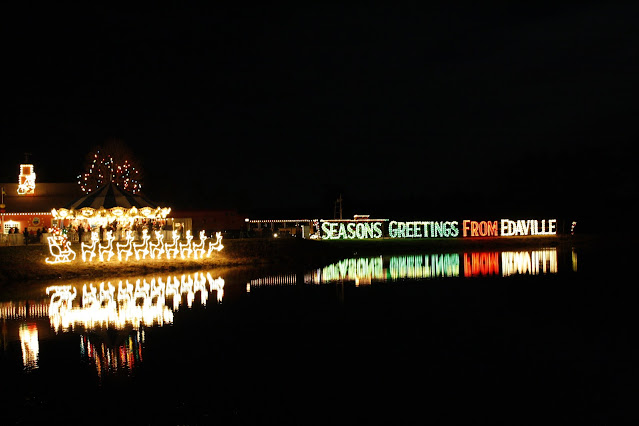 |
| Christmas at Edaville(goaliej54/flickr) |
Born in 1889 Ellis D. Atwood
was raised in Carver, Massachusetts. He graduated Tabor Academy in
the nearby town of Marion. Later on he married Elthea Eldredge of
Wareham in February 1919.
Atwood made a name for himself in the
highly profitable local cranberry growing industry. This began by him purchasing three acres of land from his father. Then with his father died in 1915 Ellis took over all of the family cranberry business.
Ellis and Elthea lived in the Murdock-Atwood House
near Sampson’s Pond which had been passed down to Ellis by his
great-Uncle Marcus Atwood.
The Atwood’s connection
with the Christmas season began with an elaborate display on their
front lawn in 1933. Cranberries, Christmas, and railroads, Ellis
Atwood’s three favorite things, would eventually be brought
together by another’s loss.
What would eventually become
Edaville Railroad was born out of the ashes of a defunct railway.
The Bridgton and Harrison Railroad had begun operations in Maine in
1883. Late in 1941 it was being shut down. The rails and train cars
were being destroyed. Having taken a blissful trip upon the railroad
in August 1941, mere months before it was rendered obsolete, Atwood
made a trip to Maine to buy what he could.
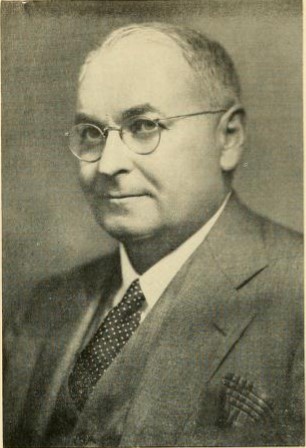 |
| Ellis D. Atwood(Cranberries Magazine, Dec. 1950) |
On December 3, 1941 Atwood
purchased one locomotive known as the Old No. 7. In addition he
bought 11 box cars, 24 flat cars, a caboose, and a half-mile of
two-foot gauge track. The final, and perhaps most important piece,
was the hiring of former Bridgton and Harrison conductor Everett
Brown. Atwood desired someone who knew the railroad and could teach
him how to drive a train.
Completing the Atwood
property railroad was delayed due to World War II. Eventually though
the man known as the Cape Cod Cranberry King soon had a
fully-operational narrow gauge railway circumnavigating the
1,800-acre Atwood property. Atwood’s goal was to combine his
success in the cranberry industry with his love of railroads. The
new railway on his property was called the Cranberry Belt Line. It
was used for sanding, spraying, and harvesting from the bogs.
Atwood’s Cranberry Belt
Line had more than five miles of track. There were some rumors in
1945 that Atwood was considering converting his railroad into an
active route between Plymouth and Boston. That did not end up
happening. Although it didn’t become an active passenger railroad
Atwood’s train was used for more than work. Not long after
beginning to take his own train rides around the cranberry bogs
Atwood had curious neighbors stopping by for a trip of their own.
In May 1946 Atwood parlayed
his Cranberry Belt Line railroad into a local tourist attraction. He
called it ‘Edaville’ for Ellis D. Atwood’s E.D.A. initials. By
the end of the year more than 25,000 people had taken a ride on his
locomotive around his cranberry bog property. During this first
season all Atwood asked of his customers for a fare was common
courtesy and common sense.
Word quickly spread during
the first few seasons of the Edaville Railroad. It was the last
narrow gauge railroad in the country. In 1948 Atwood said that more
than 35,000 people per month arrived to climb aboard the Cranberry
Belt Line. The cars and stops along the railway had cranberry-themed
names. These included cars named ‘Oceans Spray,’ ‘Eatmor,’
‘Atwood Special,’ and stops called ‘Cranberry Valley,’
‘Sunset Vista,’ and ‘Mount Urann’ which was named for Marcus
Urann who was president of the National Cranberry Association.
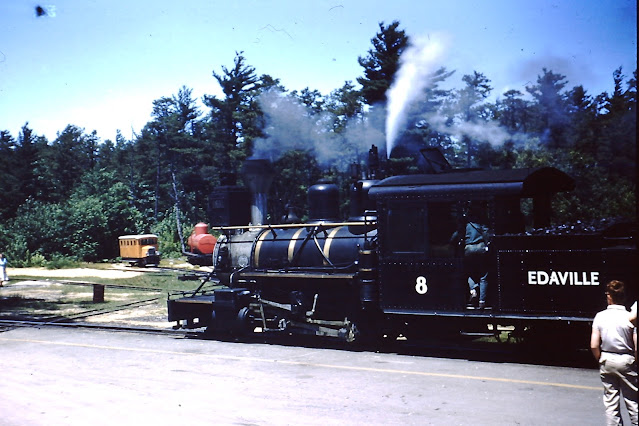 |
| The locomotive at Edaville, 1959(rickpilot_2000/flickr) |
Although it was popular
during the warmer months due to there being a beach for summertime
play it was the Christmas season where Edaville saw its largest
crowds. In 1949 alone upwards of 75,000 people came for a ride to
see the over 12,000 colorful lights and more than forty Christmas
scene displays lit by floodlights. Train rides through the season
began at 4:30pm and ran until midnight. Ellis Atwood had created a
family-friendly and wildly popular local tourist attraction. However
tragedy nearly ended Edaville.
On November 26, 1950 Ellis
Atwood was late returning home from Edaville. His wife Elthea went
to check on him. She found him face down in the basement of the
railroad administration building. The furnace had exploded with the
door striking Atwood in the head. He clung to life at Wareham’s
Tobey Hospital for four days before succumbing to his injuries on
November 30th.
Ellis D. Atwood, the Eda of Edaville, was dead at sixty-one.
Cranberry growing had made
Atwood a millionaire, but Edaville had brought him more love and
popularity. His memorial held at Edaville was attended by more than
2,000 people. Elthea carried on the day-to-day operations of the
park in Ellis’ honor. She increased the displays and lights
surrounding the Christmas season in particular by creating the
Edaville Christmas Festival. However it all became too much. Elthea
sold Edaville to F. Nelson Blount in the spring of 1956.
The railroad continued to
thrill visitors for decades. It was sold a few more times yet each
successive owner maintained or even improved upon the park’s
presentation. The cranberry bogs were highly profitable due to their
deep connection to the Ocean Spray corporation. In 1991 final owner
George Bartholomew closed the beloved park. Most of the equipment
was sold off shortly thereafter to a railroad museum in Portland,
Maine. It seemed as though Edaville was finished after more than
four decades in operation.
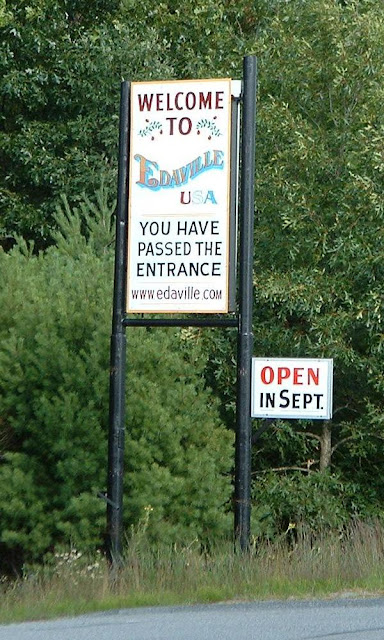 |
| The entrance to Edaville on Rt. 58 in Carver.(T.S. Custadio/Wikimedia) |
The park sat vacant for eight
years. In a surprising turn of events the CranRail Corporation
bought the decaying Edaville in 1999. The company poured $5 million
into restoring and renovating the park over five years. Edaville was
reopened to much fanfare just in time for the Christmas Lights
Festival in December 1999. Since its reopening Edaville has
enchanted countless thousands of visitors. Parents and grandparents
now bring new generations to enjoy Edaville much like they had.
Ellis Atwood had only seen a
tiny slice of the impact Edaville was to make on Massachusetts locals
and visitors before his untimely death. Despite that his name is
still front and center whenever someone utters ‘EDAville.’ It is
far more than a little train roaming the cranberry bogs of Carver.
Edaville is a destination for families annually. In a day when so
much constantly changes Edaville is a throwback to a simpler time.
It should be experienced, or re-experienced, by all of those within
reach of the park.
-----------------------------------------------------------------------------


 -era or earlier and I found it a little humorous that it is pointed eerily close to the farmers market.

 season, even twenty-five years later I can picture that trip in my mind. The park has many rides and a vintage carousel, it is easy to find and as previously stated is synonymous with the small town of Carver.
 State Forest is the largest publicly owned recreation area in the state and is home to many beautiful kettle ponds. Covering approximately 15,000 acres of land this amazing landscape is home to the endangered Plymouth Red-bellied turtle which populates several of the kettle ponds.
 quietly swimming across Furnace Pond(left) and it made for a fitting end to my trip.