Pages

Showing posts with label train. Show all posts

Monday, June 16, 2025

Initial Impressions 2.0 Blog #73: Closure, Train Dodging, Vanity Plates, etc.


1. Closure is a funny thing. You can be searching for it for almost 20 years and still not be prepared when you finally get it. I was going through a journal I had written when I was in the most important relationship of my life 20 years ago. For so long after it ended, I had been unable to find her and never was able to get closure. It was a constant loose end that needed tying up. Amazingly, I got that closure this past weekend. After years of searching, I eventually found her through a simple Google search. Not sure what changed but earlier in the same day I had put it out into the universe that I wanted to find her. Sure, that hadn’t worked before but I always try. I’ll just say that she is happy in the life she has, and that makes me happy. If you want to know the full story, I wrote about it. Here is the link: https://christophersetterlund.blogspot.com/2025/06/peaceful-emptiness-finding-closure.html


2. Any time I visit the local college library it’s like my brain goes into serious mode. I feel like I write better when I am there. I wish it were closer. Granted it’s a 15-20 minute drive, but I’d go write there more often if it were closer. It’s like I sit at a desk on one of the quiet studying floors, and my brain tries to fit in with all of the people continuing their education. I can write well at home, but I tend to get distracted by surfing the web way more. It’s like I don’t want to be seen doing that at the college.


3. There was a hilarious interaction with a chipmunk this week. I was heading out the front door and spooked a little chipmunk. Rather than running around the side of the house instead it dove into the gutter spout. I could hear it trying to climb up in the gutter but eventually slipping down. Next, I spotted its little face sticking out of the drain, hoping I would leave. I took a step toward the gutter and the chipmunk squeaked and again tried to climb up the inside of the gutter. This time I could hear it squeaking inside like it was cursing me out. Again, it poked its head out but I had my fun and left it alone.


4. I am super excited for the return of King of the Hill. I was a big fan of the show during its initial run from 1997-2009. A revival in the form of a 14th season is set to drop in the first week of August on Hulu. I have been waiting for a reason to do a free trial of Hulu, and oh boy, this will be it. If you’ve never seen King of the Hill it was created by Mike Judge who did Beavis & Butthead, and Greg Daniels who helped create the American version of The Office. It’s got bits of both shows, but a lot that is different. My hope is that the new episodes will live up to the hype, but I’ll be happy just to see everyone back and aged somewhat.


5. While out for a walk, I was in a beautiful, quiet neighborhood not far from me. I had a podcast on, so I could also hear the sounds of nature. I thought I heard muffled dog barks, so I stopped. I have had instances where a dog has suddenly shown up next to me while I’m walking. The last thing I want is to be attacked by a dog, or to step on one that I don’t see. I saw that two dogs were barking at the bay window of a house. I thought it was funny but the lady in the house didn’t. I could see her yelling at the dogs and then she even pulled the shades down. Sorry dogs.


6. One good dog story deserves another. I was at the beach walking pretty far out on the flats to get away from the crowds. It was so peaceful and nice. I soaked in the atmosphere before returning to the parking lot. As soon as I got close I heard an old man in a pickup truck telling these 2 women that dogs aren’t allowed on the beach in the summer. This is true but many dog owners are selfish and entitled so they don’t care about laws. Anyway, these 2 classy ladies with their disgusting cigarettes and the weathered faces to prove it, started yelling and swearing at the old man. He swore back and gave them the finger while driving away. Me? I just wanted to get to my car without making eye contact with those trash bags.
Not seen, the trashy 'ladies' with their dogs on the beach.


7. In most weeks, the return of King of the Hill would have been the biggest news for me. Then, a few days later, it is matched by the return of Spaceballs in 2027 for the 40th anniversary. As a child of the 80s, this is like a Schwartz ray right to my nuts, in a good way, if there is one. The trailer is basic so I can’t wait to see an actual preview with as many of the actors returning. Sadly, there won’t be John Candy or Joan Rivers but there will be Rick Moranis, Bill Pullman, and hopefully Mel Brooks, who is 99 years young now. May the Schwartz be with us all!


8. When I was younger, I had aspirations of getting some sort of vanity license plate. I figured something like my initials, ‘CJS.’ It never happened. That being said I do enjoy seeing what people choose to put on their vanity plates. Many are initials but then every now and then I see one that makes me audibly laugh. I saw a plate that read ‘EIEIOH.’ If you know, you know. But still, Old MacDonald? That’s what you chose for your license plate? Maybe if you were a farmer? This was just some run-of-the-mill pickup truck. Very creative and funny regardless.


9. Shenanigans seem to follow me wherever I go. I went out for an afternoon adventure after it had rained. After a lot of driving, I made my way to a place in Sandwich called Scorton Creek. It’s loaded with trails, marshes, a few abandoned shacks, and it crosses the railroad tracks. I couldn’t find an old abandoned shack I had found years ago. I made my way to the tracks to make better time back into the woods. I filmed a quick video joking that I was living the movie Stand By Me as I walked the tracks. I said if I saw a train, I’d have to dive off the tracks. 30 seconds later, the dinner train comes rolling down the tracks. I was in no man’s land. I didn’t know how fast the train was going, and I was at the creek so I was stuck. I had to scale down the embankment and watch as the train passed by, basically right overhead. I don’t think any of the people on the train saw the crazy guy at the bottom of the embankment, but you can be the judge, as I made a video about me jinxing myself. Enjoy.
https://youtube.com/shorts/yVuXXWwtlhg?si=FB2PViWGD_T8Dw20


10. Also during my visit to Scorton Creek. The ground was wet from the day of rain so my shoes quickly got soaked. While on the lookout for the abandoned building, I kept hearing a voice over a loudspeaker coming from somewhere in the distance. At first, it sounded like a graduation where the voice was announcing names alphabetically. Then I started thinking it might have been a graduation party or even a wedding as music was getting played as well. This included The Beatles ‘In My Life’ which made the walk through the woods magical. While walking back to my car, I came across a man walking with his two dogs. I asked him about the voice, and he had no clue. I mentioned my interaction with the train, and he just laughed. Only when he walked past me did it make sense. I could smell the weed he was smoking. He will likely think I was just a dream.


11. Happy Father’s Day to all of the good dads out there. Despite not having a good dad myself, I was blessed to have many great men who I consider second fathers in my life. Granted, it would have been better if the man who helped bring me into this world had given even a D- grade worth of effort to raising me. His karma is living his life now knowing that his actions led to his kids and grandkids wanting nothing to do with him. I cannot change the past but I can look back and look at present-day and feel grateful that I learned how to be a man from some truly good men throughout my life.


Sunday, May 21, 2023

Cape Cod Railroad History 1846-1873


    The history of rail travel goes back over two centuries. 1804 saw British engineer Richard Trevithick build the first full-scale railway steam engine. In the United States, the first railroad came in 1827. This was the Baltimore & Ohio Railroad which was chartered on February 28, 1827.

    After that, it was off to the races for the new mode of transport. By 1840 the U.S. had nearly 3,000 miles of rails. That number was set to more than triple by 1850 when the country saw more than 9,000 miles of rails. More and more were being built seemingly daily. Naturally, as more miles of tracks were laid more out of the way corners of the country became connected.

    This new mode of travel was far faster than the horse-drawn stagecoach. In the 1830s a steam engine typically averaged a speed of around 30mph. In contrast, a stagecoach averaged just over 4mph. Although nowhere near the top speeds of today (Amtrack trains regularly hit speeds of 125-150mph in the 2020s) it was a major upgrade for travelers of the day.

    In 1840 Cape Cod was rural, quiet, and disconnected. It had a population of only 32,548 over the entire peninsula. During the middle of this decade, talk grew loud for a railroad line that could connect Cape Cod to larger cities such as Boston and Providence. The push for rail service on the Cape began due to the increasing popularity of the Boston & Sandwich Glass Company.

    Cape Cod rail service finally became a real possibility with the formation of its first rail transport company. The Cape Cod Branch Railroad Company was created in the spring of 1846. There had been low rumblings in the previous months about bringing rail service to Cape Cod. The rumblings turned to concrete plans when a meeting was held on May 6, 1846, at the Barnstable County Court House. This meeting called by John Reed officially established the company.

    After approval, the first true meeting of the Cape Cod Branch Railroad Company was held on August 19, 1846. The location was the hotel of W.D. Burbank in Wareham. The meeting elected officials and also ironed out the details of getting rail service to the Cape. By the time the meeting ended, the company had its first president Col. Richard Borden of Middleboro. It had its first treasurer in Southworth Shaw Jr. of Boston. Most importantly the company decided that it would connect Cape Cod to the larger world with a twenty-seven-mile stretch of track from Middleboro to Sandwich.

    This new stretch of track would allow freight service to carry the popular Boston & Sandwich Glass products off Cape far faster and safer. The company tasked with building the first train to visit Cape Cod was Boston Locomotive Works. Based out of Boston the company was created in 1831 and had been known as Hinckley Locomotive Works until 1848. The specifics of the train were that it was a 25-ton 4-4-0 American steam engine. The 4-4-0 distinction referred to the wheel arrangement. Four leading wheels on two axles, four powered and coupled driving wheels on two axles, and a lack of trailing wheels.


    The first section of the Cape Cod Branch Railroad was opened for business on January 26, 1848. It was a 14.7-mile track length connecting Middleboro and Agawam, a village of Wareham along the Agawam River. The next step was building a bridge across Cohasset Narrows in Buzzards Bay. Development was swift and soon it was time for a big celebration.

    On May 26, 1848, the final 12.9 miles of track was completed. The Cape Cod Branch Railroad was officially opened. The tracks ended at present-day Jarves Street in Sandwich only a few hundred feet from the Boston & Sandwich Glass Company.

    The historic day saw the first train arrive at 1pm carrying roughly 1,000 passengers. A throng of people had gathered in inclement weather to cheer as the steam engine made its final approach. There was a function after with seating for 1,200, glassware from Boston & Sandwich Glass, and appropriately sandwiches to eat.


The East Sandwich Railroad Station


    Dignitaries on hand wondered about when the railway would connect the Atlantic and Pacific Oceans (it would come in 1869). Locals wondered when the railway would connect both to the tip of Cape Cod in Provincetown. For Cape Cod, the progress was slow going.

    Although the railway had two arrival times daily in Sandwich and stagecoaches shuttling passengers all the way into Orleans the desire to extend the tracks existed from Day One. The main sticking point was where the extended track would end. It was a battle between Barnstable and Yarmouth.

    The popularity of rail travel was evident from the beginning. Hard numbers from the time show that profits for the Cape Cod Branch Railroad doubled from July 1849 to July 1852 from $1,961 per month ($77,259) to $3,823 per month ($150,617). This worked out to just over $1.8 million per year in today’s money.

    Work on the track extension began in 1853. It reached West Barnstable around Thanksgiving and a depot was erected there along Meetinghouse Way (Route 149). It was decided to ultimately extend the tracks into Yarmouth. During this construction, another significant change happened. The Cape Cod Branch Railroad became known simply as the Cape Cod Railroad in early 1854.

    While construction of the new track extension was ongoing there was a series of donations from Nantucket residents that directly led to another transportation institution. This influx of cash to the Cape Cod Railroad came with a catch. When the tracks made their way to Hyannis a spoke of track had to be built south to Hyannis Port. There a wharf would be built. It would serve as a disembarking point for a new steamboat ferry service. The steamboat would connect Cape Cod to Nantucket Island via the Cape Cod Railroad. This would supplant New Bedford as the nearest ferry location.


Yarmouth Port Railroad Depot(Wikipedia/Public Domain)


    All of this came to pass during the spring and summer of 1854. The extension of the Cape Cod Railroad line was 18 miles in length and cost $824,058(29.7 million in 2023). The first passenger train ran on the tracks on May 19, 1854. From that point, all remained quiet on the railroad front until 1860.

    It was at this time that talk turned to either extending the tracks east from Yarmouth into Harwich or Orleans or creating a stagecoach road running the same length. Easier access to the Outer Cape was the overriding point. It was also around this time that a new railroad company was formed. It became known as the Cape Cod Central Railroad. Although it has the same name in the 2020s the companies are in no way related.

    Local newspapers were surprised at the lack of public discourse about extending the railroad. Lack of interest notwithstanding surveying of a future extension lasted from January through April 1861. Progress on raising the funds to begin the project was slow for the Cape Cod Central Railroad. The main sticking point was getting each town that would see the tracks pass through it to pay its fair share. It was more than three years until the extension of the tracks into Orleans became more than empty words at meetings.

    Finally, on June 29, 1864 ground was broken at the Yarmouth Port terminus of the railway. The plan was for 18 miles of track to be laid, ending in Orleans. As the way was being laid Woods Hole and Provincetown, the two furthest apart points on the peninsula, started talking about rail access.

    Petitions were sent to the Massachusetts State Legislature to extend the tracks into Provincetown. Before that though the railway had to get to Orleans. The route was graded by June 1865. On October 5, 1865, the Harwich section of the track was opened to much fanfare. It was a gala event that included a visit from Governor John Andrew. It marked the halfway point of the extension with 9 more miles to go to Orleans. That destination was reached on December 6, 1865. The Cape Cod Central Railroad had succeeded in extending the reach of the rails nearly to the Outer Cape.

    The Cape Cod Railroad, perhaps seeing the competing company’s progress, bought the Cape Cod Central Railroad in May 1868. This consolidated organization listened to the public and started working on another track extension.

    In April 1870 talks began to extend the tracks into Wellfleet. Bids were taken from some of the largest and most respected contractors in Massachusetts. The new 11.6-mile extension took from May to December to construct. The depot was erected near the present-day intersection of Commercial Street and Railroad Avenue along Duck Creek. December 28, 1870, saw the first passenger train arrive to crowds of cheering locals.


    While Wellfleet celebrated Woods Hole and Provincetown continued to clamor for their own railroad depots. Provincetown raised the funds necessary on its end to get the tracks built, however, a delay came in getting neighboring Truro to do the same. In Woods Hole, it was a different story as the track continuation needed to come south from Buzzards Bay.

    The ground was broken on the spoke of the track to Woods Hole on September 12, 1871. It began at Cohasset Narrows in Buzzards Bay. 17.5 miles of track were laid south. Several depots were built along the way in Falmouth before ending at the water in Woods Hole. The first passenger train arrived at the Woods Hole depot on July 18, 1872. For the Cape Cod Railroad, it would be their last successful venture.

    Overtures about a potential takeover of Cape Cod Railroad began in earnest in late 1871. Meetings were held throughout the first half of 1872. It became obvious that the far larger Old Colony Railroad was going to make a bid. On March 27, 1872, Old Colony Railroad’s bid was approved. Later in the year on October 5th, the purchase of the Cape Cod Railroad became official and a celebration was held. It became known as Old Colony’s ‘Cape Cod Division.’

    1873 dawned with final preparations being made to extend Cape Cod’s railway into Provincetown. With the funds secured the progress was quick. 14 miles of track were laid in only seven months to connect Wellfleet to Provincetown. The track terminus was a depot along the newly created Bradford Street. The actual tracks ended at Railroad Wharf (where MacMillan Wharf is today) some 1,200 feet out into the water. This extra distance was to make it easy for fishermen to load their catch onto train cars.

    July 22, 1873, was a day of great celebration. The Old Colony Railroad’s Cape Cod Division had succeeded in connecting 14 of the 15 towns on the Cape with the greater world. Chatham would have to wait to become the 15th in 1887.

    A train departed the Yarmouth station loaded with more than 1,000 passengers, many of them famous dignitaries of the area, bound for Provincetown. At around 3pm the train arrived at a festive scene. A tent on High Pole Hill was the site of a gala dinner filled with speeches from dignitaries. People spoke of how now Cape Cod was connected to Boston, New York, Philadelphia, and Chicago. Only twenty-five years after the Cape Cod Railroad was founded the tracks extended all the way to the tip of the Cape.


The view of Provincetown from Railroad Wharf with the old Town Hall on High Pole Hill in the background. (Boston Public Library)


    President Ulysses S. Grant took a ride on the railroad into Provincetown one year later in August 1874. From this point forward Cape Cod grew into the vacation destination it remains to this day. Ease of access to virtually all places on the peninsula gave potential visitors all the motivation they needed.

    The railroad dominated travel for the next thirty years. However, a new invention came about in the latter years of the 19th century that would eventually topple the train as the premiere mode of transportation. The automobile would change the world as it became more readily available.

    Today there is still a fair amount of railroad tracks on Cape Cod. However, less than half of the Cape is accessible via rail. For those curious as to where the tracks used to run one only needs to hop onto the Cape Cod Rail Trail beginning in South Yarmouth and follow it out to Wellfleet. It follows the old path the trains followed. There is even a segment of the rail trail that travels into Chatham that is named the Old Colony Rail Trail. It is named after the company that helped finish the job of bringing the railroad to the entire Cape that the Cape Cod Railroad began.

    A follow-up to this article will cover the gradual decline of Cape Cod’s railroad throughout the 20th century.

Color Images Created with Bing AI

--------------------------------------------

Purchase a DVD copy of the Lady of the Dunes documentary here:

Purchase the new book Searching for the Lady of the Dunes written by 12th Generation Cape Codder Christopher Setterlund.


Sources:

Tuesday, December 28, 2021

In Their Footsteps: New England History - Edaville Railroad, Carver, Massachusetts


    For generations it has been a holiday right of passage for those living in Southeastern Massachusetts. Simple beauty, family fun, filled with wholesome memories, Edaville has been visited by countless thousands of families during its existence. Developed in the vision of its creator this Massachusetts staple has come back from several tragedies to now be going strong into its eighth decade. This is the story of the creation and perseverance of Edaville.

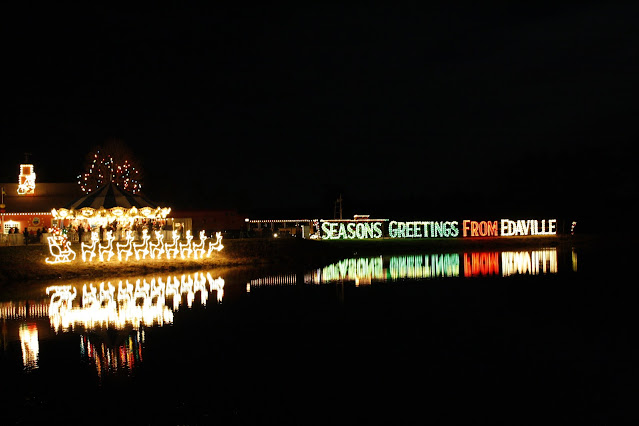
Christmas at Edaville(goaliej54/flickr)


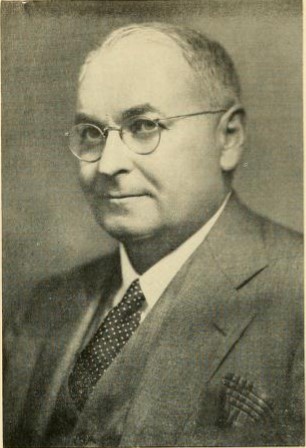
    Born in 1889 Ellis D. Atwood was raised in Carver, Massachusetts. He graduated Tabor Academy in the nearby town of Marion. Later on he married Elthea Eldredge of Wareham in February 1919. 

    Atwood made a name for himself in the highly profitable local cranberry growing industry.  This began by him purchasing three acres of land from his father.  Then with his father died in 1915 Ellis took over all of the family cranberry business.  

    Ellis and Elthea lived in the Murdock-Atwood House near Sampson’s Pond which had been passed down to Ellis by his great-Uncle Marcus Atwood.

    The Atwood’s connection with the Christmas season began with an elaborate display on their front lawn in 1933. Cranberries, Christmas, and railroads, Ellis Atwood’s three favorite things, would eventually be brought together by another’s loss.

    What would eventually become Edaville Railroad was born out of the ashes of a defunct railway. The Bridgton and Harrison Railroad had begun operations in Maine in 1883. Late in 1941 it was being shut down. The rails and train cars were being destroyed. Having taken a blissful trip upon the railroad in August 1941, mere months before it was rendered obsolete, Atwood made a trip to Maine to buy what he could.

Ellis D. Atwood(Cranberries Magazine, Dec. 1950)


    On December 3, 1941 Atwood purchased one locomotive known as the Old No. 7. In addition he bought 11 box cars, 24 flat cars, a caboose, and a half-mile of two-foot gauge track. The final, and perhaps most important piece, was the hiring of former Bridgton and Harrison conductor Everett Brown. Atwood desired someone who knew the railroad and could teach him how to drive a train.

    Completing the Atwood property railroad was delayed due to World War II. Eventually though the man known as the Cape Cod Cranberry King soon had a fully-operational narrow gauge railway circumnavigating the 1,800-acre Atwood property. Atwood’s goal was to combine his success in the cranberry industry with his love of railroads. The new railway on his property was called the Cranberry Belt Line. It was used for sanding, spraying, and harvesting from the bogs.

    Atwood’s Cranberry Belt Line had more than five miles of track. There were some rumors in 1945 that Atwood was considering converting his railroad into an active route between Plymouth and Boston. That did not end up happening. Although it didn’t become an active passenger railroad Atwood’s train was used for more than work. Not long after beginning to take his own train rides around the cranberry bogs Atwood had curious neighbors stopping by for a trip of their own.

    In May 1946 Atwood parlayed his Cranberry Belt Line railroad into a local tourist attraction. He called it ‘Edaville’ for Ellis D. Atwood’s E.D.A. initials. By the end of the year more than 25,000 people had taken a ride on his locomotive around his cranberry bog property. During this first season all Atwood asked of his customers for a fare was common courtesy and common sense.

    Word quickly spread during the first few seasons of the Edaville Railroad. It was the last narrow gauge railroad in the country. In 1948 Atwood said that more than 35,000 people per month arrived to climb aboard the Cranberry Belt Line. The cars and stops along the railway had cranberry-themed names. These included cars named ‘Oceans Spray,’ ‘Eatmor,’ ‘Atwood Special,’ and stops called ‘Cranberry Valley,’ ‘Sunset Vista,’ and ‘Mount Urann’ which was named for Marcus Urann who was president of the National Cranberry Association.

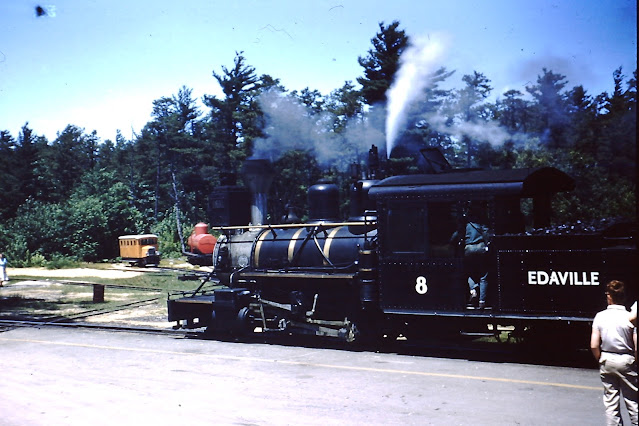
The locomotive at Edaville, 1959(rickpilot_2000/flickr)


    Although it was popular during the warmer months due to there being a beach for summertime play it was the Christmas season where Edaville saw its largest crowds. In 1949 alone upwards of 75,000 people came for a ride to see the over 12,000 colorful lights and more than forty Christmas scene displays lit by floodlights. Train rides through the season began at 4:30pm and ran until midnight. Ellis Atwood had created a family-friendly and wildly popular local tourist attraction. However tragedy nearly ended Edaville.

    On November 26, 1950 Ellis Atwood was late returning home from Edaville. His wife Elthea went to check on him. She found him face down in the basement of the railroad administration building. The furnace had exploded with the door striking Atwood in the head. He clung to life at Wareham’s Tobey Hospital for four days before succumbing to his injuries on November 30th. Ellis D. Atwood, the Eda of Edaville, was dead at sixty-one.

    Cranberry growing had made Atwood a millionaire, but Edaville had brought him more love and popularity. His memorial held at Edaville was attended by more than 2,000 people. Elthea carried on the day-to-day operations of the park in Ellis’ honor. She increased the displays and lights surrounding the Christmas season in particular by creating the Edaville Christmas Festival. However it all became too much. Elthea sold Edaville to F. Nelson Blount in the spring of 1956.

    The railroad continued to thrill visitors for decades. It was sold a few more times yet each successive owner maintained or even improved upon the park’s presentation. The cranberry bogs were highly profitable due to their deep connection to the Ocean Spray corporation. In 1991 final owner George Bartholomew closed the beloved park. Most of the equipment was sold off shortly thereafter to a railroad museum in Portland, Maine. It seemed as though Edaville was finished after more than four decades in operation.

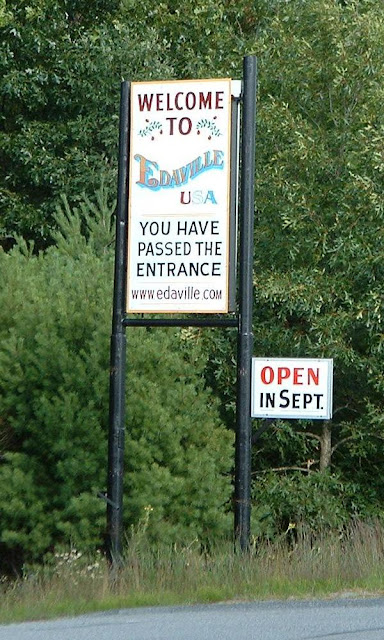
The entrance to Edaville on Rt. 58 in Carver.(T.S. Custadio/Wikimedia)


    The park sat vacant for eight years. In a surprising turn of events the CranRail Corporation bought the decaying Edaville in 1999. The company poured $5 million into restoring and renovating the park over five years. Edaville was reopened to much fanfare just in time for the Christmas Lights Festival in December 1999. Since its reopening Edaville has enchanted countless thousands of visitors. Parents and grandparents now bring new generations to enjoy Edaville much like they had.

    Ellis Atwood had only seen a tiny slice of the impact Edaville was to make on Massachusetts locals and visitors before his untimely death. Despite that his name is still front and center whenever someone utters ‘EDAville.’ It is far more than a little train roaming the cranberry bogs of Carver. Edaville is a destination for families annually. In a day when so much constantly changes Edaville is a throwback to a simpler time. It should be experienced, or re-experienced, by all of those within reach of the park.

-----------------------------------------------------------------------------

Be sure to check out my website: Christopher Setterlund.com

Zazzle Store: Cape Cod Living