Pages

Showing posts with label harwich. Show all posts

Tuesday, May 14, 2024

In Their Footsteps: Cape Cod History - The Shocking End of the Sitzmark II/Cinema Lounge


Is it possible for a location to be cursed? Many times truth is stranger than fiction.

Cape Cod, Massachusetts, despite being still relatively low-key and laid back in the 2020s, has had its share of events in history that seem like they were ripped straight from popular television crime shows.

Fifty years ago a shocking crime rocked the Mid-Cape area. Those who were there will never forget. This is the story of the short life, and abrupt end of the Cinema Lounge, also known as Sitzmark II in West Harwich.


An article from Cape Codder newspaper about the fire.


The story of the Sitzmark II starts with owner Robert Fusco.

Fusco was born in Leominster, Massachusetts on April 20, 1942, and became a successful business owner at a young age. This began with his purchase of the Fairmont Cafe in Fitchburg, Massachusetts in 1967. At its peak, Fusco’s business enterprise included fifteen properties in Central Massachusetts as well as Cape Cod and Florida.

The Sitzmark restaurant and club first came to be in Fitchburg, Massachusetts. Being a relatively short drive from Mount Wachusett it seemed appropriate to name the establishment Sitzmark as the word is defined as the impression a skier makes when falling into the snow backward.

As his business empire grew Fusco set his sights on Cape Cod. In late 1971 he found a perfect location for a second Sitzmark location on Route 28 on the Dennis Port/West Harwich line. Fusco leased 2.75 acres of land owned by Lillian Dowd.

A mortgage of $135,000($1 million in 2024) was taken out to develop a new eating and drinking establishment Fusco appropriately named Sitzmark II.


The story of Sitzmark II cannot be told without diving a little deeper into the property upon which it stood. This is where the story truly gets strange.

Located at approximately 10 Route 28 in West Harwich the property saw a string of failed businesses before and after. Curse might be a strong word but the multitude of failures are difficult to ignore.

Lillian Dowd had been running a laundry service on the property beginning in 1949. Known as Cape Self Service Laundry it was a fairly straightforward business venture. She lived in a home next door, across from what is today the Noble House restaurant. Her neighbor on the property was a nightclub known as Cape Towne House. This establishment had been open since the early 1950s and was located inside a renovated barn.

In an eerie bit of foreshadowing a fire in April 1956 destroyed the barn. The owners were undeterred and rebuilt thanks partially to Dowd leasing them another chunk of her property. Throughout the 1960s the Cape Towne House was a success.

The success was fleeting and Cape Towne House ultimately failed after losing its liquor license in 1968. Dowd, sensing an opportunity, opened a dance hall for teenagers in the former nightclub. She christened it The Embers.

The Embers catered to teens at first. However, Dowd purchased her own liquor license so as to appeal to the older crowd as well. The work proved exhausting and Dowd gave up the liquor license in August 1969 choosing to stick with the teenage dances.

In the end, The Embers did not last long. Thus Dowd was willing to sell the land, and her laundry business when Robert Fusco came calling in late 1971.

Sitzmark II began operating in the summer of 1972. It was a club offering live music, dancing, and cocktails. However, it also offered a breakfast and lunch menu in an area called The Third Door.


An advertisement for Sitzmark II from 1972(Barnstable Patriot)


Despite being a restaurant as well, the nightlife got Fusco’s new establishment into trouble. The law stated any noise from the building needed to remain confined to the property. In its first season, Sitzmark II was routinely cited for noise complaints from neighbors as well as overcrowding.

Rock bands, orchestra, dinner theater, and more entertained patrons at Sitzmark II. Eventually, the loud music drew the ire of Harwich selectmen who shut it down in 1973.

Fusco had no choice but to acquiesce to the town. He changed the name of the establishment to Cinema Lounge entering 1974 while also eliminating the loud music from the schedule. However, a new act brought in would permanently change the direction of the business.

For the 1974 summer Fusco hired a drag show called ‘All That Glitters Is Not Girls’ run by Karl Huston. The show was a massive hit drawing in thousands of customers with many more having to be turned away. That success again put Cinema Lounge in the cross-hairs of Harwich selectmen and the nearby West Harwich Baptist Church whose prejudice deemed the shows risque.

The thinly veiled homophobia was hardly disguised by the politicians. The show was classified by them as burlesque/strip which they said was not a part of the entertainment license for Fusco’s club. A local politician was quoted in the Cape Cod Standard-Times referring to the members of the drag show with a homophobic slur.

Even a seemingly positive article about the show in a local newspaper in June 1974 was rife with ignorant verbiage. It stated that ‘The idea of eight men parading around dressed, and often undressed, as women is stomach-turning to most normal heterosexuals.’

The majority of the clientele at the All That Glitters shows were elderly people. Karl Huston stated that these people seemed to enjoy the show with nobody complaining.

The summer of 1974 was a battle between Fusco and Harwich. In August the Cinema Lounge had its liquor license suspended. It then had its entertainment license revoked due to the All That Glitters show being purportedly wrongly classified as a ‘dance band.’ Fusco estimated the club lost in the range of $20,000($126,700 in 2024) in two days when the club was shut down on August 9th.

Bad press and closings took their toll on the business. Courts had already begun foreclosure proceedings against Cinema Lounge. Fusco was shocked by the level of fervor against his establishment. He stated at the time that Harwich was the only town in which he owned a business that he was subject to such harassment.

Huston and Fusco hired attorneys to sue the Town of Harwich for closing the show down. On August 21st Harwich selectmen reinstated the liquor license and issued a revised entertainment license to Cinema Lounge. A tentative reopening was slated for August 23rd. However, Fusco stated that even with the licenses reinstated the club’s time was drawing to a close. He had no idea how prophetic those words were.

Twenty-four hours later the Cinema Lounge was history.


The Cinema Lounge was destroyed.(Bing AI)


At roughly 11pm on August 22, 1974, a pair of nearly simultaneous explosions rocked the Cinema Lounge building. The explosions created a hole in the ground upon which the building crumbled and burned. It was virtually destroyed with the ensuing fire finishing the job. As the club was closed there was luckily nobody inside and nobody nearby was injured.

Calls flooded in from neighbors upon hearing the loud explosions. This was not a common occurrence on Cape Cod in the 1970s. The fire was so intense that there was not much the Harwich Fire Department could do upon arrival. Even as neighboring fire departments arrived it was difficult to get the blaze under control.

Immediately the circumstances surrounding the fire made it appear suspicious. Investigators noted there were no combustible materials stored in the building. The explosions and overall ferocity of the fire made arson the main theory.

Shortly after the fire Fusco and everyone associated with the Cinema Lounge were cleared of any involvement. Arson investigators suspected the fire was set by a professional. Someone entered the premises unbeknownst to the owners and placed the explosives that destroyed the building. It was referred to as ‘revenge arson.’ But who wanted revenge?


Who was behind the 'revenge arson' of the Cinema Lounge?(Bing AI)


Although a suspect was never officially named authorities stated that they knew exactly who it was. He was purported to be an underworld journeyman criminal. This suspect was connected to other horrific crimes like more arson and even murder. However, he would never be brought to justice. Only a short while after being suspected in the Cinema Lounge fire the man was himself murdered.

The question does still remain though. If it was ‘revenge arson’ who wanted revenge on Cinema Lounge and Robert Fusco?

In the aftermath of the destruction of the Cinema Lounge Fusco sold the land and moved on. This included a stint managing the Compass Lounge in South Yarmouth, Massachusetts.

The property remained vacant for years. At one point in 1984 chatter got loud about Burger King buying the property but it was shouted down by locals.

In a final surreal irony in March 1987 Lillian Dowd’s home on the eastern edge of the property was gutted by fire. Dowd had a cooking accident but still, it was yet another fire on that property. Cursed is a strong word but it is at least a series of interesting circumstances.


Where Sitzmark II/Cinema Lounge once stood in West Harwich.


Today the property on the Dennis/Harwich line is nondescript. It is home to the Harwich Antiques Center as well as a strip mall with a Domino’s Pizza. Virtually nothing remains of that short time when Robert Fusco ran the Sitzmark II and then Cinema Lounge.

The story when read sounds like something out of a movie. Multiple fires, battles with the town, and a final explosive fire set by an underworld criminal. No, it was not Hollywood, it was Cape Cod in the 1970s.


Friday, October 7, 2022

The Solemn Graves in the Harwich Woods


Sunday, February 6, 2022

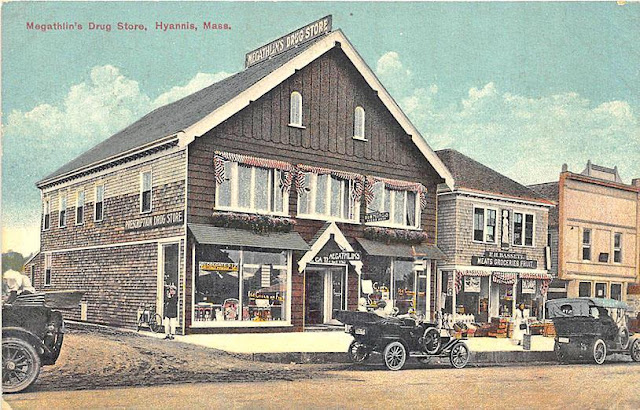
Charles Megathlin's Drug Store, Hyannis MA


    In the 21st century pharmacies, much like all of business, are dominated by a few big names. CVS, Walgreens, Rite-Aid, and more are located in nearly every nook and cranny of America. Even supermarkets like Publix and retailers like Walmart dabble in prescriptions. A century ago things were far different. The local pharmacy was a Mom and Pop operation. It was a friendly and familiar face. It was as much a hangout and general store as it was a place to pick up our scripts.

    On Cape Cod there have been many beloved local pharmacies during the 19th and 20th centuries. However one that stands up near the top of the mountain in Cape history is that of Megathlin’s Drug Store. Existing for decades on Hyannis’ Main Street it was the home of operations for Charles W. Megathlin, but it was hardly the only thing he was known for. This is a bit about the man and the business that bore his name.

    Charles W. Megathlin was born in Harwich, Massachusetts on April 2, 1872 to Anthony and Mary Megathlin. While attending Harwich High School Megathlin worked in the drug store of Dr. Benjamin Eldredge. It gave him a taste of what would be his future. After graduating from Harwich High School in 1891 and marrying Louise Munsell in October 1893 the young Megathlin set his sights on a career.

    An opportunity arose in the form of a drug store on Main Street in Hyannis. The 21-year old Megathlin bought the Hyannis Pharmacy from John P. Bowen. Bowen had run the business since 1890 before closing it in October 1893 to take a job in Boston as a traveling salesman.

    Megathlin immediately made improvements, including renaming it to Megathlin’s Drug Store. The grand opening soon thereafter. In order to keep close to his new venture Megathlin rented the former home of Captain Asa Bearse just down the street.

    Pharmacies at the time, much like today, sold far more than just medications. Basic toiletries like soaps and tooth powders, chocolates, and rare gifts and novelties were advertised in the local newspaper as being on sale at Megathlin’s. The business was an immediate success. Within two years it had outgrown its current location.

    Megathlin leased the building across the street in March 1894. This building had been the home of Louis Arenovski’s American Clothing House. Locals had doubts as to whether Megathlin could fill the large space with products. He did so with ease. The next several years saw Megathlin’s Drug Store dominate Hyannis business. It became the go-to for much of the everyday items that locals needed. In 1900 Charles purchased a building owned by William Lewis. This was converted into a new location for the drug store. It appeared as though nothing could slow the growth of Megathlin’s. However an event out of Charles’ control brought everything to a halt.

Postcard image of the Main Street fire. (Sturgis Library)


    On December 10, 1904 a major fire broke out around midnight, engulfing much of the business district of Main Street. The fire raged unchecked for hours. In the end several longtime establishments were damaged or destroyed. These included Megathlin’s Drug Store. In addition the Universalist church, Thomas Nickerson’s marble works, James Baxter’s shoe store, Eagleston’s store, the New England Telephone office, Walter Baker’s department store, and more were lost. Though the fire was said to have been accidental it left much of the east end of Main Street in ruins. Conservative estimates at the time had losses at more than $110,000($3.4 million in 2022)

    Charles Megathlin pulled up his boot straps and soldiered on though. Since the fire had been slow burning there had been ample time to remove much of the goods from the store. Megathlin got right to work on rebuilding his popular pharmacy. Within six weeks the new store was partly raised and boarded. In the meantime Megathlin took up temporary residence nearby and sold what dry good he had.

Megathlin's rebuilt store on Main Street(Sturgis Library)


    The new Megathlin’s opened April 20, 1905. He had taken the opportunity to make the new building bigger and better. The improvements included work rooms and laboratory rooms for medications. In addition people came from near and far to see the incredible marble countered soda fountain. The store continued its upward trajectory after the near-tragic fire. The store became an important distraction when Louis died in June 1906 at the young age of forty-one. A year later Charles married Mabel Lumbert.

    It got the point where the Hyannis store was seen on the same level as bigger city stores like those in Boston. More changes came in the summer of 1916. Megathlin added a new staircase to the second floor, mahogany wall cases, and a new drug counter with one hundred drawers. The wise businessman added a Japanese shop and Victrola department on the second floor of the revamped store.

    Decades of faithful service gave Megathlin’s the status as one of the largest local drug store operations in all of New England. It was during this time that Megathlin began to branch out in the grander scheme of the Cape Cod community. His knowledge of business, banking, pharmaceuticals, and more made him a popular local figure. Megathlin’s kind and genial nature only enhanced his stature.

    His new accolades included becoming the President of the New England Association of Rexall Druggists and the President of the Public Safety Committee of Hyannis both in 1917. In 1920 Megathlin added to this by becoming the President of the Cape Cod National Bank of Harwich which later became the Cape Cod Trust Company. His final, and perhaps greatest locally, achievement was becoming the first President of the Cape Cod Chamber of Commerce in February 1921. Megathlin only held that title until the organization’s next meeting which was the next month due to his other obligations.

    Despite having many new responsibilities Megathlin’s first love was his drug store. By the time he got into his mid-50’s though Megathlin was looking to slow down his life a bit with his second wife. In a major event the longtime owner sold Megathlin’s Drug Store to Louis Liggett also of drug store fame. Charles retained ownership of the building including an office he used on the second floor. Despite his name being removed from the business Charles Megathlin was still highly influential. His banking and real estate ventures led the entire building that housed Liggett’s and a few other businesses to be renamed the Megathlin Block later in 1926.

    In a sad irony, only a year after selling his beloved drug store to slow his life down some tragedy struck. Mabel Megathlin died in August 1927 at the age of fifty-seven. In 1928 Charles married for a third time. This was to Marguerite Baldwin. Charles and Marguerite became parents to Charles Jr. in August 1929. Megathlin was fifty-eight at the time and this was his only child.

The historical marker at Ocean St., denoting Megathlin's. (HMdb.org/Brandon D. Cross)


    Although he remained somewhat active locally Charles Megathlin for the most part faded from the public view. He spent the 1930’s and 1940’s enjoying being a husband and father. Charles did end up becoming President of the Cape Cod Chamber for a second time in March 1949. Entering his eighties Megathlin had carved out an extensive legacy on Cape Cod.

    The end came for Charles late on December 2, 1954. During a severe snowstorm Megathlin was driving alone through West Dennis when he lost control and struck a tree. He died instantly.

    Though the final act for Charles Megathlin was that of a tragic accident his life was a rousing success. Through tragic deaths, and the near-total loss of his business, Megathlin and his drug store transcended into iconic status. Even nearly a century after Charles sold his store to Louis Liggett the name Megathlin still echoes along Hyannis’ Main Street.

--------------------------------------------------------------------------

Previous Blog Posts:

Be sure to check out my website: Christopher Setterlund.com

Zazzle Store: Cape Cod Living


Sunday, July 18, 2021

In Their Footsteps: Cape Cod History - Lincoln Lodge, Harwich


    Cape Cod over the centuries has had a rich connection to the ocean. There are numerous beautiful sea captains’ homes which dot the peninsula from one end to the other. Many of these have been deemed of historic significance, such as those on the Captain’s Mile along Route 6A in Yarmouth Port. Some of these homes have enjoyed a second life though as a piece of Cape Cod’s historic nightlife including The Columns in West Dennis which began as the home of Obed Baker. Another such sea captains’ home which went on to live a second life resided a stone’s throw from Allen Harbor in Harwich. It was originally the home of Captain Leonard Robbins and would go on to become the popular Lincoln Lodge during the mid-20th century.

    Around 1833 the home would be built for the aforementioned Captain Robbins. It would be christened the Massachusett Lodge for a planting field located in the area run by the Native American tribe of the same name. It would be owned by three different people throughout the 19th century before being purchased around the turn of the 20th century by a retired judge from Chicago named William Keough.

    Keough would make many changes to the home, mostly enlarging it into a stately summer manor. However after nearly thirty years as owner of the home Keough’s life would change drastically. He was called into court in Chicago in the late 1930’s in a dispute over properties he owned, battling against members of notorious Al Capone’s gang. When Keogh refused to sell his properties the rents were raised immensely. He went to court to appeal the rent increases. When his appeals were denied it did not sit well with him and Keogh in turn shot and killed the victorious party’s assessor in the courthouse. The retired judge would be declared legally insane and sent away to an institution. Subsequently Keough’s children would sell the property to the Borden Family whose dairy company still operates to this day.

The Lincoln Lodge c. Rebecca Lufkin-Catron


    It would be the Borden’s who took the stately manor and turned it into a rooming house. They would also be the ones to give it its ‘Lincoln Lodge’ name. The property would be named for Joseph Lincoln rather than former President Abraham Lincoln. Joseph Lincoln was an author born in Brewster who during his career, specifically the first few decades of the 20th century, wrote about a fictionalized version of Cape Cod and had pieces published in such illustrious publications as the Saturday Evening Post. When the property was sold again in the 1940’s to William Jenks he kept the Lincoln Lodge name, assuming it was in honor of President Lincoln.

    Jenks would sell the Lodge to Else Lufkin in 1953 and the former sea captain’s home would embark on its most celebrated chapter. Lufkin and her son Robert Jr. would begin the process of turning the former rooming house into a popular eating and drinking establishment. The Lodge’s décor was cozy with half of the establishment having half circular couches with coffee tables facing a field stone fireplace and colonial wallpaper. The other half had the dining area and bar.  One popular change was the addition of the ‘Village Fare’ which was a changing buffet dinner Saturday nights. In the late 1960’s Lufkin would build a two-story motel on the property known as the Mary Todd Court. This meant that visitors could enjoy an evening at Lincoln Lodge, and if it was desired, stay the night close by.

Lincoln Lodge and Mary Todd Court


The Lincoln Lodge would promote its menu heavily including jumbo shrimp, clam pie, scallop stew, and Southern fried chicken. It would also become the Cape’s only Fondue restaurant adding to the popularity and uniqueness of the Lodge. Woe be to those who dropped food into the fondue. According to Bob Lufkin’s daughter Rebecca Lufkin-Catron there were specific instructions on how to rectify their mistake.


“A waitress would bring that customer a box with slips of paper with instructions for the customer,” she explains. “These would include instructing he or she to sing a song, tell a joke, recite a poem or kiss the host or hostess.”

Bob Lufkin would promote an air of fun and comradery at his spot. This included Hawaiian Luau’s on the outside lawn where a Hula dance instructor was on site to teach the dance to patrons. Rebecca Lufkin-Catron describes another way of bringing strangers together, Nut and Bolt Night which began after 9pm.

“A guy would be given a bolt and a gal a nut as they came in the lodge,” Lufkin-Catron says, “Which was a way to get people to mingle, by seeing whose nut matched whose bolt.”

However Robert Lufkin would shift the focus of his establishment in the late 1970’s when he created the hugely popular drink the Nantucket Sleigh Ride.

Postcard in front of Mary Todd Court


Lufkin created a monster with this famous drink. Although Lincoln Lodge was opened for cocktails nightly until 1am Sunday was set aside as Sleigh Ride Night. Rebecca Lufkin-Catron says it was so popular that on Sleigh Ride Night people would be lined up outside all the way to the end of the parking lot just to get a taste. Due to its potency though Lufkin set a limit of two drinks per customer. To this day Lufkin-Catron says that she is asked just what is needed to make a Nantucket Sleigh Ride. However that is rightfully a guarded family secret.

The Nantucket Sleigh Ride increased the establishment’s popularity, as did a new entertainment license in 1984. However both of these positives were double-edged swords. By 1985 there was an outcry by some neighbors about overcrowding and noise at Lincoln Lodge due to its increasing business. Though Lufkin went above and beyond to try to control noise and minimize intoxicated customers he continued to battle against neighbors and local police for several years. The constant battles with the town, coupled with increased police presence in the area and shortened operating hours on Sundays proved to be too much.

c. Rebecca Lufkin-Catron


Lufkin would sell his beloved Lincoln Lodge in May 1988 to Scott Sogard who would drastically change the business which had been there for more than thirty years. He would rename it Goucho’s Mexican Restaurant which it would remain for a decade before becoming Widow’s Walk Condos in 1999. As of 2021 the former Lincoln Lodge is still operating as the condos.

-----------------------------------------------------------------------------

Previous Blog Posts:

Be sure to check out my website: Christopher Setterlund.com
Zazzle Store: Cape Cod Living


Monday, January 11, 2021

In Their Footsteps: Cape Cod History - Storyville

     Cape Cod and Jazz, the two go together like peanut butter and jelly. The beautiful peninsula and the popular music genre have been connected throughout the 20th and 21st centuries. The Columns in West Dennis was well known for its jazz during its 1970’s heyday. However there was a spot which rivaled it as far as sheer talent which appeared there. For a few brief years during the middle of the 20th century one place shined brighter than all others when it came to Cape Cod jazz and that was Storyville in Harwich.

    Storyville may have opened its doors along Pleasant Lake in Harwich in 1957 but its legacy goes back much further to the waning years of the 19th century. In 1897 the original Storyville was opened in New Orleans, Louisiana. As jazz was in its infancy a district of the city was created by Alderman Story to house the new music. Years later accomplished musician George Wein would open his own Storyville in Boston. Wein, who would gain fame for creating the Newport Jazz Festival and Newport Folk Festival, made it his mission to bring the most talented jazz artists to play at his Boston locale. With his success at Storyville-Boston secure Wein planned his next step.

    In 1956 Wein spent the summer in Wellfleet playing music at local nightspots with his close friend Paul Nossiter. It was during this time that he fell in love with Cape Cod and decided that it needed a permanent spot to showcase jazz. He found a perfect spot in a former Cape restaurant. The Robin Hood Inn gained fame during the 1920’s as a Prohibition-era spot being built atop the filled in remains of the Cape’s first cranberry bog owned by Cyrus Cahoon and designed by his cousin Alvan.

    Wein would purchase the former restaurant-turned-inn the following year. Although he added a wing to the home to bring its capacity from 300 up to 600 people he kept much of its medieval interior charm. Storyville-Harwich would set the tone for its all too brief existence on its very first night. It was on July 4, 1957 that the Cape’s hottest jazz club would debut with none other than Louis Armstrong playing two long sets to a raucous crowd. The opening season would see other legends of the day such as Dave Brubek and Erroll Garnor stopping in to ply their trade for week-long engagements. The first season at Storyville would be a huge success, a harbinger of things to come.

Storyville Menu (Worthpoint.com)


    Initially the establishment would serve only drinks to its patrons. However with the rousing success of the opening season Wein decided to serve food as well, hiring a chef and maître d’. Opening night saw throngs of people waiting three hours for their dinners as Wein and Nossiter were not restaurateurs. Though they had the ‘hippest menu’ complete with steaks, ribs, chicken, lobster and more, the foray into serving food lasted only a month as they served high quality food for reasonable prices, losing money on the venture.

    Despite that failure the musical acts continued to be what drew the people. Stars like Ella Fitzgerald, Duke Ellington, Pee Wee Russell, Benny Goodman, Sarah Vaughan, and others would make the trip over the Cape Cod Canal to the woods of rural Harwich to entertain the masses during the ten-week summer season. However the supernova that was Storyville could not be sustained.

The Circus Room of the Bradford Hotel where Storyville-Boston was located in 1959. (Boston Public Library)


    In 1959 the star power was still there with mainstays like Armstrong, Vaughan, Garner, and others returning. However it was a double-edged sword. In order to bring in such acts they needed to be paid, yet there was only so much that Wein and Nossiter could charge people to get into Storyville. This meant that the club was not making much, if anything, in terms of profit. It was around this time that George Wein began being stretched too thin with his commitments to the Newport Jazz Festival, Newport Folk Festival, as well as other projects. He simply could not devote as much time and energy to his Harwich spot.

    In 1960 the star power of the musical acts would wane. As the big names of jazz began to get nationwide exposure Storyville was not able to afford to bring them in to play anymore. Customers had been accustomed to the big names and when they became fewer the business went as well. Wein sold his Boston Storyville location after the 1960 season. It ran for another season under new management before closing for good in 1961. This left Wein to run his Harwich location for one more year.

    Despite the impending end of the establishment the 1961 season still managed to attract megastars like Duke Ellington, Erroll Garner, and Louis Armstrong. However the death knell for Storyville came when the wildly popular Kingston Trio failed to sell enough tickets for a July show and canceled. The rising cost for acts and ticket prices was a combination too powerful for Wein and Nossiter to overcome. Storyville was shuttered after the 1961 season. The building itself would have another chapter, being renamed The Red Garter. The name would be changed again to Your Father’s Moustache due to a copyright problem. It was badly burned in a fire later in the 1960’s.

George Wein in 2009 (Infrogmation/Wikipedia)


    The building was torn down. Your Father's Moustache reopened in Dennis Port in the same building as Improper Bostonian. In the 1970's the site of the former jazz club became home to a housing development roughly in the area of Prince Charles Drive. George Wein continued to be a force in jazz, running the Newport Jazz Festival into 2020. He is still going strong at age 95. As for his contribution to the jazz scene on Cape Cod the only thing left behind is Storyville's legacy of great music.

----------------------------------------------------------


Previous Blog Posts:


Be sure to check out my website: Christopher Setterlund.com

Thursday, April 24, 2014

In My Footsteps: Cape Cod - Wychmere Harbor

My first book, In My Footsteps: A Cape Cod Travel Guide, is available at SchifferBooks.com, BarnesandNoble.com, and Amazon.com, and stores everywhere!  Follow me on Twitter and YouTube for more on In My Footsteps.


Come and see me at the Brewster In Bloom Festival May 3rd, and Sandwich Heritage Day June 14th!

Monday, February 8, 2010

In My Footsteps: Trip 19: Harwich, Mass.


In My Footsteps
Christopher Setterlund

Trip 19: Harwich, Mass.
February 6, 2010

            Cape Cod is known for many things, beaches, historic villages, and quaint shops among them.  However, just as much as those, Cape Cod is known for its cranberry bogs, some of which supply Ocean Spray with their fruit.  In fact the Cape Cod Cranberry Growers Association represents nearly half of all of the growers in North America.  Of all the towns on the Cape, Harwich may be the cranberry bog capital.  There is even an annual Cranberry Harvest Festival held in Harwich during September.
            Though some of these cranberry bogs are private there are some that can be walked.  The best place to go for an up close and personal tour of a working cranberry bog is the Cape Farm & Cranberry Company(left) located on Main Street in Harwich.  The bog is toured via a large motorized cart through the spring, summer, and fall.  Besides the bog itself there are farm animals that can be enjoyed by children and adults alike.  Reservations are needed but all group sizes can be accommodated including buses and school field trips.  The Harwich Historical Society at Brooks Academy has a large exhibit on the cranberry culture of Cape Cod.
            Harwich has much to offer besides cranberry bogs.  One such example is the Bells Neck Conservation Area.  At more than 250-acres of natural beauty, Bells Neck is filled with walking trails, ponds, and an amazing marsh(right) area that includes a view of an immense blue water tower hovering above the tree line.  Entering from Great Western Road you will see the large West Reservoir on the right side.  It is nearly always populated by swans and ducks during the warmer months.  The main dirt road if taken will lead you eventually to Route 28 but there is one side road and it needs to be taken.  This dirt road takes you to the marsh area at Bells Neck and there is a walking bridge that gives you an amazing view.  The scope of the conservation area is in full view from this spot.  The muddy area along the marsh river is filled with tiny marsh Fiddler crabs that scurry away as you approach.  The trails are great for walking but the Cape Cod Rail Trail slices through the conservation area as it makes its way from Dennis up to Provincetown.
            Not to be forgotten in the town of Harwich is the beautiful coastline.  Perhaps the best spot to enjoy the nautical portion of the town is at Wychmere Harbor(right).  Located on Rt. 28 there is a spectacular view of the harbor at a small dirt turn off.  It is along a busy road so be careful when pulling off, but the view is worth it and there are benches for sitting there as well.  
            Just to the east of Wychmere Harbor, located next to the hugely popular Brax Landing restaurant, is Saquatucket Harbor(left).  Saquatucket is the Native American word which loosely translated means ‘Stony Brook’ a name that is quite common in Brewster as that town was first considered part of Harwich.
From this harbor ferry boats leave for trips to Nantucket as well as out to Monomoy Island off of Chatham.  It is on Monomoy where groups of seals congregate and the ferries will take you out there to see them.
            As far as actual beaches go the best one for my money is Red River Beach, easily accessible from three different roads.  The Red River represents the border between Harwich and Chatham.  For hikers there is a marsh area behind the beach parking lot that leads to the Red River Swamp. 
            Another great long hike is at the Hawksnest State Park which is located off of Spruce Road near Exit 11 of the highway.  The large Hawksnest Pond and the smaller Olivers Pond are located within the boundaries of the park.  There is also the small 19th Century Head of the Bay Cemetery located in the northwest portion of the park.  Seth Whitfield Road runs north to south through the forest.  It is dirt and is somewhat tough to navigate.  It might be best to have an off-road capable vehicle to drive this road.  There is only one cabin located in the area and that is private.  It is here where the Hawksnest Camp, a duck hunting area, was founded in 1925.  A small group called Friends of Hawks Nest has begun work on getting funding to help clean up the park which is basically under no control.
            Originally incorporated in 1694 Harwich has over 300 years of history that can be seen, smelled, and even tasted.  Whether you like beaches and boats, hiking through the forest, or cranberry bogs and farm animals, Harwich’s rich natural beauty and history will be sure to capture your imagination and heart.  Have fun and happy traveling!
Directions:  Cape Farm Cranberry Bog: From Rt. 28 in Harwich turn north onto Lothrop Ave.  Follow it to the end and turn left onto Main Street.  The bog is on the right about 300 feet away.
Wychmere Harbor: The overlook area is located between Snow Inn Rd. and Harbor Rd.
Red River Beach: The beach can be accessed by either Deep Hole Rd. or Uncle Venies Rd.
Bells Neck Conservation Area: From Rt. 28 turn north onto Depot Rd., and take a slight right onto Bells Neck Rd.
                    Harwich Historical Society
                    Wychmere Harbor Beach and Tennis Club
                    Cape Farm Cranberry Bog Tours