Pages

Showing posts with label fire. Show all posts

Monday, May 25, 2026

Initial Impressions 2.0 Blog #122: Record Temperatures, Dogs In Golf Carts, Nice Parking, etc.


1. Well, that escalated quickly. We graduated from a typical Cape Cod spring, meaning low 50s with loads of clouds, fog, and drizzle. In a snap, it was record-high temperatures. We hit right around 80 degrees with low humidity and tons of sun. I had a great time going for a morning walk in the perfect weather. I enjoyed it so much that I created a short video of my walking route. Granted, the record highs didn’t last. We dropped to more normal, but still nice, temperatures in the low to mid 60s. It was perfect for mid to late May. Much like the first snow of the season, the first hot day of the season is fun, but as it becomes more common, it gets less appealing. To me, perfect weather is low humidity, partly cloudy, temperatures in the low to mid 70s. If I could bottle that, I would. Now it is the race to see how long it is until I have to put in my air conditioner. Last year, it was early, maybe the third week of June. I am hoping to hold off until after the 4th of July, as I typically do, but I can’t control the weather.


2. The sirens wailed as I walked to my car one morning this week. I was headed to work. I hear sirens almost daily, police and fire. I see the vehicles go by the house every so often. On this day, one fire truck flew by, then another. I had to wait as a third flew by. I wondered where they were headed. It didn’t take long to find out. After not even a minute of driving, I saw the huge plumes of black smoke billowing up from the trees. It wasn’t a forest fire, though. Near the end of the road I live on, I saw the fire trucks congregated. There it was. A shed, a boat that was probably 20-feet long, and a back fence were engulfed in flames. The next-door neighbor was dousing their side of the fence with a hose to try to hold off the fire. Cars slowed but didn’t stop. I wondered all day about the fate of that house. On the way home in the evening, I slowed down by that house. The fence looked like it survived. The shed had a massive hole in its roof. I saw the front half of the boat, but I don’t know if the back end was a loss. Thankfully, the house looked fine, and I can only assume all of the people were okay. Cheers to the Yarmouth Fire Department for getting there so fast and getting the fire out.


3. Aging is a weird thing. It’s like mentally I feel like I am still 18, but that was 30 years ago. Certain songs or foods can immediately bring my mind back to how I felt as a teenager. Even when I look in the mirror, I don’t feel like I have aged badly. Yes, I have more gray than I’d like, but I have a full head of hair. Between 40-53% of men in their 40s are going bald, or are bald. That jumps to 50-85% of men in their 50s. Granted, I could start going bald in 11 years and still be in my 50s, but I have good genes. Physically, though, is where the differences are piling up. It wasn’t when I turned 40 that things started changing. It was actually after turning 42 in 2019. I had a bad hip injury from running, and also battled Covid and lived through it like we all did. Those things all seemed to turn the tide in a way I haven’t been able to come back from. I do well for a few months and lose 10-15 pounds, but then my energy and willpower just get sapped, and I fall off. I think recognizing it is a benefit, though. Every new day, you can try again to get it right. Is that a stricter diet? Lowering my caffeine intake? Reducing my workload so I can go to the gym more? A little of all of them? I have no idea. All I know is that, going back to those good genes, I am likely going to be lucky enough to reach my 90s, as many in my family tree have. That means I have 40-something years left. I can either keep working hard and have more healthy years ahead. Or I can just give up and have decades of a downhill trend. The choice is mine.


4. The heat wave in May in New England broke in spectacular fashion. It was as hot as 88 degrees with a real feel of 101. I decided to make the most of it by going for a walk in the afternoon when I got out of work. I was on the bike trail. It was not as bad in the shade, not very humid. I saw in the sky the thunderclouds billowing above the trees. I knew it wasn’t long until the rains would arrive. I walked 3.5 miles, so it took me an hour. When I parked my car at the bike trail, my car’s thermometer read 84 degrees. When I got back an hour later, it was 74. Dropping 10 degrees in an hour is pretty wild. In fact, the longer I walked, the more I could actually feel the heat breaking. It took a couple of hours, but the heavy rain and a few thunderstorms arrived. It was the ultimate example of ‘if you don’t like the weather in New England, just wait 5 minutes.’ We went from a real feel of 101 one day to low temperatures dropping into the upper 40s the next night. It feels like it might be a wacky, unpredictable summer weather-wise.


5. I don’t know what to say. I guess wild animals trust me. That is my thought process after this week. I was out for a run when I was passing a golf course and noticed a pair of cute little chipmunks running and playing near an open gate. One was lagging behind, and I got the sense that it might end up coming around the corner of the gate when I was walking by. Instinctively, I grabbed my phone in the hopes of getting a photo of one of them. The curious chipmunk not only came out from the fence, but it literally walked right up and sniffed my sneakers. I was able to get a few seconds of video of this tiny chipmunk by my feet before it ran off with its friend. Now, couple this with the foxes last week that seemed all too comfortable with me hanging around. Then go back a couple of years to a little bunny that wandered out from the bushes at a beach and literally climbed on my shoe and tried to eat my laces. I’m not saying I can go sit under a tree, and birds are going to land on my shoulders like pets, but I’ve had more wild animals get close to me recently than I’d expect. Soon, I will have amassed an army of creatures. Too bad it’s all bunnies, chipmunks, and baby foxes.


6. One day each week, I either wait with my youngest niece, Sylvie, for the bus or go with her to get dropped off at school. I look forward to it every time. She is so sweet and kind and always looks to give me something of hers. I have been finding new ways to ‘forget’ and leave them behind. Usually, when she gets dropped off, I get out of the back of the van and move up front, so her mom doesn’t feel like she is a taxi driver. Sylvie has explained to me before how to close the sliding side door properly. You tug the handle once, and it automatically slides closed. As she was getting out, she did that, and I couldn’t stop the door. Only when there were a few inches to go did the door stop. Then it began setting off a beeping to warn you that the door was open. We had to drive to a parking spot so I could get the door closed once the automatic function was turned off. I laughed because I said Sylvie told me how to do it right, but obviously, I am old, and technology will now be my enemy, I guess.


7. My Fitbit has a few times it will buzz to let me know of achievements. They usually have to do with heart rate zones. It also buzzes when I hit 150 exercise minutes per week, or 10,000 steps in a day. Whenever I hit those milestones, it’s a good feeling that I am being active and healthy. The only problem is that Fitbit has a tendency to track steps using arm swinging motions as much as actual foot movement. This came through one day this week when I was sitting at my desk recording my podcast, and my Fitbit started buzzing. I looked and saw I had passed 10,000 steps. But how? I mean, I was pretty close to 10K anyway, so it wasn’t a major glitch like I magically got 10K steps while sitting. No, I think I was gesturing too demonstratively with my hands while recording, and the Fitbit took that as steps. Despite sitting still, I somehow kept adding steps. I guess now I know that if I’m close to 10K but don’t feel like going for a walk, and can just wiggle my arm a whole bunch and get there anyway.


8. I never know what interesting things I am going to see when out for a walk/run. At this point, there really isn’t anything that could shock me. For example, one day this week, I went walking to a little neighborhood located right on Bass River near me. It’s one of those semi-private neighborhoods, not quite gated, with a sign at the entrance with some fancy name to it. This neighborhood is very relaxed; the only vehicles driving through it tend to be those who live there. Those who do live there venture around the roads not in their cars or trucks, but many of them drive golf carts. It is pretty unique. I was walking through the neighborhood and saw a golf cart coming around a corner. It was driven by a girl who couldn’t have been more than eleven. Her passenger was an adorable golden retriever. Just a young girl, her dog, and a golf cart. I just smiled and thought it was par for the course as far as things I see on my walks. Yes, the pun was intended.

Like this, but even cuter


9. Sometimes the stereotype fits. I drove to the Three Sisters Lighthouses in Eastham. There is a small dirt parking lot that can only fit a handful of cars. I pull in. There is a car parked normally, and next to it, some jerk parked diagonally, taking up 2 spaces. When there are dozens of spots, and you park diagonally, you’re a jerk, but it’s not as egregious. When there are like 5 spots, and you do it, you’re an inconsiderate prick. I looked at the New York license plate. My first thought was ‘typical New Yorker.’ I know not all people from New York are pricks, but you do see a lot of them. This jackass wasn’t even at the lighthouses. I am pretty sure he parked there and walked the ¼ mile down to Nauset Light Beach so he wouldn’t have to pay. I got some photos and videos, and when walking back to my car, I saw this idiot and his equally stupid wife getting into the car. A guy had to wait for this moron to back out and leave before he could pull in. Of course, the smug jerk couldn’t even look at any of us watching him leave. It took all of my composure not to just yell at him. The person pulling in asked if I could believe that guy. Needing to vent my anger, I said the guy was a ‘f*cking prick.’ Then I saw his young son getting out of the truck. I quickly apologized for my language, but he was cool. We laughed, and I left. Moral of the story: Whether you’re from New York, Massachusetts, or anywhere, just don’t be a jerk. It’s really not that hard...for most people.


10. For 5 years, I had been running my Facebook business/fan page entirely dedicated to my podcast. I finally realized recently that I was selling myself short. I spend so much time creating that it’s basically a second full-time job. One that I get paid considerably less for currently, but I’m working on that. The fact that I was only promoting my podcast on that page when I also have books, blogs, videos, photos, and film projects, was definitely downplaying all of the hard work I do. This week, I chose to revamp that page from being only about my podcast to everything I do. Fittingly, I renamed it The World of Christopher Setterlund. My plan is to post several times a day there, featuring not only current things I’ve finished, but also shining a light on some of my archived projects. I have a tendency to finish something, share it a few times, and relegate it to a metaphorical box in the back of my closet. I need to promote older stuff much more. The fact that I literally have thousands of pieces of content in various forms that I can pull from means that my back catalog feels totally fresh again. This will be a fun new way to share all of my creative work.


Tuesday, May 14, 2024

In Their Footsteps: Cape Cod History - The Shocking End of the Sitzmark II/Cinema Lounge


Is it possible for a location to be cursed? Many times truth is stranger than fiction.

Cape Cod, Massachusetts, despite being still relatively low-key and laid back in the 2020s, has had its share of events in history that seem like they were ripped straight from popular television crime shows.

Fifty years ago a shocking crime rocked the Mid-Cape area. Those who were there will never forget. This is the story of the short life, and abrupt end of the Cinema Lounge, also known as Sitzmark II in West Harwich.


An article from Cape Codder newspaper about the fire.


The story of the Sitzmark II starts with owner Robert Fusco.

Fusco was born in Leominster, Massachusetts on April 20, 1942, and became a successful business owner at a young age. This began with his purchase of the Fairmont Cafe in Fitchburg, Massachusetts in 1967. At its peak, Fusco’s business enterprise included fifteen properties in Central Massachusetts as well as Cape Cod and Florida.

The Sitzmark restaurant and club first came to be in Fitchburg, Massachusetts. Being a relatively short drive from Mount Wachusett it seemed appropriate to name the establishment Sitzmark as the word is defined as the impression a skier makes when falling into the snow backward.

As his business empire grew Fusco set his sights on Cape Cod. In late 1971 he found a perfect location for a second Sitzmark location on Route 28 on the Dennis Port/West Harwich line. Fusco leased 2.75 acres of land owned by Lillian Dowd.

A mortgage of $135,000($1 million in 2024) was taken out to develop a new eating and drinking establishment Fusco appropriately named Sitzmark II.


The story of Sitzmark II cannot be told without diving a little deeper into the property upon which it stood. This is where the story truly gets strange.

Located at approximately 10 Route 28 in West Harwich the property saw a string of failed businesses before and after. Curse might be a strong word but the multitude of failures are difficult to ignore.

Lillian Dowd had been running a laundry service on the property beginning in 1949. Known as Cape Self Service Laundry it was a fairly straightforward business venture. She lived in a home next door, across from what is today the Noble House restaurant. Her neighbor on the property was a nightclub known as Cape Towne House. This establishment had been open since the early 1950s and was located inside a renovated barn.

In an eerie bit of foreshadowing a fire in April 1956 destroyed the barn. The owners were undeterred and rebuilt thanks partially to Dowd leasing them another chunk of her property. Throughout the 1960s the Cape Towne House was a success.

The success was fleeting and Cape Towne House ultimately failed after losing its liquor license in 1968. Dowd, sensing an opportunity, opened a dance hall for teenagers in the former nightclub. She christened it The Embers.

The Embers catered to teens at first. However, Dowd purchased her own liquor license so as to appeal to the older crowd as well. The work proved exhausting and Dowd gave up the liquor license in August 1969 choosing to stick with the teenage dances.

In the end, The Embers did not last long. Thus Dowd was willing to sell the land, and her laundry business when Robert Fusco came calling in late 1971.

Sitzmark II began operating in the summer of 1972. It was a club offering live music, dancing, and cocktails. However, it also offered a breakfast and lunch menu in an area called The Third Door.


An advertisement for Sitzmark II from 1972(Barnstable Patriot)


Despite being a restaurant as well, the nightlife got Fusco’s new establishment into trouble. The law stated any noise from the building needed to remain confined to the property. In its first season, Sitzmark II was routinely cited for noise complaints from neighbors as well as overcrowding.

Rock bands, orchestra, dinner theater, and more entertained patrons at Sitzmark II. Eventually, the loud music drew the ire of Harwich selectmen who shut it down in 1973.

Fusco had no choice but to acquiesce to the town. He changed the name of the establishment to Cinema Lounge entering 1974 while also eliminating the loud music from the schedule. However, a new act brought in would permanently change the direction of the business.

For the 1974 summer Fusco hired a drag show called ‘All That Glitters Is Not Girls’ run by Karl Huston. The show was a massive hit drawing in thousands of customers with many more having to be turned away. That success again put Cinema Lounge in the cross-hairs of Harwich selectmen and the nearby West Harwich Baptist Church whose prejudice deemed the shows risque.

The thinly veiled homophobia was hardly disguised by the politicians. The show was classified by them as burlesque/strip which they said was not a part of the entertainment license for Fusco’s club. A local politician was quoted in the Cape Cod Standard-Times referring to the members of the drag show with a homophobic slur.

Even a seemingly positive article about the show in a local newspaper in June 1974 was rife with ignorant verbiage. It stated that ‘The idea of eight men parading around dressed, and often undressed, as women is stomach-turning to most normal heterosexuals.’

The majority of the clientele at the All That Glitters shows were elderly people. Karl Huston stated that these people seemed to enjoy the show with nobody complaining.

The summer of 1974 was a battle between Fusco and Harwich. In August the Cinema Lounge had its liquor license suspended. It then had its entertainment license revoked due to the All That Glitters show being purportedly wrongly classified as a ‘dance band.’ Fusco estimated the club lost in the range of $20,000($126,700 in 2024) in two days when the club was shut down on August 9th.

Bad press and closings took their toll on the business. Courts had already begun foreclosure proceedings against Cinema Lounge. Fusco was shocked by the level of fervor against his establishment. He stated at the time that Harwich was the only town in which he owned a business that he was subject to such harassment.

Huston and Fusco hired attorneys to sue the Town of Harwich for closing the show down. On August 21st Harwich selectmen reinstated the liquor license and issued a revised entertainment license to Cinema Lounge. A tentative reopening was slated for August 23rd. However, Fusco stated that even with the licenses reinstated the club’s time was drawing to a close. He had no idea how prophetic those words were.

Twenty-four hours later the Cinema Lounge was history.


The Cinema Lounge was destroyed.(Bing AI)


At roughly 11pm on August 22, 1974, a pair of nearly simultaneous explosions rocked the Cinema Lounge building. The explosions created a hole in the ground upon which the building crumbled and burned. It was virtually destroyed with the ensuing fire finishing the job. As the club was closed there was luckily nobody inside and nobody nearby was injured.

Calls flooded in from neighbors upon hearing the loud explosions. This was not a common occurrence on Cape Cod in the 1970s. The fire was so intense that there was not much the Harwich Fire Department could do upon arrival. Even as neighboring fire departments arrived it was difficult to get the blaze under control.

Immediately the circumstances surrounding the fire made it appear suspicious. Investigators noted there were no combustible materials stored in the building. The explosions and overall ferocity of the fire made arson the main theory.

Shortly after the fire Fusco and everyone associated with the Cinema Lounge were cleared of any involvement. Arson investigators suspected the fire was set by a professional. Someone entered the premises unbeknownst to the owners and placed the explosives that destroyed the building. It was referred to as ‘revenge arson.’ But who wanted revenge?


Who was behind the 'revenge arson' of the Cinema Lounge?(Bing AI)


Although a suspect was never officially named authorities stated that they knew exactly who it was. He was purported to be an underworld journeyman criminal. This suspect was connected to other horrific crimes like more arson and even murder. However, he would never be brought to justice. Only a short while after being suspected in the Cinema Lounge fire the man was himself murdered.

The question does still remain though. If it was ‘revenge arson’ who wanted revenge on Cinema Lounge and Robert Fusco?

In the aftermath of the destruction of the Cinema Lounge Fusco sold the land and moved on. This included a stint managing the Compass Lounge in South Yarmouth, Massachusetts.

The property remained vacant for years. At one point in 1984 chatter got loud about Burger King buying the property but it was shouted down by locals.

In a final surreal irony in March 1987 Lillian Dowd’s home on the eastern edge of the property was gutted by fire. Dowd had a cooking accident but still, it was yet another fire on that property. Cursed is a strong word but it is at least a series of interesting circumstances.


Where Sitzmark II/Cinema Lounge once stood in West Harwich.


Today the property on the Dennis/Harwich line is nondescript. It is home to the Harwich Antiques Center as well as a strip mall with a Domino’s Pizza. Virtually nothing remains of that short time when Robert Fusco ran the Sitzmark II and then Cinema Lounge.

The story when read sounds like something out of a movie. Multiple fires, battles with the town, and a final explosive fire set by an underworld criminal. No, it was not Hollywood, it was Cape Cod in the 1970s.


Saturday, October 15, 2022

Cape Cod History - What Happened to Thomas Powers?


    In the early morning hours of Thursday, April 14, 1898, James Jennings was heading out of his Sandwich, Massachusetts home on his way to work. Jennings spotted flickering light coming from inside his neighbor James Keenan’s stable. Curious, Jennings walked over and peered in through a window. What he saw was something of indescribable horror. The light was fire and it was consuming a human body.

    Jennings burst into the stable and beat the flames out. It was far too late. The young man was dead and his body was nearly charred beyond recognition. He was Thomas Powers who had been working for Keenan as a stableman. How had he ended up in such a condition?

A similar stable to Keenan's(John L. Hildreth)


    A further inspection of the scene was performed when State Detective Sim Letteney and Sheriff Eugene Haines were called to the scene. Though Powers’ clothes had been almost entirely consumed by the fire the investigators found the metal hooks of his suspenders by his feet. It appeared as though someone had tried to remove his pants before he had caught fire.

    Word of the horrific scene at Keenan’s stable quickly spread around Sandwich and beyond. It was like nothing that Cape Cod had seen before. Powers’ body was eventually removed from the stable with an autopsy scheduled for later in the week.

    Rather quickly it became apparent that Powers had not been alone the previous night. Detective Letteney and Sheriff Haines spoke with half a dozen witnesses who said Powers had been in the barn with at least two other persons. The investigators were able to ascertain that whatever happened to Powers likely occurred around midnight.

    Several questions were at the forefront. Who was with Thomas Powers the night before? How did Powers meet his end? Was the fire the cause of his death, or an attempt to cover up the true cause? The answer to the first question came shortly thereafter.

    Those interviewed told the investigators that Powers had been hanging out with four men the previous night. They were identified as Philip Smith, Eugene Allen, Eben Battles, and Allen Webster.

    Detective Letteney interviewed Eugene Allen first. Allen admitted to being a part of the group at Keenan’s stable the night before. He said the five young men had all been drinking heavily. In fact, Webster and Battles were so inebriated that Allen had to walk them home. The three men left Thomas Powers and Philip Smith in the stable.

    Letteney sought out Philip Smith for an interview. Smith also admitted to being with the group the previous night, drinking heavily. However, he said he had passed out in the office around ten. The fire had awakened him as it began to creep its way into the office. Smith claimed to have thrown water on the fire and called out to Powers. Not hearing anything he passed out again. Upon awakening, Smith said he simply walked home.

    The stories of Allen and Smith did not seem to match up, especially with the evidence that Letteney and Haines had already collected. Legend has it that Detective Letteney did in fact uncover the truth about what happened to Thomas Powers that night in 1898. So why is this case still classified as unsolved?

    Detective Letteney brought his evidence to District Attorney Andrew Jennings of Fall River, no relation to the man who had found Thomas Powers’ body. At the time of the investigation, it was reported that Jennings had ordered the case to be further investigated. The problem was that Jennings was far more interested in a case he was pursuing that involved Alicia LeBau Berger. She was the daughter of Cornelius Vanderbilt who was the richest man in the United States. To Jennings that was more important than the potential murder of a poor Irish boy from Cape Cod. Detective Letteney had to do it himself.

Barnstable County Court House in the early 1900s.


    The investigation was brought before Judge Frederick Swift at Barnstable District Court on April 15, 1898. Letteney was not a trained attorney and therefore was at a huge disadvantage when it came to presenting a case before a grand jury. Although Philip Smith was never officially named a suspect it was believed that he had something to do with Powers’ grisly demise.

    Letteney did the best he could to present a compelling case. He brought twenty-two witnesses before a grand jury. Nearly the entire day was spent individually examining them. Unfortunately, much of the evidence was circumstantial and the grand jury chose not to indict Philip Smith or anyone else for that matter. This meant that nobody would end up being held responsible for the death of Thomas Powers. In the end, it was reported that the belief was Powers died from smoke inhalation and subsequently the fire. How exactly the fire was started was never answered.

    The outrage on Cape Cod was palpable. If D.A. Jennings had tried the case perhaps a resolution could have been had. The locals saw Jennings as someone who didn’t care about the Cape unless he was being paid by the uber-wealthy Vanderbilt family. They had their chance to extract some revenge in short order.

    Mere days before the horrific death of Thomas Powers Cape Cod’s congressional representative, John Simpkins, died. D.A. Jennings quickly announced his candidacy for the open spot. The Republican party caucus took place a few weeks later. It was here that Jennings got his comeuppance. He received no support from Cape Cod and finished dead last out of all of the prospective candidates.

    Jennings did not run for district attorney again. He also promised to run again for Congress but that also did not materialize. One interesting twist to the Jennings saga came during the May 31, 1898, special election for the Simpkins seat. One lone person from Cape Cod gave Jennings a write-in vote. It leads to speculation as to whether that write-in vote came from Thomas Powers’ murderer who never was apprehended partially due to the lax attitude of Jennings.

    In the end, young Thomas Powers' death remains unsolved. Was he murdered? Was it simply an accident? Was Philip Smith at fault? Or was it someone else? Sadly that answer will likely never come. Regardless of who was at fault, it was a horrific way for someone’s life to end.

----------------------------------------------------------------

Previous Blog Posts:

Be sure to check out my website: Christopher Setterlund.com

Zazzle Store: Cape Cod Living

Saturday, September 17, 2022

In Their Footsteps: Cape Cod History - The Great Hyannis Fire of 1904


    Natural disasters come in all forms. Hurricanes, tornadoes, blizzards, earthquakes, tsunamis, and more attack without remorse and change land and lives in their wake. Fires are sometimes natural disasters and sometimes man-made. They are no less devastating whatever their origin is.

    Cape Cod has seen its share of fires. There have been some terrible forest fires over the centuries. However what about fires that caused an overwhelming loss of property? One of the deadliest such fires occurred in the first decade of the 20th century and forever changed Downtown Hyannis. This is the story of Main Street’s great fire of 1904.

Looking west down Main Street before the fire. Everything on the right was basically wiped out.


    In the 2020s it’s hard to imagine that there was a time when Hyannis’ Main Street was anything but wall-to-wall shopping and restaurants. A century ago however it was dotted with residential homes as much as businesses. It has always been referred to by its ‘ends.’ The East End lies near the end of the railroad tracks and is close to Cape Cod Hospital, while the West End is today near a rotary and close to the Cape Cod Melody Tent.

    The Main Street area of Hyannis had actually seen a pair of large fires in the preceding years both in 1892 and again in 1894. What came in the early morning hours of December 2-3, 1904 topped both of them in terms of loss.

    The exact location and cause of the fire itself have never truly been established. However, it can be traced to one of two places. Although the fire could have begun at either L.P. Wilson’s grocery store or Walter Baker’s neighboring department store, both located near Center Street across from the railroad depot. It was Wilson who first was made aware of the blaze.

    Living above his store Wilson’s mother alerted him and his wife and two children just before midnight on September 2nd. They were all able to escape the fire in the nick of time with only the clothes on their backs. Wilson’s store was the easternmost location to be lost. Wilson’s mother thought the fire began next door in Baker’s building. However with the buildings all being built so close together, some as close as six feet, it will likely never be known where the actual ignition location was.

    Shortly after midnight on Saturday, December 3rd the alarm had been sounded for the fire department in the form of the bell atop the nearby Universalist Church. It is unknown just how long the flames had been roaring before being brought to anyone’s attention. Wilson’s Hyannis Public Market and Walter Baker’s Department Store were the first structures to go, but they weren’t the last.

    Strong northeast winds coupled with the wooden buildings being so closely packed together meant that the fire spread easily. The flames were essentially blown right down Main Street. Luckily many of the buildings in the path of the flames had items removed by volunteers before the flames could reach them. This included stock from some of the businesses. The Hyannis Fire Department got five pieces of apparatus together but it was no match for the growing fire. Calls were made to other local departments with firefighters from as far away as Middleborough, Provincetown, and Brockton making their way to help. In an extreme act of bravery, a man from the Telephone Exchange Co. was atop a nearby telephone pole sending messages for help as long as he was safe.

    The fire ate through more than 600 feet of Main Street real estate. The exclamation point in the carnage came at just after 3am when the steeple of the Universalist Church came toppling to the ground. A perimeter was set up using wet rugs and blankets on and around buildings that were just out of the fire’s reach. Eventually, the strong northeast winds died down, and by 4am the fire had been contained.

    Heading west along Main Street the following businesses were totally destroyed by the fire: The Universalist Church, post office, Richardson Bros. Photographers, William P. Bearse & Co. who sold meats and provisions, P. F. Campbell & Co. who were tailors, Singer Sewing Machine Co., Charles W Megathlin’s pharmacy, A. P. and E. L. Eagleston’s department store, New England Telephone Exchange, Julia Stevens dressmaker, James E. Baxter boots/shoes, Thomas Nickerson’s marble, and granite works, and finally A. B. Nye & Co.’s paint store.

Postcard of the fire's aftermath, taken by Walter Baker whose department store was destroyed.


    When all was said and done fifteen buildings had been destroyed. Conservative estimates had the damage somewhere in the neighborhood of $150,000($5 million in 2022). For A. B. Nye it was the third time that his paint store had burned down in twelve years. Only once had the fire started on Nye’s property. Sadly sixty-nine-year-old retired sea captain William Penn Lewis died of a heart attack while in the process of saving his house from the fire. As day broke on that Saturday morning all that was left was carnage. Nearly ten acres of property, retail and residential, government and worship, all lay in ruins.

    With the perseverance of a bygone generation, those Hyannis residents who lost their homes or businesses did not stay down for long. In fact, the post office was quickly moved into the home of Mrs. E. C. Benson. Thanks to the determination of Postmaster Percy Goss it was delivering its first shipment of mail by 7:30 that same morning. Most of the businesses quickly set up temporary locations in and around the charred remains of their establishments. Insurance adjusters came later in the day on Saturday, and by the end of the day, plans were already being made for rebuilding Main Street.

Main Street as it appears today. (Google Maps)


    By April 1905 nearly all of the lost buildings had been rebuilt, most of them in the same locations where they previously stood. Today there is little to no reminder of the devastating fire that changed the face of Main Street Hyannis. The ‘new’ buildings are all now nearly 120 years old themselves. They have seen generations of change on Cape Cod and in the world. The solitary reminder in plain sight is a historic marker at the intersection with Ocean Street. It was roughly where the fire was stopped and shows a photo of the aftermath of the blaze.

-----------------------------------------------

Previous Blog Posts:

Be sure to check out my website: Christopher Setterlund.com

Zazzle Store: Cape Cod Living


Sunday, May 15, 2022

In Their Footsteps: Cape Cod History - The Cape's Worst Wildfire


    When one hears the word ‘wildfire’ it typically refers to tragic events that commonly occur in California. The routinely dry conditions, which give the state some of the most desirable weather in the country, also leave it vulnerable to fires. The largest wildfire, in August 2020, burned more than one million acres of land in six counties and destroyed 935 structures. In comparison the entirety of the Cape Cod National Seashore is 43,607 acres.

    Despite it not being as serious a threat to the Cape as hurricanes and blizzards are, wildfires have occurred more often than you would think. The worst fire in Cape Cod history happened over seventy-five years ago and this is the story of the perfect storm that led to it.

    The seeds of the worst forest fire in Cape Cod history were sown beginning eighteen months prior. The Great Atlantic Hurricane struck New England on September 15, 1944 with heavy rain and strong winds. Needless to say the winds toppled countless trees. By the time the spring of 1946 arrived there were still plenty of those dead trees lying where they fell.

    The late-winter and early-spring of 1946 were particularly dry. The threat of potential wildfires was so high that in March State Deputy Fire Warden Ormand Dottridge Jr. warned residents of what could happen. Regulations were put into place for burning leaves and people were implored to be careful and not start anything they couldn't finish.

    Watch-tower service and forest fire patrols were put into service. Despite this there were small fires that began breaking out in late March. These were a precursor of what was to come.

    Early on April 19, 1946 fire broke out in Sandwich in the area near the Bourne Bridge. Northwest winds gusting up to 35mph combined with the relatively dry conditions were a terrible combination. The fire pushed south and east through the Shawme-Crowell State Forest and toward Camp Edwards(Otis AFB).

The Bourne Bridge, near where the fire originated. 


    Firefighters temporarily got the fire in check by building several backfires a mile from Sandwich center. This was only brief though and by 9pm on April 20th a 15-square mile area of Sandwich and Mashpee was burning or charred. Governor Maurice Tobin closed all public forest land in Southeastern Massachusetts. He also went to the Cape to help direct operations. There was still a few days before a chance of rain and the situation was extremely serious.

Barnstable County Brush Breaker c.1942(CapeCodFD.com)


    Sandwich, Bourne, and West Barnstable were temporarily left without power as fire scorched the wires. The fire jumped across Route 130 and seemed to be on a collision course with West Barnstable and possibly Hyannis. More than 3,000 firefighters came from fifty-two different communities and worked nonstop building backfires, digging trenches, and working the fire hoses. They were led by John Stokes, the state commissioner of public safety, who left Boston to help. The group set up headquarters the East Sandwich Grange Hall on Old County Road.

    At midday on April 21st the fire could be seen and smelled in Hyannis. It was only six miles west of the airport. The State Police barracks in South Yarmouth expressed their concern if the winds did not subside. The flames got to within a quarter-mile of forty homes in Sandwich. Much of Rt. 130 and parts of Route 6A(then Old Kings Highway) were closed to all but fire vehicles. Trains from Boston to Hyannis were diverted to Woods Hole with passengers then being shuttled by bus the rest of the way.

    Late in the afternoon of April 22nd the blaze had finally been contained. What turned the tide was the firefighters burning a 1,000-foot wide hollow square around the fire.

The Sandwich Fire Tower that was a big part of the event.(CapeCodFD.com)


    When all was said and done authorities estimated 30-35,000 acres of Cape Cod land had burned, though the official number is likely closer to 15,000. More than twenty-five structures were lost and over one hundred people had been evacuated from their homes. The fire traveled a total of 8 ½ miles east from the Bourne Bridge. The price tag of damage was said to be more than $1 million($14.74 million in 2022). It took another 24-48 hours to fully extinguish the fire. In the immediate aftermath it was described as the worst forest fire in Massachusetts history.

    The worst part of the entire ordeal was the fact that these fires appeared to have been deliberately set. They were a series of small fires that came together to wreak havoc on the Upper Cape.

    On April 26th two Falmouth men, Theodore Andrade and Ruby Antone, were arrested in connection with the fires. Local authorities said that up to twelve fires had been set and that they thought there were more than two people responsible. The two men claimed that they had spotted one of the fires and had stopped to try to put it out.

    The dry weather did not subside and less than two weeks later two more massive fires broke out. The fires that occurred on May 7th centered in Yarmouth and West Barnstable ended up destroying 8,000 more acres. Unbelievably officials believed these fires to be deliberately set as well.

    In October 1946 Andrade and Antone faced a Grand Jury for their possible roles in the fires. Before they even went to trial they were found guilty for receiving stolen goods and sentenced to six months in jail. That charge was later overturned and the Grand Jury dismissed the charges pertaining to the fires. No other suspects were ever arrested.

    The most devastating forest fire on Cape Cod was actually captured on film. The Massachusetts Department of Conservation and Recreation is responsible for the filming and it is broken up into two parts on YouTube. You can see the terrible damage caused and also the tireless work of the brave firefighters who fought to put it out.

Cape Cod Brush Fire 1946 Part 1

Cape Cod Brush Fire 1946 Part 2

-----------------------------------------------------------------------------------------------------

Previous Blog Posts:

Be sure to check out my website: Christopher Setterlund.com

Zazzle Store: Cape Cod Living

Sunday, February 6, 2022

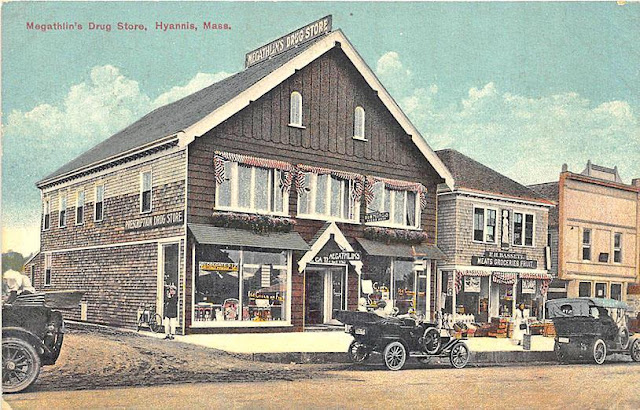
Charles Megathlin's Drug Store, Hyannis MA


    In the 21st century pharmacies, much like all of business, are dominated by a few big names. CVS, Walgreens, Rite-Aid, and more are located in nearly every nook and cranny of America. Even supermarkets like Publix and retailers like Walmart dabble in prescriptions. A century ago things were far different. The local pharmacy was a Mom and Pop operation. It was a friendly and familiar face. It was as much a hangout and general store as it was a place to pick up our scripts.

    On Cape Cod there have been many beloved local pharmacies during the 19th and 20th centuries. However one that stands up near the top of the mountain in Cape history is that of Megathlin’s Drug Store. Existing for decades on Hyannis’ Main Street it was the home of operations for Charles W. Megathlin, but it was hardly the only thing he was known for. This is a bit about the man and the business that bore his name.

    Charles W. Megathlin was born in Harwich, Massachusetts on April 2, 1872 to Anthony and Mary Megathlin. While attending Harwich High School Megathlin worked in the drug store of Dr. Benjamin Eldredge. It gave him a taste of what would be his future. After graduating from Harwich High School in 1891 and marrying Louise Munsell in October 1893 the young Megathlin set his sights on a career.

    An opportunity arose in the form of a drug store on Main Street in Hyannis. The 21-year old Megathlin bought the Hyannis Pharmacy from John P. Bowen. Bowen had run the business since 1890 before closing it in October 1893 to take a job in Boston as a traveling salesman.

    Megathlin immediately made improvements, including renaming it to Megathlin’s Drug Store. The grand opening soon thereafter. In order to keep close to his new venture Megathlin rented the former home of Captain Asa Bearse just down the street.

    Pharmacies at the time, much like today, sold far more than just medications. Basic toiletries like soaps and tooth powders, chocolates, and rare gifts and novelties were advertised in the local newspaper as being on sale at Megathlin’s. The business was an immediate success. Within two years it had outgrown its current location.

    Megathlin leased the building across the street in March 1894. This building had been the home of Louis Arenovski’s American Clothing House. Locals had doubts as to whether Megathlin could fill the large space with products. He did so with ease. The next several years saw Megathlin’s Drug Store dominate Hyannis business. It became the go-to for much of the everyday items that locals needed. In 1900 Charles purchased a building owned by William Lewis. This was converted into a new location for the drug store. It appeared as though nothing could slow the growth of Megathlin’s. However an event out of Charles’ control brought everything to a halt.

Postcard image of the Main Street fire. (Sturgis Library)


    On December 10, 1904 a major fire broke out around midnight, engulfing much of the business district of Main Street. The fire raged unchecked for hours. In the end several longtime establishments were damaged or destroyed. These included Megathlin’s Drug Store. In addition the Universalist church, Thomas Nickerson’s marble works, James Baxter’s shoe store, Eagleston’s store, the New England Telephone office, Walter Baker’s department store, and more were lost. Though the fire was said to have been accidental it left much of the east end of Main Street in ruins. Conservative estimates at the time had losses at more than $110,000($3.4 million in 2022)

    Charles Megathlin pulled up his boot straps and soldiered on though. Since the fire had been slow burning there had been ample time to remove much of the goods from the store. Megathlin got right to work on rebuilding his popular pharmacy. Within six weeks the new store was partly raised and boarded. In the meantime Megathlin took up temporary residence nearby and sold what dry good he had.

Megathlin's rebuilt store on Main Street(Sturgis Library)


    The new Megathlin’s opened April 20, 1905. He had taken the opportunity to make the new building bigger and better. The improvements included work rooms and laboratory rooms for medications. In addition people came from near and far to see the incredible marble countered soda fountain. The store continued its upward trajectory after the near-tragic fire. The store became an important distraction when Louis died in June 1906 at the young age of forty-one. A year later Charles married Mabel Lumbert.

    It got the point where the Hyannis store was seen on the same level as bigger city stores like those in Boston. More changes came in the summer of 1916. Megathlin added a new staircase to the second floor, mahogany wall cases, and a new drug counter with one hundred drawers. The wise businessman added a Japanese shop and Victrola department on the second floor of the revamped store.

    Decades of faithful service gave Megathlin’s the status as one of the largest local drug store operations in all of New England. It was during this time that Megathlin began to branch out in the grander scheme of the Cape Cod community. His knowledge of business, banking, pharmaceuticals, and more made him a popular local figure. Megathlin’s kind and genial nature only enhanced his stature.

    His new accolades included becoming the President of the New England Association of Rexall Druggists and the President of the Public Safety Committee of Hyannis both in 1917. In 1920 Megathlin added to this by becoming the President of the Cape Cod National Bank of Harwich which later became the Cape Cod Trust Company. His final, and perhaps greatest locally, achievement was becoming the first President of the Cape Cod Chamber of Commerce in February 1921. Megathlin only held that title until the organization’s next meeting which was the next month due to his other obligations.

    Despite having many new responsibilities Megathlin’s first love was his drug store. By the time he got into his mid-50’s though Megathlin was looking to slow down his life a bit with his second wife. In a major event the longtime owner sold Megathlin’s Drug Store to Louis Liggett also of drug store fame. Charles retained ownership of the building including an office he used on the second floor. Despite his name being removed from the business Charles Megathlin was still highly influential. His banking and real estate ventures led the entire building that housed Liggett’s and a few other businesses to be renamed the Megathlin Block later in 1926.

    In a sad irony, only a year after selling his beloved drug store to slow his life down some tragedy struck. Mabel Megathlin died in August 1927 at the age of fifty-seven. In 1928 Charles married for a third time. This was to Marguerite Baldwin. Charles and Marguerite became parents to Charles Jr. in August 1929. Megathlin was fifty-eight at the time and this was his only child.

The historical marker at Ocean St., denoting Megathlin's. (HMdb.org/Brandon D. Cross)


    Although he remained somewhat active locally Charles Megathlin for the most part faded from the public view. He spent the 1930’s and 1940’s enjoying being a husband and father. Charles did end up becoming President of the Cape Cod Chamber for a second time in March 1949. Entering his eighties Megathlin had carved out an extensive legacy on Cape Cod.

    The end came for Charles late on December 2, 1954. During a severe snowstorm Megathlin was driving alone through West Dennis when he lost control and struck a tree. He died instantly.

    Though the final act for Charles Megathlin was that of a tragic accident his life was a rousing success. Through tragic deaths, and the near-total loss of his business, Megathlin and his drug store transcended into iconic status. Even nearly a century after Charles sold his store to Louis Liggett the name Megathlin still echoes along Hyannis’ Main Street.

--------------------------------------------------------------------------

Previous Blog Posts:

Be sure to check out my website: Christopher Setterlund.com

Zazzle Store: Cape Cod Living


Sunday, November 28, 2021

In Their Footsteps: Cape Cod History - The Blue Tavern of Barnstable


    Barnstable Village is one of the most beautiful areas on Cape Cod. Where Route 6A passes through it there is the atmosphere of a quaint Main Street. So much of what attracts people to the Cape is located in barely a half-mile stretch of road. There are shops, restaurants, libraries, churches with beautiful gardens, the District Court, and even a fire department.

    The fire department in Barnstable Village came into existence after a pair of devastating fires in the mid-1930’s. The first fire was the catalyst to get people talking about creating a village fire department. It was a tragic event that could have very easily been prevented. Five fire departments came in time, the only thing they lacked was the water to put the fire out. The victim of this fire was the popular and luxurious Blue Tavern. This is the story of the brief tenure of this long forgotten Cape Cod establishment.

    The idea for a luxurious hotel in Barnstable Village came from the mind of Harold Daggett and on the land owned by his father. It was late in 1925 when the reports of a new hotel possibly being constructed in the village popped up. The land was directly across Route 6A from what is today the Barnstable House.

    Construction was slow going at the beginning. An early frost and cold frozen ground on Cape Cod caused Daggett to delay the rock blasting to break ground on the hotel’s cellar. After waiting until it was more favorable weather-wise work began in late December 1925.

    Located up on a hill the progress on the Blue Tavern was rushed during the winter and spring of 1926 in the hopes of getting it opened by the summer. There was a main entrance leading into the property from Route 6A and the winding driveway led around and exited out onto Old Jail Lane. Despite rushing the construction the fabulous Blue Tavern was ready for its grand opening on June 1, 1926.

    The specs of the new hotel included three floors and twenty-eight guest rooms. A huge chimney rose from the ground on either end of the building which was naturally adorned with blue trimmings. All of the guest rooms had private baths and telephones, many of these rooms were named after Cape Cod towns. There was a basement tea room, a fully equipped pump house, and a twelve car garage. Blue Tavern sat on twenty-one acres of land surrounded by evergreens. It gave it the feeling of being secluded even though it was only a few hundred feet from the road. The total cost of the project was estimated at $125,000 ($1.93 million in 2021).

The Blue Tavern (Sturgis Library)


    The first season of the Blue Tavern was considered a success highlighted by Henry Ford staying for several nights in the ‘Chatham’ room. Being a luxury hotel attracted higher class clientele yet this was a double-edged sword. It turned out that running a hotel with opulent amenities along with running the Blue Lantern Tea Room across the street was an expensive undertaking. The Blue Tavern was said to have been one of the costliest properties on Cape Cod as far as upkeep went.

    Harold Daggett had been under the belief that a Cape Cod land boom was on the horizon as he debuted the Blue Tavern. This, however, did not end up occurring. The repercussions were immediate as Daggett was forced into bankruptcy shortly after closing the hotel for the season. The end result was the hotel being sold in January 1927 to Elmer Clapp of Boston for the sum of $94,280 ($1.48 million in 2021).

    Clapp installed Ernest Sharpe of Swampscott, Massachusetts as General Manager due to his previous successes running several hotels in Florida. The Blue Tavern opened for its second season in March 1927. The ride was smooth for the new ownership only for about a year. Sharpe resigned from his post as GM in May 1928 to go and run the Yarmouth Tavern. Elmer Clapp appointed his son Charles as the new GM shortly thereafter.

An ad for the Blue Tavern from Yarmouth Register July 2, 1927


    For the next several years the Blue Tavern earned a reputation as one of the premier hotels on Cape Cod. In addition to being frequented by travelers from all parts of the country the hotel was also a perfect location for other events. Important meetings, wedding receptions, intimate dining affairs, and more were held on the property. After some stops and starts it appeared that nothing could keep Blue Tavern from creating a lasting legacy in Cape Cod history.

    Sadly that was not to be the case. On June 25, 1934 a fire of unknown origin broke out just after dawn. Within a short period of time five different neighboring fire departments arrived at the Blue Tavern. Hyannis Fire Department Chief J. Lester Howland later admitted that the fire itself was fairly routine and could have easily been taken care of. However that did not end up happening. The reason? There was a lack of water for the firemen to use.

    Although it had been a bone of contention for many years Barnstable Village did not have its own water supply to be used to fight fires. The village depended on using water from local creeks and in a case of bad timing the tide was out that morning as the Blue Tavern burned.

    The fire was first noticed by hotel employee Eleanor Scott shortly after 8am. Luckily there were only nine guests at the hotel at the time. They were all alerted and safely got out of the hotel. In fact the fire burned so slowly that all of the guests had ample time to pack their belongings before exiting. When all was said and done the only thing left standing of the Blue Tavern was a wing on the east side.

    Though some furniture was saved management said almost immediately that the building was unlikely to be rebuilt. Cementing the likely end a note of appreciation was written by owner Elmer Clapp thanking the fire department and police for all of their attempts to save the Blue Tavern. It was a devastating loss not only for travelers to Cape Cod but for the staff as well. The Great Depression was crippling the job market in America and things did not bode well for the former employees who lost their jobs as well as surrounding businesses that benefited from the tourism.

    Despite the fire spelling the likely end of the Blue Tavern the remains of the property still stood for several years. There were rumors of the property being converted into a jail farm but those never materialized. The final curtain came in December 1940 when the last pieces of the Blue Tavern hotel were knocked down and removed. The property stayed unoccupied until 1970 when a family home was built there.

The Barnstable Village fire department. (Google Maps)


    Although the Blue Tavern is a long forgotten blip on the radar in history there was an event that resulted from its demise that is still around today. Barnstable got its own official fire department on July 14, 1935. It was approved by voters including money for a fire engine and land donated by Alfred Crocker in memory of his father. Upon this land the fire station was constructed. Located in the center of Barnstable Village it still stands to this day. It might have been too late to save the Blue Tavern but the loss of the luxury hotel led to the creation of a fire department that without question has saved lives and property in the decades since. In that vein the Blue Tavern was a rousing success.

-----------------------------------------------------------------------

Previous Blog Posts:

Be sure to check out my website: Christopher Setterlund.com

Zazzle Store: Cape Cod Living