Although they still exist today the video arcade's heyday was the 1980's. The soundtrack of many an 80's child's life was the buzz of countless video games being played all at once. In the days before the home consoles like PlayStation and Xbox made arcades less appealing the best way to play your favorite game was to fill your pockets with quarters, get on your bike and ride to the nearest arcade.
What
we think of as an arcade in the last few decades is an offshoot of
what was originally called a 'penny arcade.'
These were actually the evolution of what was called an amusement
parlor. These first came about in the 1880's and 1890's and were
quite popular. They featured photos, and later motion pictures, some
appropriate for all ages, and some risque ones. However as with most
things the novelty wore off and by the turn of the 20th century they
were revamped as penny arcades.
 |
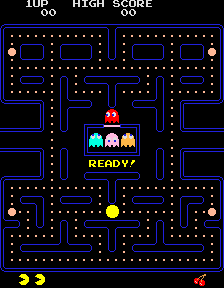
The Pac-Man arcade game. (Peter Handke/Wikimedia)
|
A
typical penny arcade had non-electric pinball machines, fortune
teller machines, love testers, strength machines, slot machines, and
coin-operated Amberolas which were very old school phonographs. The
term itself came into the American lexicon around 1905 and centered
around the cost to operate any of the machines.
What
Gen-X kids think of as arcades had their start in the early-1970's.
In the
summer of 1971
Nutting Industries, based out of Milwaukee, Wisconsin, created the
first commercially sold coin-operated video game. Designed by Nolan
Bushnell and Ted Dabney the game called Computer
Space
pitted a player-controlled rocket ship against two
computer-controlled flying saucers. For old school gamers it was
essentially Asteroids without the titular asteroids. Initially 1,500
of the games were assembled
and it became a success on college campuses. However it was not a
hit anywhere else and the sales slowed with less than 1,000 being
sold and no further units being built. Though not a resounding
success it did allow Bushnell and Dabney to start their own video
game company the following year: Atari. The arcade as a concept
though was about to get going when Pong
was invented in 1972 and eventually sold 19,000 units.
 |
A vintage Computer Space game. (Carlo Nardone/Wikimedia)
|
The
1970's saw classic video games like Space Invaders, Asteroids,
Galaxian, Tank, and others lay the groundwork for the new arcade
phenomenon. In the mid to late-1970's bans on pinball machines were
lifted (yes they were banned in some states in the 1940's being seen
as units of gambling) and the original arcade amusement game was back
in action. As the 70's turned into the 80's arcades became the place
to hangout on weekends and after school, as long as you had enough
quarters though.
1982
was the peak year for the video arcade in America with around 13,000
locations. Icons like Pac-Man, Ms. Pac-Man, Donkey Kong, Frogger,
Centipede, and Mario Bros burst onto the scene in the early-1980's.
Some of the most popular machines in arcades could pull in $400
($1,078 in 2020) in quarters a week at the time. At this point the
stand-up video game consoles began appearing elsewhere like grocery
stores, restaurants, and shopping malls.
Above
all others Pac-Man became the giant of arcade games. Developed by
Japanese company Namco in 1980 it was a nonviolent alternative to
most games of the day which made it appealing to women. Namco sold
400,000 units of Pac-Man to arcades around the globe making the
company $3.5 billion in sales by 1990. In the peak year of 1982
estimates had Americans spending $8 million ($21.5 million in 2020) a
week playing Pac-Man in arcades. The game spawned tons of
merchandise, a cartoon show, a Ms. Pac-Man game, and even a parody
song 'Pac-Man Fever' in 1982 by Jerry Buckner and Gary Garcia that
reached #9 on the Billboard Top 100 Chart.
 |
Some of the classic 1980's arcade game logos. (Video Amusement.com)
|
For
as high as the highs were in the early-to-mid-1980's the video game
arcade began to decline as the decade moved along. The release of
the Nintendo Entertainment System in 1985 kept some kids at home to
play a lot of the popular arcade games. The other main cause of the
decline of the arcade ended up being its own success. Many arcade
owners were making lots of money and thought more machines meant more
money. They were ordering more games than their clientele could
support. This was coupled with the underlying fear of arcades and
video games in genera being a bad influence on the youth of America.
That feeling had been there festering just below the surface for
decades and had been a part of the aforementioned pinball machine
ban.
The
final factor was the Video Game Crash of 1983. This was essentially
an over-saturation of the market, specifically by Atari, and an
influx of low quality games like the infamous E.T. debacle. It led
to a recession in the video game market that did not end until
Nintendo released the NES in late-1985. The video game industry as a
whole saw its revenue drop from over $12 billion at the peak to $100
million in 1985.
A
renaissance occurred in 1991 with the release of Street Fighter II.
Selling more than 60,000 machines it was seen as a game that needed
to be played in an arcade rather than home console. Mortal Kombat
came in 1992 and the arcades drew new customers to their locations.
These games though came with the stigma of being too violent and did
not make a total resurgence of the industry possible. Plus the
advent of higher quality consoles like PlayStation, Xbox, and
Nintendo 64 in the mid-1990's made staying home to play preferable.
Today
video arcades do still exist. Most of these though are as a part of
a larger entertainment complex like Dave and Buster's, Ryan Family
Amusement, Chuck E Cheese, and others. Stand alone arcades are
harder to find. In 2017 it was listed by Arcade Heroes.com that
there were 2,500 such arcades in America, though it is unknown what
the 2020 number is.
 |
A typical Dave and Buster's arcade. (Dustin M. Ramsey/Wikimedia)
|
The
increase in online gaming and high quality home consoles likely means
that a huge upswing in arcades won't happen anytime soon. However
the stand-up machines have become something of a collector's item and
people have taken to buying their favorite game and having it in
their own home. It likely brings back fond childhood memories
without the worry of running out of quarters.
Helpful Links:
---------------------------------------------------------------------
Coming November 5, 2020 the debut episode of the In My Footsteps Podcast wherever you get your podcasts!
View my previous blog posts: