In
life, most people have to deal with some sort of adversity. Only a
rare few have a path uninterrupted by tough times. Now imagine being
dealt several unimaginable tragedies. How would you react? Most would
not be blamed for throwing their hands in the air and giving up.
Young
Helen Keller was robbed of her sight and hearing as a young child.
Though incredibly difficult to comprehend to those with all five
senses Helen not only navigated those rough waters but thrived in
life. Helen Keller became a living miracle and an icon of
perseverance.
The
journey from not being able to see or hear the world to writing
twelve books was long and arduous. Some of that journey took place on
Cape Cod in the town of Brewster. This is the story of Helen Keller
and her time spent on the sandy peninsula.
Helen
Keller was born on June 27, 1880, in Tuscumbia, Alabama. She was born
a typical healthy baby. In the months leading up to her second
birthday, Helen was struck with an illness. It is uncertain if it was
scarlet fever, meningitis, or something else, but the results were
catastrophic. Barely a toddler Helen was rendered both blind and
deaf.
Early
childhood was tough for Helen. She had no formal education and was
prone to fits of anger due to not being able to communicate. Without
sight or hearing she also did not speak. Therefore Helen developed
home signs to convey her needs and wants. It was clear to her family that
Helen was extremely intelligent and simply needed a teacher to be
able to help her reach her potential.
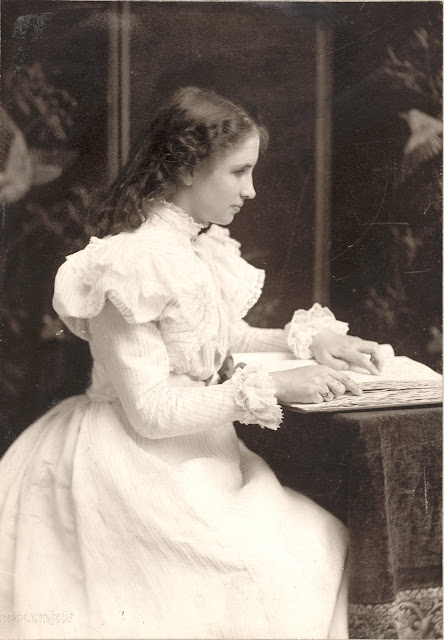 |
| Helen Keller reading as a teenager.(Boston Public Library) |
Helen’s
mother Katherine searched for help from experts including famed
telephone inventor Alexander Graham Bell. Ultimately Katherine was
referred to a teacher named Anne Sullivan. She ended up being the
most important person Helen Keller would ever meet.
On
March 3, 1887, Sullivan first met Helen at her home in Alabama. It
seemed to be a match made in heaven. Sullivan was a graduate of
Perkins School for the Blind in Watertown, Massachusetts. She was
also nearly blind herself. This gave Sullivan a great deal of empathy
toward what Helen was coping with. However, their relationship started
rocky.
During
the first few weeks of their relationship, Helen kicked, bit, and
pinched Sullivan, even knocking one of the teacher’s teeth out. She
could have easily given up on Helen but she didn’t. Through
patience and consistency, Anne Sullivan began to earn Helen’s trust.
Sullivan
taught Helen the alphabet by drawing letters on Helen’s palm. This
included giving Helen a doll and spelling d-o-l-l into her hand.
Within a few weeks, she had begun to understand. The key turning point
was when Sullivan spelled w-a-t-e-r while also pumping water over
Helen’s hand. From there on it was off to the races. Helen wanted
to learn as many words as possible.
A
year was spent working at Helen’s home in Alabama. In May 1888
Sullivan brought Helen to Perkins School for the Blind. This was
where Keller learned to read braille and also type with a specially-made typewriter. Helen learned 1,500 words within a year thanks to
the help of Anne Sullivan and the Perkins School. Her miraculous
achievements began to be chronicled in newspapers nationwide.
It
was in 1888 while studying at Perkins that Helen Keller’s
connection to Cape Cod came to be. During her own studies at the
Perkins School, Anne Sullivan met Brewster, Massachusetts resident
Sophia Crocker-Hopkins. Hopkins had gotten a job as a house mother at
Perkins after the tragic death of her daughter Florence in 1883. A
sea captain’s widow, Sophia brought Sullivan home with her to
Brewster during the school’s summer break to stay at her home
located at 1491 Main Street. Sullivan fell in love with the Cape and
wanted to share its majesty with young Helen.
In
July of 1888, Sullivan brought eight-year-old Helen down to Cape Cod
for the first time. The pair stayed with Sophia at her boarding house
in Brewster. It was during this initial visit that Helen first
ventured to the sea. She took a series of sandy paths along with Anne
to the area of present-day Breakwater Beach.
 |
| Breakwater Beach in Brewster, the area Helen visited in 1888. |
In
her first autobiography, The Story of My Life, written in 1903, Helen
wrote that her first encounter with the ocean was a mixed bag. She
was enraptured by the smell of the salty air and fascinated by the
sheer enormity of the ocean. Helen admitted that she could sense how
big it was.
The
eight-year-old jumped into the water full of exuberance. It was then
that her foot struck a rock and plunged her underwater. Though she
was never in danger the experience did make her timid around the
mighty ocean. Fortunately by the end of her time on Cape Cod that
summer Helen was firmly in love with the ocean again. She even wrote
in her autobiography a story of Anne bringing her a horseshoe crab
and her amazement at it.
It
was during this first visit to Cape Cod that a famous photo was
taken. A local photographer named Cornelius Chenery snapped a
brilliant photo of young Helen sitting in a chair and cradling a doll
that had been given to her by Sophia Crocker-Hopkins. Kneeling beside
the child is Anne Sullivan looking on with what can only be described
as pride. Throughout their time together Anne would take up that role
of beaming with pride at Helen’s achievements from the background.
 |
| The famed photo of young Helen and Anne Sullivan taken in Brewster in July 1888.(Wikipedia) |
The
first trip to Cape Cod was such a joy that Sullivan brought Helen
back in May 1890 for a week's stay. Again they stayed with Sophia on
Main Street in Brewster. The local newspapers heaped praise on Keller
upon her return. At that point, they remarked that her vocabulary was
north of 3,000 words. She also could recognize people she knew by
their scent or even the clothes they wore. The most spectacular news
relayed in the article was Helen learning to speak herself.
The
incredible achievement was learned first by Helen placing her hands
on Anne’s throat and lips. Sullivan would speak and Helen would try
to mimic the words. Not only did she speak but she did an interview.
It was here that Helen spoke to a stranger for the first time in her
life. In time Helen would also be able to ‘hear’ music as well.
The
next time Helen Keller visited Cape Cod was in July 1894. She and
Anne Sullivan stayed with Sophia for much of the summer. However, by
this point, fourteen-year-old Helen was somewhat of a national
celebrity due to her incredible achievements despite tremendous
adversity.
This
could not have been made more evident than when a reception was held
in her honor. It was no ordinary reception. This was a party thrown
by First Lady Frances Cleveland, wife of the-President Grover
Cleveland, at their summer White House known as Gray Gables located
in Bourne. Over her lifetime Helen Keller went on to meet every
United States president from Cleveland to John F. Kennedy.
Anne
and Helen continued to visit Sophia in Brewster including in 1896 and
1897. In August 1903 Helen brought her mother Katherine with her to
visit Sophia in Brewster. This was due to the fact that in 1901 Anne
Sullivan suffered a major stroke that left her completely blind
and she was recovering.
1904
saw Helen graduate from Radcliffe College in Cambridge,
Massachusetts. Her friend Mark Twain had introduced Helen to Standard
Oil magnate Henry H. Rogers. He along with his wife Abbie had paid
for Helen’s education. She was the first deaf-blind person to earn
a Bachelor of Arts degree.
In
the fall of 1904 Helen and Anne purchased a house in Wrentham,
Massachusetts. Located only an hour or so from Brewster meant that
Sophia could visit her friends there during the winter. Not long
after buying the house, Anne Sullivan married John A. Macy. He was a
Harvard instructor and literary critic who had helped Helen in
getting her works published.
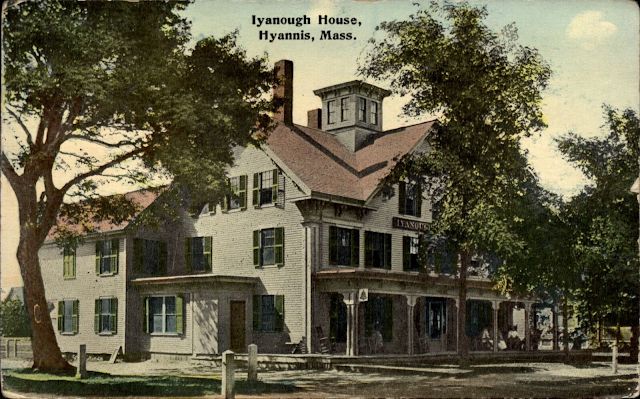 |
| The Iyanough House in Hyannis the site of Helen's last Cape visit in 1908. |
Macy
moved in with Anne and Helen in Wrentham. He even joined them in
staying at the then-new Iyanough House hotel on Main Street in
Hyannis in September 1908. However, the marriage soon began to fall
apart. That said, the couple would never officially divorce.
Anne
Sullivan’s health began to trend downward. Helen Keller’s
celebrity and drive for social causes including disability rights and
women’s suffrage only grew. This meant that visits to Cape Cod
ended after the final trip in 1908. Helen remained in the spotlight
on the Cape, just in the form of numerous newspaper articles about
her amazing achievements.
 |
| Helen Keller's autobiography written in 1903. |
Sadly
Anne passed away on October 15, 1936, at the age of 70. She and Helen
had been inseparable for fifty years and Helen was there with her at
the end. By the time of her own death on June 1, 1968, at the age of
87 Helen Keller was a legend.
Helen
Keller became a 20th-century icon with twelve books
published and numerous articles. She championed social causes, was
awarded the Presidential Medal of Freedom, and was elected to the National Women’s Hall of Fame. All of this was done without the
ability to see or hear the world around her. Helen Keller’s
courage, intelligence, and unyielding determination, are the types of
things that seem impossible.
Over
a period of 20 years, Helen made frequent visits to Cape Cod. She
walked to the ocean and smelled the salty air. She soaked up the
summer sun, touched the grass, and smelled the flowers. Cape Cod
became a beloved part of her life much like it has for many who have
lived and visited there.
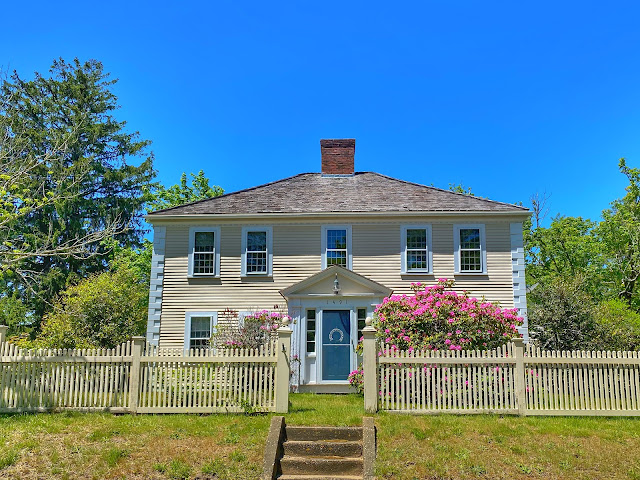 |
| 1491 Main Street in Brewster where Helen stayed numerous times. |
The
house Helen Keller stayed in numerous times over the years with Anne
Sullivan still stands at 1491 Main Street in Brewster. Several
artifacts from Helen’s time on Cape Cod can be viewed at the
Brewster Historical Society in the Captain Elijah Cobb House at 739
Lower Road in Brewster.
----------------------------------------------------------
Purchase a DVD copy of the Lady of the Dunes documentary here:
Purchase the new book Searching for the Lady of the Dunes written by 12th Generation Cape Codder Christopher Setterlund.
Sources:


