Pages

Showing posts with label cleveland. Show all posts

Saturday, May 27, 2023

In Their Footsteps: Helen Keller and Cape Cod


    In life, most people have to deal with some sort of adversity. Only a rare few have a path uninterrupted by tough times. Now imagine being dealt several unimaginable tragedies. How would you react? Most would not be blamed for throwing their hands in the air and giving up.

    Young Helen Keller was robbed of her sight and hearing as a young child. Though incredibly difficult to comprehend to those with all five senses Helen not only navigated those rough waters but thrived in life. Helen Keller became a living miracle and an icon of perseverance.

    The journey from not being able to see or hear the world to writing twelve books was long and arduous. Some of that journey took place on Cape Cod in the town of Brewster. This is the story of Helen Keller and her time spent on the sandy peninsula.

    Helen Keller was born on June 27, 1880, in Tuscumbia, Alabama. She was born a typical healthy baby. In the months leading up to her second birthday, Helen was struck with an illness. It is uncertain if it was scarlet fever, meningitis, or something else, but the results were catastrophic. Barely a toddler Helen was rendered both blind and deaf.

    Early childhood was tough for Helen. She had no formal education and was prone to fits of anger due to not being able to communicate. Without sight or hearing she also did not speak. Therefore Helen developed home signs to convey her needs and wants. It was clear to her family that Helen was extremely intelligent and simply needed a teacher to be able to help her reach her potential.

Helen Keller reading as a teenager.(Boston Public Library)


    Helen’s mother Katherine searched for help from experts including famed telephone inventor Alexander Graham Bell. Ultimately Katherine was referred to a teacher named Anne Sullivan. She ended up being the most important person Helen Keller would ever meet.

    On March 3, 1887, Sullivan first met Helen at her home in Alabama. It seemed to be a match made in heaven. Sullivan was a graduate of Perkins School for the Blind in Watertown, Massachusetts. She was also nearly blind herself. This gave Sullivan a great deal of empathy toward what Helen was coping with. However, their relationship started rocky.

    During the first few weeks of their relationship, Helen kicked, bit, and pinched Sullivan, even knocking one of the teacher’s teeth out. She could have easily given up on Helen but she didn’t. Through patience and consistency, Anne Sullivan began to earn Helen’s trust.

    Sullivan taught Helen the alphabet by drawing letters on Helen’s palm. This included giving Helen a doll and spelling d-o-l-l into her hand. Within a few weeks, she had begun to understand. The key turning point was when Sullivan spelled w-a-t-e-r while also pumping water over Helen’s hand. From there on it was off to the races. Helen wanted to learn as many words as possible.

    A year was spent working at Helen’s home in Alabama. In May 1888 Sullivan brought Helen to Perkins School for the Blind. This was where Keller learned to read braille and also type with a specially-made typewriter. Helen learned 1,500 words within a year thanks to the help of Anne Sullivan and the Perkins School. Her miraculous achievements began to be chronicled in newspapers nationwide.

    It was in 1888 while studying at Perkins that Helen Keller’s connection to Cape Cod came to be. During her own studies at the Perkins School, Anne Sullivan met Brewster, Massachusetts resident Sophia Crocker-Hopkins. Hopkins had gotten a job as a house mother at Perkins after the tragic death of her daughter Florence in 1883. A sea captain’s widow, Sophia brought Sullivan home with her to Brewster during the school’s summer break to stay at her home located at 1491 Main Street. Sullivan fell in love with the Cape and wanted to share its majesty with young Helen.

    In July of 1888, Sullivan brought eight-year-old Helen down to Cape Cod for the first time. The pair stayed with Sophia at her boarding house in Brewster. It was during this initial visit that Helen first ventured to the sea. She took a series of sandy paths along with Anne to the area of present-day Breakwater Beach.

Breakwater Beach in Brewster, the area Helen visited in 1888.


    In her first autobiography, The Story of My Life, written in 1903, Helen wrote that her first encounter with the ocean was a mixed bag. She was enraptured by the smell of the salty air and fascinated by the sheer enormity of the ocean. Helen admitted that she could sense how big it was.

    The eight-year-old jumped into the water full of exuberance. It was then that her foot struck a rock and plunged her underwater. Though she was never in danger the experience did make her timid around the mighty ocean. Fortunately by the end of her time on Cape Cod that summer Helen was firmly in love with the ocean again. She even wrote in her autobiography a story of Anne bringing her a horseshoe crab and her amazement at it.

    It was during this first visit to Cape Cod that a famous photo was taken. A local photographer named Cornelius Chenery snapped a brilliant photo of young Helen sitting in a chair and cradling a doll that had been given to her by Sophia Crocker-Hopkins. Kneeling beside the child is Anne Sullivan looking on with what can only be described as pride. Throughout their time together Anne would take up that role of beaming with pride at Helen’s achievements from the background.

The famed photo of young Helen and Anne Sullivan taken in Brewster in July 1888.(Wikipedia)


    The first trip to Cape Cod was such a joy that Sullivan brought Helen back in May 1890 for a week's stay. Again they stayed with Sophia on Main Street in Brewster. The local newspapers heaped praise on Keller upon her return. At that point, they remarked that her vocabulary was north of 3,000 words. She also could recognize people she knew by their scent or even the clothes they wore. The most spectacular news relayed in the article was Helen learning to speak herself.

    The incredible achievement was learned first by Helen placing her hands on Anne’s throat and lips. Sullivan would speak and Helen would try to mimic the words. Not only did she speak but she did an interview. It was here that Helen spoke to a stranger for the first time in her life. In time Helen would also be able to ‘hear’ music as well.

    The next time Helen Keller visited Cape Cod was in July 1894. She and Anne Sullivan stayed with Sophia for much of the summer. However, by this point, fourteen-year-old Helen was somewhat of a national celebrity due to her incredible achievements despite tremendous adversity.

    This could not have been made more evident than when a reception was held in her honor. It was no ordinary reception. This was a party thrown by First Lady Frances Cleveland, wife of the-President Grover Cleveland, at their summer White House known as Gray Gables located in Bourne. Over her lifetime Helen Keller went on to meet every United States president from Cleveland to John F. Kennedy.

    Anne and Helen continued to visit Sophia in Brewster including in 1896 and 1897. In August 1903 Helen brought her mother Katherine with her to visit Sophia in Brewster. This was due to the fact that in 1901 Anne Sullivan suffered a major stroke that left her completely blind and she was recovering.

    1904 saw Helen graduate from Radcliffe College in Cambridge, Massachusetts. Her friend Mark Twain had introduced Helen to Standard Oil magnate Henry H. Rogers. He along with his wife Abbie had paid for Helen’s education. She was the first deaf-blind person to earn a Bachelor of Arts degree.

    In the fall of 1904 Helen and Anne purchased a house in Wrentham, Massachusetts. Located only an hour or so from Brewster meant that Sophia could visit her friends there during the winter. Not long after buying the house, Anne Sullivan married John A. Macy. He was a Harvard instructor and literary critic who had helped Helen in getting her works published.

The Iyanough House in Hyannis the site of Helen's last Cape visit in 1908.
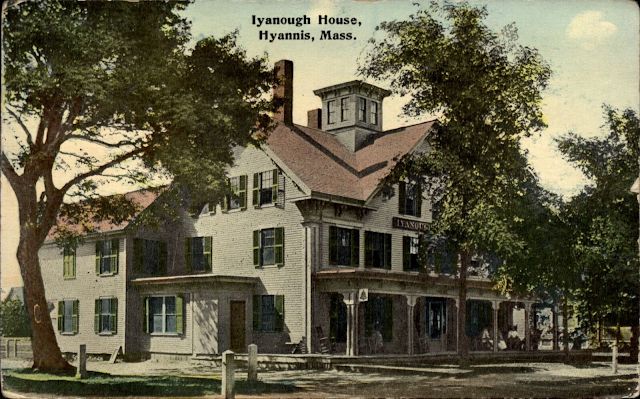

    Macy moved in with Anne and Helen in Wrentham. He even joined them in staying at the then-new Iyanough House hotel on Main Street in Hyannis in September 1908. However, the marriage soon began to fall apart. That said, the couple would never officially divorce.

    Anne Sullivan’s health began to trend downward. Helen Keller’s celebrity and drive for social causes including disability rights and women’s suffrage only grew. This meant that visits to Cape Cod ended after the final trip in 1908. Helen remained in the spotlight on the Cape, just in the form of numerous newspaper articles about her amazing achievements.

Helen Keller's autobiography written in 1903.


    Sadly Anne passed away on October 15, 1936, at the age of 70. She and Helen had been inseparable for fifty years and Helen was there with her at the end. By the time of her own death on June 1, 1968, at the age of 87 Helen Keller was a legend.

    Helen Keller became a 20th-century icon with twelve books published and numerous articles. She championed social causes, was awarded the Presidential Medal of Freedom, and was elected to the National Women’s Hall of Fame. All of this was done without the ability to see or hear the world around her. Helen Keller’s courage, intelligence, and unyielding determination, are the types of things that seem impossible.

    Over a period of 20 years, Helen made frequent visits to Cape Cod. She walked to the ocean and smelled the salty air. She soaked up the summer sun, touched the grass, and smelled the flowers. Cape Cod became a beloved part of her life much like it has for many who have lived and visited there.

1491 Main Street in Brewster where Helen stayed numerous times.


    The house Helen Keller stayed in numerous times over the years with Anne Sullivan still stands at 1491 Main Street in Brewster. Several artifacts from Helen’s time on Cape Cod can be viewed at the Brewster Historical Society in the Captain Elijah Cobb House at 739 Lower Road in Brewster.

----------------------------------------------------------

Purchase a DVD copy of the Lady of the Dunes documentary here:

Purchase the new book Searching for the Lady of the Dunes written by 12th Generation Cape Codder Christopher Setterlund.


Sources:


Tuesday, February 2, 2010

In My Footsteps: Trip 16: Cape Cod's West Coast


In My Footsteps
Christopher Setterlund

Trip 16: Cape Cod’s West Coast
January 31, 2010

            Cape Cod’s east coast has the National Seashore.  The northern coast has Sandy Neck Beach.  The southern coast has got Craigville and West Dennis Beach.  These places are all well known popular destinations, but there is another coastline that can at times be overlooked.  The west coast of Cape Cod, stretching from Woods Hole up to the Cape Cod Canal, is filled with quaint little villages and sandy beaches.  The easiest way to make the trip along the west coast of the Cape is via Route 28-A which parallels the much busier Route 28.  Rt. 28 in this area doubles as another leg of the highway so a drive along the more rural 28-A is recommended for sightseers. 
            My trip began where my very first trip ended: Woods Hole.  Whether taking Rt. 28 west or south it is suggested that you take the turn onto Rt. 28-A at its southern most point and travel north until you reach the Canal.  The first of the small villages that you pass through is Sippewissett.  The sights in this village just to the north of Woods Hole include two spectacular marshes, The Little and Great Sippewissett Marshes, and the Sippewissett Campgrounds & Cabins.  The campground is located on Palmer Ave. and is opened to families from May through September but they do not allow dogs.

After passing through the Sippewissett area you find the first of the west coast beaches; it is a small spot just before the West Falmouth Historic District.  Chapaquoit Beach(above) located on the road of the same name is tucked away from the main roads and is small.  There is a good view of the Cleveland Ledge Light Station.  The last lighthouse built in New England, the Cleveland Ledge Light was named for former President Grover Cleveland who fished the waters of Buzzards Bay.  The lighthouse sits two miles off shore on a fifty-two foot tall concrete pillar and is maintained by the Coast Guard.  It is best viewed from shore and can not be climbed.
            Not far from Chapaquoit Beach sits Old Silver Beach, probably the best known spot on the west coast of the Cape.  Located on Quaker Rd. in North Falmouth, Old Silver Beach is well known to locals who fill the parking lot daily during the summer.  The salt marsh empties into the bay(right) and there are amazing views of the marsh on the right and Buzzards Bay on the left as well as the Cleveland Ledge Light off in the distance.  A five minute drive north of Old Silver Beach leads you to a beautifully secluded harbor in the tiny village of Megansett.  It has a great view of the private Scraggy Neck Island and a small beach with calm water.
            The west coast of Cape Cod is not all about beaches though.  Located near Red Brook Harbor in another tiny village named Cataumet is one of a few parcels and land set aside for conservation.  This particular set of trails leads you either west toward a great location overlooking Red Brook Harbor, or east as I went.  This route leads you to the railroad tracks and the Cataumet Train Station.  The original building was opened in 1890, but burned in 1925 and was subsequently replaced by the structure standing today.  It is a fascinating piece of history, giving you the feel of old railway life.  There is even a rusty metal pole near the station presumably used to hang mail during the old days of the Railway Mail Service which lasted through the 1960’s.
            Less than fifteen minutes away from Red Brook Harbor sits the historic Wings Neck Lighthouse(right).  Positioned literally inches from the water on Wings Neck Island in Pocasset, the lighthouse is now part of a private home available for vacation rentals.  The current lighthouse was built in 1889 and was very important during the time before and right after the construction of the Cape Cod Canal as it sits at the tip of Wings Neck which sticks a mile and a half out into Buzzards Bay.  It is a private residence and can not be seen up close unless you are a resident, but it can be seen quite well from the gated opening on the edge of the property.
            A short drive further north in Pocasset takes you to the Little Bay conservation area.  This spot, crossed by the railroad tracks, offers a great view of Tobey Island which is a small land mass located just north in Monument Beach.  The Little Bay trails bring you out onto one of two small peninsulas that stretch out into Wings Cove.  These trails also include Monks Park just to the south as well.  Monument Beach is the next tiny village along the west coast and includes the wooden bridge road that leads onto Tobey Island.  This is another private area but the harbor at Monument Beach has a great view of both Tobey Island and Mashnee Island.  Heading up Shore Road in Monument Beach takes you into the center of the village where there is the former train station of the village(above).  It is now closed and up for rent but still houses the same old-time railway charm with the overhangs along the tracks.
            Just before reaching the railroad bridge at the Canal there is one last very worthwhile detour to take.  It is Mashnee Island, located nearly a mile out into Buzzards Bay along Mashnee Rd.  There is a breathtaking view of Mass Maritime, the railroad bridge, and the Bourne Bridge all along the horizon.  The best place to view this is at the very popular Mashnee Island Grill & Beach Bar.  From this point you can see a lot of the area just traveled; it is a fitting end to a beautiful drive.  These tiny villages are not the only spots to hit up along Cape Cod’s west coast.  There are plenty more, you just have to take you time and look for them.  Have fun, and happy traveling!
Directions: Route 28-A: From Rt. 28 head west into Falmouth.  Turn left onto Rt. 28-A which is located 1.5 miles north of Falmouth Hospital.
Old Silver Beach: From Rt. 28-A head north 1.5 miles, turn left onto Old Dock Rd., quick right onto Nashawena St.  Continue onto Quaker Rd., follow it to beach on left.
Red Brook Trails: From Rt. 28-A head north 6 miles, turn left onto County Rd.  Take the 3rd left onto Scraggy Neck Rd., turn right at Red Brook Harbor Rd.  The trails are about 600 feet up on the right, the parking area is dirt.
Little Bay Conservation Area: From Rt. 28-A follow into Pocasset.  Turn left onto Long Hill Rd., take 2nd right onto County Rd., turn left at Valley Bars Rd. which becomes Valley Bars Circle.  Follow to parking lot, there is a railroad overpass.
Mashnee Island: From Rt. 28-A get onto Rt. 28 north at rotary.  Follow to Bourne Rotary and take Trowbridge Rd. exit.  Continue onto Shore Rd. and then onto Monument Neck Rd.  Turn right at Presidents Rd., take 1st left to stay on this road.  Turn left at Mashnee Rd. and follow it out to island.  
References:  Wings Neck Lighthouse
            Sippewissett Campground & Cabins
            Cleveland Ledge Light Station
           

Thursday, January 21, 2010

In My Footsteps: Trip 6: Cape Cod Canal - Cape Side

In My Footsteps
Christopher Setterlund

Trip 6: Cape Cod Canal – Cape Side
January 20, 2010


With so many destinations on the map when it comes to visiting Cape Cod, there are some very obvious ones that tend to get overlooked. One such place is seen by every single person who ever visits the Cape: the Cape Cod Canal. Stretching just over seventeen miles in length from Cape Cod Bay to Buzzards Bay and crossed by three bridges the Canal is a man made miracle that gets lost sometimes in the allure of the many beautiful beaches and shops of the Cape. This article is going to be all about the Canal and what there is to see along its shores. Being far too long it will be divided into an on Cape article and an off Cape article.

I began at the mouth of the Canal on the east side which empties into Cape Cod Bay. After a short walk across a very rocky beach I was lucky enough to arrive at the edge of the Canal just in time to watch a large ship from the Great Lakes area pass through and head out into the bay(left). At a maximum width of 540-feet the Canal sees over 20,000 ships pass through its waters annually.

Located a few hundred yards from the bay end of the Canal is a Power Plant owned and run by the Atlanta-based energy company, Mirant. A trail way leads from the mouth of the Canal back toward one of the visitor’s centers. Directly across from the visitor’s center is the Coast Guard station as they, along with many fishermen, operate out of the small harbor at the Sandwich Marina.
Route 6A is the best way to follow the Canal. There is a service road for authorized vehicles and bike trails running along either side of the waterway but most of the sights along the Canal can be driven to without a problem. Traveling along 6A, the first major sight is that of the Sagamore Bridge. Opened in 1935 and spanning 1,408 feet across the Canal, this bridge is the way to get onto the Cape from Boston and points north as it continues seamlessly from Route 3 to Route 6. The ‘Sagamore Flyover’ project, completed in 2006 replaced a rotary that caused traffic to become severely congested with an easier to navigate system of roads. 


Route 6A becomes Sandwich Road during its run along the Canal. Just before the Bourne Bridge rotary comes into sight Sandwich Road bears right. Follow this road and you will find yourself stepping into a hidden piece of Cape Cod, and United States history. Sandwich Road travels along a more secluded section of the Canal, passing directly under the Bourne Bridge(right). Unlike with the Sagamore Bridge there is a designated recreation area next to the bridge allowing visitors to park. People can get out and walk along the Canal while listening to the rush of highway traffic passing overhead. It is a soothing sort of hum. There are active railroad tracks which also pass along the Canal and they should be watched in case of trains. The bike path can be used to walk on and on warmer days it is highly recommended and highly populated by bicyclists, runners, and skaters.
Sandwich Road continues and it is along here that the visit to the Canal takes on a more historic twist. After passing by the Jonathan Bourne Library a right hand turn down Perry Avenue will lead you to the Aptucxet Trading Post museum. Built in 1627 it was the first trading post used by the fledgling Plymouth Colony. The building that stands is a replica of the original, but the museum houses excavated pieces of the nearly 400-year old building inside. Not to be missed as well sitting less than a hundred feet from the Aptucxet Trading Post museum is the Gray Gables railroad station. It was created for President Grover Cleveland whose summer home in Bourne was named Gray Gables. The building was moved to the Aptucxet grounds in 1976.

Aptucxet Road leads to Shore Road via a surprisingly beautifully painted overpass. Turn right and follow Shore Road to Bell Road and the third and final bridge along the Canal. The railroad bridge, built in 1935 and crossing the Canal near Buzzards Bay, was the largest vertical lift bridge in history when it was originally built. It is still right up there today. When raised it has a clearance of 135-feet. Near the Buzzards Bay end of the Canal sits a small cove where on this day hundreds upon hundreds of ducks and other water fowl congregated. No trains passed during my stop here but watching the railroad bridge(below) move is a spectacular sight to see.

Not to be lost in all of the sights and activities along the Cape side of the Canal is the fact that the entire waterway was man made. It is amazing to think of how technology was different when the project began nearly one hundred years ago. That information makes the whole scope of the trip even more remarkable. Stay tuned for the second part of this article focusing on the off-Cape side of the Canal. Have fun and happy traveling!

Directions: Cape Cod Bay end of the Canal: On Cape, take Rt. 6A into Sandwich, take a right onto Tupper Rd. to Town Neck Rd. Off Cape, take Exit 1C after crossing Sagamore Bridge, turn right onto Sandwich Road. Follow it just over a mile and take a left onto Tupper Rd.
Bourne Recreation Area: Follow Sandwich Rd. west along Canal. Bear right before Bourne rotary. Recreation area is right turn at foot of bridge.

Aptucxet Trading Post & Gray Gables: Follow Sandwich Rd. west along Canal, bear right before Bourne rotary, follow Sandwich Rd. into Bourne. Turn right onto Perry Ave., a quick left onto Aptucxet Road. The grounds are designated by a windmill and sign.
Railroad Bridge: Follow Sandwich Rd., turn right onto Shore Rd. Right turn onto Bell Rd. less than 1 mile away. Follow it to the Canal.

                     Cape Cod Canal Chamber of Commerce