Vampires. The undead ghouls
that prey upon the blood of the living for their own sustenance. The
terrifying monsters have been a part of mythical folklore for
centuries. They have been the subject of countless books and films
beginning with Bram Stoker's legendary Dracula which was published in
1897. Despite it being highly unlikely that such evil entities truly
exist the subject of vampires in fiction is actually based in
reality. In fact there was a period of several decades in the 19th
century when the state of Rhode Island was considered the Vampire
Capital of America. Occurring roughly between 1870-1900 the most
famous case during this time was that of Mercy Lena Brown. This is
her story among the vampire panic that gripped New England.
 |
The original 1897 cover of Dracula. (British Library Board/Wikimedia)
|
The story begins with a
seemingly normal family headed up by farmer George Brown and his wife
Mary. The couple lived in the tiny town of Exeter, Rhode Island,
southwest of Providence, along with their daughters Mary Olive,
Hattie May, Mercy Lena, Myra, and their son Edwin. Exeter was a
farming town dwindling in population in the years after the Civil War
from 2,500 in 1820 to only 961 in 1892. Such a small community meant
that most people knew each other making the terrible events that
befell the Brown family more impactful.
The first tragedy to strike
George Brown and his family came in December 1883 when his wife of
twenty years passed away. Mary had been sick and deteriorating
slowly over the preceding months with symptoms of tuberculosis (TB)
or 'consumption' as doctors at the time called it. Tuberculosis
symptoms include a painful long-lasting cough expelling a mixture of
blood and mucus, and severe weight loss among others. It is a
terrible illness.
After the loss of Mary the
family had barely had time to finish grieving when George's oldest
daughter Mary Olive began exhibiting the symptoms of TB. She passed
in June 1884 at the age of 20. Two sad losses in 6 months stunned
the family and community of Exeter most of which attended young
Mary's funeral. Things remained relatively normal for the next few
years until 1889 when George's only son Edwin began to suffer the
same symptoms as the others. Before a similar fate could befall him
Edwin and his wife Hortense were sent out to Colorado Springs where
it was hoped that the mountain air would cure him. It helped to a
degree but was not a cure for the TB ravaging his body.
While Edwin was out west
Mercy began suffering from the consumption as well. It is thought
that both she and Edwin had what was called the 'galloping' strain of
the illness. This meant it likely lay dormant inside of them for
years asymptomatic. Mercy became the 3rd member of the Brown family
to die of TB in January 1892.
After 18 months in Colorado
Springs Edwin returned to Exeter near the end of February 1892 after
hearing of Mercy's death. Any progress he had made quickly
dissipated and it was at this time that the story took a turn from
tragic to unbelievable. As his illness progressed Edwin began having
fever dreams which were marked by him talking in his sleep saying
things like: “she was here”, “she wants me to come with her”,
and “she haunts me.” At this point the small town of Exeter
became convinced that there was something else going on when it came
to the deaths in the Brown family. It is here that the vampire
hysteria took over.
 |
A newspaper article from Boston during the vampire panic. (Public Domain)
|
For some context the vampire
hysteria seemed interconnected with a rash of tuberculosis cases in
the late 18th through the 19th century. The physical changes a
person goes through suffering with the illness can give the illusion
of an evil blood-sucking spirit having control over them. However
the hysteria in rural New England took it a step further. Believing
that vampires were the cause of the problem it stood to reason by
these people that digging up the undead and destroying their bodies
would stop said vampire from wreaking more havoc.
This led to a series of
gruesome exhumations. The process included digging up a suspicious
corpse. If it looked as if it had not decayed enough to the people's
liking they would perform tasks such as beheading the corpse,
breaking its bones, and if available mutilating the organs, including
removal of and burning of the heart. In an interview with How Stuff
Works.com, New England author and folklorist Michael Bell said at
least 80 such rituals took place during the vampire panic, although
usually these corpses were not referred to specifically by the name
'vampire.'
The most famous of these
exhumations took place in the spring of 1892. As Edwin Brown slipped
away the residents of Exeter became convinced that he was being
drained by an unseen force. They begged George Brown to dig up the
bodies of his wife and 2 deceased daughters to prove them wrong.
Although not a believer in such supernatural ideas George was
eventually convinced as he was desperate to save the life of his only
son. On the morning of March 17, 1892 three exhumations took place
in Exeter's Chestnut Hill Cemetery.
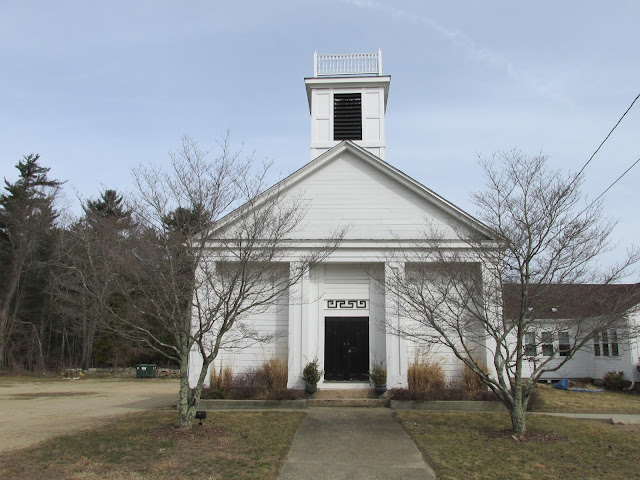 |
Chestnut Hill Baptist Church in Exeter (John Phelan/Wikimedia)
|
George's wife Mary and eldest
daughter Mary Olive, having been dead for close to a decade at the
time were revealed to be only skeletons. However Mercy proved far
different. Having only been dead for 2 months, and also been buried
in the cold of a New England winter, Mercy's body looked surprisingly
life-like when exhumed. Her skin receding postmortem also gave the
appearance of her fingernails and hair having grown. Already on edge
before the exhumations the crowd at the cemetery were stunned to find
traces of blood still in Mercy's body.
Fearing the worst her heart
was subsequently removed. It was placed on some nearby rocks and
burned. Not satisfied with that act the crowd convinced George that
the vampire's heart could help cure Edwin. In a final ghastly twist
some of the ashes of Mercy's heart were mixed in with Edwin's
medicine. The macabre concoction did not help and sadly Edwin was
felled by the consumption on May 2, 1892.
News of this incident and its
aftermath made its way across the ocean. It became an influence as
previously mentioned for Bram Stoker's classic Dracula.
It was definitely an influence on Rhode Island horror writer H.P.
Lovecraft and his book The
Shunned House. All
subsequent vampire books and films can trace their origins to these
times and to Mercy Brown.
 |
The grave of Mercy Brown. (Josh McGinn/Flickr)
|
Rhode Island's time as the
Vampire Capital of America ended shortly after Mercy Brown was
returned to the cold ground. The threat of vampires dwindled.
Though not as severe of an epidemic today as it was in the 19th
century tuberculosis is still a serious threat. In fact according to
the World Health Organization a total of 1.4 million people died from
TB in 2019.Her grave remains to this day along with her siblings and
parents at the Chestnut Hill Cemetery. Although hers is shackled and
chained to a nearby tree to stop thieves from taking it. Legend has
it that the ghost of Mercy Brown haunts the area around her grave and
even a nearby bridge. Perhaps when going to pay respects to the
'last vampire' of New England, keep an eye out, Mercy Brown may just
be closer than you think.
-----------------------------------------------------------
View my previous blog posts:


