Pages

Showing posts with label italy. Show all posts

Friday, January 14, 2022

In Their Footsteps: Cape Cod History - The Buried Treasure of Mabel Simpkins-Agassiz


    The name Mabel Simpkins-Agassiz might not ring a bell to many currently residing on Cape Cod. Her name does carry a lot of weight today especially in Yarmouth. First and foremost the sandy beach at Dennis Pond on Summer Street once was owned by Mabel. It was part of the Sandyside estate that the Simpkins family called home for generations. As she aged Mabel leased the beach to the town for use by ‘the children of Yarmouth.'

    Mabel Simpkins was the sister of John Simpkins. He was a U.S. Representative from Massachusetts from 1890-1891. Perhaps more notably for locals is the school that bore his name for decades. Now senior apartments, not very long ago the stoic brick building on Yarmouth’s Old Main Street was known as John Simpkins Elementary School.

    In addition to the beach at Dennis Pond, Mabel Simpkins made several generous donations to the town. These included the John Simpkins wing of the Yarmouth Port Library as well as creating the Cape Cod Library Club. Despite these contributions to her home town and despite her well known local family there is one thing Mabel might be known for above all else. It is a story of the treasure she buried on her Sandyside property nearly a century ago.

    The saga of Mabel Simpkins’ buried treasure started with her marriage to George Agassiz in June 1902. Agassiz himself was part of a famed family also. George was an astronomer and zoologist and Harvard graduate. His father Alexander was a scientist and engineer. While his grandfather Louis was an important biologist and geologist.

    The newlyweds took their honeymoon to Europe, specifically Italy. It was there that they visited a relatively new automobile company known as Fabbrica Italiana Automobili Torino or FIAT. George and Mabel purchased a brand new 1904 FIAT 24/32HP. These expensive luxury vehicles were made from 1903-1905 and had top speeds in excess of 75km/h(46mph).

An advertisement for the 1904 FIAT 24/32HP


    The auto was built fresh, listed as Chassis No.745 shipped to America in June 1904. In total the vehicle cost the couple $9,000($279,000 in 2021). Once on Cape Cod it became only the second vehicle registered in Yarmouth. Overall at the time there were a measly sixteen vehicles registered on the entire Cape. Mabel and her brother Charles Simpkins did the majority of the driving of the vehicle taking it on trips all over Cape Cod. For twenty-seven years Mabel and Charles enjoyed innumerable cruises around Cape Cod in the FIAT 24/32HP.

Portrait of Mabel Simpkins-Agassiz from 1917(Frick Digital Collections)


    Charles died suddenly of a heart attack in June 1931 at the age of sixty-four. Mabel was devastated. She had a deep emotional connection to the automobile and tried desperately to find a buyer. However the vehicle was nearing three decades in service and it was not seen as a worthwhile investment. Rather than simply cut bait with such a special piece of machinery Mabel had a far different, and far more unique idea.

    Much like a beloved member of the family the FIAT was given a proper burial on the property of Sandyside in 1932. For many years the FIAT remained underground, out of sight but not out of mind. In fact the rumor and legend of the buried car in Yarmouth Port grew. The rumor and legend made it to the ears of Boston resident Ted Robertson in 1942.

    Robertson contacted Mabel and asked for permission to ‘exhume’ the FIAT. She agreed and Robertson purchased the vehicle sight-unseen for $50($848 in 2021). When Robertson and his crew dug up the vehicle he was amazed at its condition. The FIAT had been buried upside-down, with its seats removed, and with its wheels on top of it like arms folded across the chest of a body.

    Remarkably despite it being in well-worn condition the FIAT was sold in between several different collectors over the proceeding decades. Robertson went on to found the Sports Car Club of America in 1944. David Uihlein from Milwaukee bought it for $500($5,200 in 2021) in 1952 and kept it stored for forty years. Restorations on the vehicle did not take place until the early 1990’s. The FIAT was returned to its former glory despite being nearly a century old including ten of those years being spent underground. In 2007 Jan Bruijn of the Netherlands bought it. He held on to it until 2018 when it was sold at auction through Bonhams for $808,000.
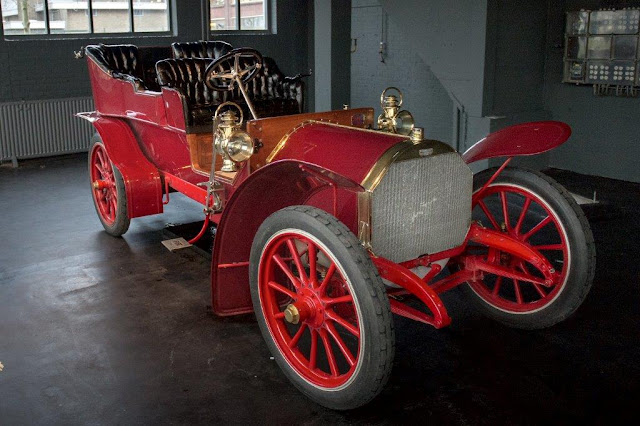
Mabel Simpkins-Agassiz's famed FIAT when owned by Jan Bruijn(Style-e-Auto.com)


    After the FIAT was exhumed and sold off Mabel and George continued to live at Sandyside in Yarmouth Port. George Agassiz died in February 1951 at the age of 89. In memorial Harvard University named their observatory at Oak Ridge in Harvard, Massachusetts after George. After his death Mabel moved to Dedham, Massachusetts where she lived out her remaining years. She died in March 1961 at the age of 91.

    Despite the story of the buried FIAT on her property might spring to mind first when thinking of Mabel Simpkins-Agassiz it is far from her most important contributions to Cape Cod. She was a hugely giving benefactor to her hometown of Yarmouth. From Dennis Pond to the Bass River Road and Gun Club, Yarmouth Port Library to John Simpkins Elementary School, her fingerprints were and still are apparent all over Yarmouth.

------------------------------------------------------------------------------------------------------------

Wednesday, July 22, 2020

In Their Footsteps: Cape Cod History - The Wellfleet Marconi Station


    On January 18, 1903 the first ever two-way wireless communication took place between President Theodore Roosevelt and England’s King Edward VII. It changed the landscape of communication forever and paved the way for radio and television to become a staple of life only a few decades later. The site for this historic milestone was not a big city. It was a remote section of beach in Wellfleet on Cape Cod. The man behind this newfound wonder was Guglielmo Marconi. This is the story of his wireless site that changed the world forever.

     Guglielmo Marconi was born in Bologna, Italy on April 25, 1874. He became a physicist and in 1894 first began experimenting with radio waves as a student at the Livorno Technical Institute in Rome. Basing his work on advancing the previous work of Henry Hertz and Oliver Lodge Marconi was able to develop a basic system of wireless telegraphy. From there he received his first patent in England in 1897.


The former pavilion at the Marconi Site from 2011


     After founding the England-based Marconi Telegraph Company in 1899 Marconi got started on perfecting his wireless telegraph. His first transmission traveled only a mile and a half but was a success. In March 1900 rumors circulated that perhaps a Marconi wireless station could be constructed on the Nantucket South Shoal Lightship.

     In order to assure a clear path between receivers Marconi looked for a companion site to his wireless station in Poldhu on England’s west coast. He found a perfect location in Wellfleet on Cape Cod. Plans for the construction of a wireless station at Wellfleet began in May 1901 with the money for the station being fronted by English capitalists and the work done by Boston contractors.

     The Wellfleet station was situated on eight acres of land, equipped with ten sets of two poles. Each pole stood nearly 100-feet tall and were set in a semi-circle fashion. The poles cost $2,900 ($88,000 in 2020) each to build. In June 1901 the long-rumored wireless station on the Nantucket Lightship was constructed, although this would only be connected to Sankaty Head Lighthouse approximately forty-eight miles away.

     Catastrophe came that November when the strongest storm in three years roared across Cape Cod. The Marconi station in Wellfleet was completely destroyed leaving vessels traveling between New York and Europe without the added aide.
Ironically it was only when the station was damaged by the storm that the people of Wellfleet discovered that it was owned by Guglielmo Marconi. It had been built in relative secrecy. Despite his great accomplishments in the field Marconi himself remained reserved, not wanting to seem boastful of how his invention was revolutionizing communication.


Guglielmo Marconi posing with his early wireless apparatus at the turn of the 20th century. (Smithsonian)


     In December 1901 a wireless station was built at Signal Hill in St. John’s, Newfoundland. This allowed Marconi to continue with his experiments with the technology while the Wellfleet station was being rebuilt. Signal Hill was about as close as North America could get to England being 900 miles closer to the Poldhu station than the Wellfleet location.

     It took more than a full year for the new wireless station to be finished in Wellfleet. In December 1902 it was completed with four 250-foot tall towers on a rectangular base replacing the original setup. Marconi himself arrived from Sydney, Australia to inspect the station marking the first time he had set foot on Cape Cod.
Not long after his arrival on the Cape Marconi and his assistant George S. Kemp got to work on what would be his greatest achievement to that point. The messages between the two world leaders was to be the grand reopening of the Marconi Wireless Station in Wellfleet. The Wellfleet station initially had the call letters CC (Cape Cod), this would change to MCC (Marconi Cape Cod), and finally to WCC when all eastern stations took the W prefix.

     As previously stated the date of January 19, 1903 was a landmark day in communication. It was on that date where the first two-way wireless conversation took place between President Theodore Roosevelt and King Edward VII.

     This accomplishment made it impossible for Guglielmo Marconi to remain in the shadows of success any longer. Within a week of the transatlantic conversation reporters from the leading newspapers and magazines of Boston and New York descended upon Wellfleet for a chance to find out about the man behind the invention. Marconi had high hopes of securing the rights to wireless communication basically everywhere in the world. He was referred to in some newspapers as a ‘wizard’ and his achievements were seen as more impressive by the fact that he was not even twenty-nine years old yet. Just as the fervor around the young inventor reached a fevered pitch Marconi left Cape Cod and returned to England by way of New York. He would return often to Cape Cod however.

     Marconi’s goal of commercializing wireless communication came true in September 1907. The messages were sent at a rate of twenty words per minute with the cost ranging from 10 cents a word for regular messages ($2.74 in 2020), and 5 cents a word for press related messages ($1.37 in 2020). In 1909 Marconi received the Nobel Prize for Physics sharing the prize with fellow wireless communication pioneer German physicist Karl Ferdinand Braun.

     A second wireless station was built by Marconi in Chatham overlooking Ryder’s Cove in 1914. The site was chosen for its relative isolation and was built for a total cost of $300,000 ($7.7 million in 2020). In 1920 the station became part of the Radio Corporation of America (RCA). It inherited the WCC call letters and became the busiest ship-to-shore station during much of the 20th century.


A postcard of the Wellfleet Marconi Site from 1905.


     When World War I came knocking for America the United States Navy took possession of the Wellfleet station as well as the Chatham site. In April 1917 the Wellfleet site fell under the command of J.W. Mullins, the chief electrician of the Navy. This proved to be the beginning of the end for the wireless station on the Outer Cape. After the war ended the station closed. The writing was on the wall from nature as well.

     The bluffs along the Outer Cape have been ravaged by erosion for many decades. Even a century ago the cliffs rapidly eroding to the point that the concrete bases closest to them were already being compromised before the station’s official closing. Despite rumors of the station possibly reopening late in 1919 nothing came to fruition. The closure of the Wellfleet Marconi station was a mixed blessing for the residents of the town. They were not completely upset with its demise due to the fact that while in operation the sparking of 30,000 watts supplied by the three-foot rotor could be heard up to four miles away.

     Guglielmo Marconi continued his research and experiments with wireless technology throughout the remainder of his life. Some later achievements included a mean system for long distance communication and experimentation with microwaves and the principles for developing radar. He received numerous honorary degrees and awards during his lifetime. After a few years of declining health Marconi died in Rome, Italy from a series of heart attacks on July 20, 1937 at the age of 63.

     His Wellfleet wireless station site would be wiped off the map entirely over time. It was dismantled in 1920. Between 1902 and 1972 the bluff in front of the station eroded 170 feet. Two of the concrete bases for the towers eventually fell to the sea. Camp Wellfleet was constructed on the grounds in 1942 and remained there until 1961 when after it was deemed unnecessary it became a part of the new Cape Cod National Seashore.

     In 1953 a plaque commemorating the conversation between Roosevelt and King Edward from 1903 was placed at the site. A shelter was constructed in 1974 housing a scale replica of the wireless site along with a bronze bust of Guglielmo Marconi. The beach below the cliffs was named Marconi Beach for the inventor.


An exposed base from the Marconi Wireless Site in 2011


     In a final piece of irony the eroding cliffs claimed the replica of the station as well. In July 2013 the replica and bust were removed and the shelter demolished. Incredibly only a short time before this a pair of the original concrete bases were exposed at the beach below. Sadly today the only remains of the original Marconi wireless station are bits of wood and brick gathered neatly in an area close to the eroding cliffs. Someday those will have to be removed as well.
----------------------------------------

My first eBook in 10 years, In Their Footsteps, featuring the interesting stories of Cape Cod's history, is on sale at Amazon.com.