Pages

Thursday, August 27, 2020

In My Footsteps: 'Smells Like Teen Spirit' Changes Everything

     Life is just a series of moments and memories. Some of these are random, some correspond to something beautiful, tragic, happy, or sad. For everyone though there are the moments/memories that shape the person you became. These are the types of moments that are burned into your mind. You can remember where you were, who you were with, and other minuscule details surrounding that point in time.

     One such moment for me happened 29 years ago this September. Music has the strength to create powerful memories. It is quite literally the soundtrack to one’s life. Never before and never since had music shifted the course of my life in the way it did in September 1991. I was in 7th grade and 13 years old.

     In the previous few years a new sound had been bubbling beneath the surface on the West Coast and particularly the city of Seattle, Washington. This was a branch off of the rising alternative music genre. Known as Grunge it was a grittier and far less mainstream sound geared toward the youth of America, particularly Generation-X. Some of the bands that would become staples of the burgeoning Grunge movement had already released music to varying degrees of success. However it was one song that did not bring Grunge to the mainstream but rather brought the mainstream to Grunge.

     It was an evening after school when I first heard the opening riff of a song named Smells Like Teen Spirit. Ironically I knew more of the women’s deodorant in the song’s title than the band that created it, Nirvana. Teen Spirit was originally created by Mennen in the late 1980’s. Legend has it that the title of the song came from ‘Kurt smells like Teen Spirit’ being written on his wall by a member of the band Bikini Kill of which Cobain was dating Tobi Vail.
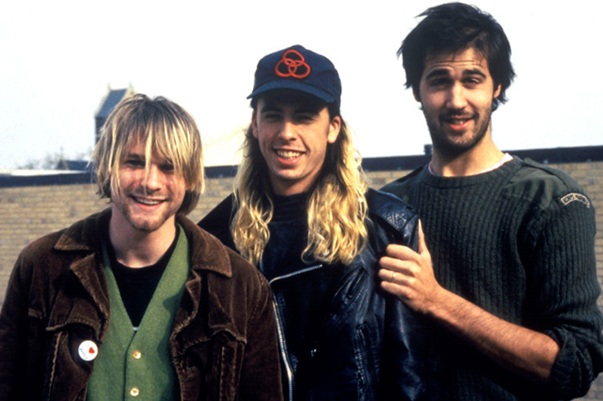
Nirvana c. 1991 (portalternativo.com)


     Sitting in the basement bedroom of my friend Matt Medeiros we decided to turn on the small alarm clock radio next to his waterbed. This in itself was an anomaly as we either would be outside playing, evening after dark, or if in his room we would be watching TV. The radio dial was already set on local station PIXY 103, which still is on the air today. Within seconds my world changed.

     As luck would have it Smells Like Teen Spirit had just begun. The guitar that came pouring out of the small speaker on the radio was like nothing I had ever heard before. The vocals from Kurt Cobain were so gritty and visceral that my attention was totally diverted from whatever conversation a pair of 13-year old boys had back in 1991. For about 5 minutes my brain was connected to the new raw sound that was piercing my consciousness for the first time. It was one of those moments where after I had walked home the music remained bouncing around my head.

The Nirvana Nevermind album cover.  


     Not too long after that I bought my copy of Nirvana’s landmark album Nevermind. To this day I still have the CD, though in reality it is quite scratched and in a terrible state of disc rot. Kurt Cobain spoke to me in a way unlike any other artist I had listened to up to that point. Before hearing Smells Like Teen Spirit my favorite artists/lyricists were Axl Rose (Guns N Roses), Bono (U2), Michael Jackson, and Chuck D (Public Enemy) among others. Their lives did not match mine really. Kurt Cobain, though 10 years older than me said things that resonated through my obligatory teenage angst.

     Then came the video. The dingy high school auditorium setting along with the throngs of kids headbanging and then smashing up the set seemed to match my internal feelings. It blew up on MTV and made Grunge and Nirvana household names. The slow then fast rhythm, the pounding drums, the slightly anarchist visual of the video. It all combined to make me want to become a singer/songwriter.


     Unfortunately over the years I would discover to great disappointment that I just did not have the musical chops for guitar. I did enjoy the lyric writing which evolved into stories, books, articles, poetry, right up to these words I am currently writing. Though my desire to be a writer stems back to 2nd grade and my teacher Ms. Rodrigues the actual pathway was not laid out and my skills did not begin to be honed until the night in September 1991 when Smells Like Teen Spirit shook my world.

     Kurt Cobain would go on to be one of the biggest influences on my life. It is impressive to say the least for me considering he was only an active musician for less than 3 years after I first was introduced to him. In the future I will definitely dive deeper into Kurt Cobain, Nirvana, and Grunge music in general. For now I wanted to capture that moment when everything that came after was initially conceived.

     To put a little bow on this to truly explain the magnitude of this moment for me and people from my generation here are a few facts. The Nevermind album was released on September 24, 1991. It only debuted at #144 on the Billboard charts, selling a measly 6,000 copies. On January 11, 1992 it dethroned Michael Jackson’s Dangerous album as #1 in the United States. It was a symbolic passing of the torch in music. By this time Nevermind was selling upwards of 300,000 copies per week. As of 2020 it has sold over 30 million copies worldwide according to Billboard. The video for Smells Like Teen Spirit has over 1.1 billion YouTube views as of 2020. It really became a seminal moment in the lives of a lot of people my age.

     The song also made the deodorant a massive hit. For a time it was Mennen’s best-selling product. For those wondering, Teen Spirit the deodorant is technically still available. Today though it goes by Teen Spirit by Lady Speed Stick.


Sources:

- 9 Chart Facts About 'Nevermind' - Billboard.com

- 10 Things You Didn't Know About Nirvana's 'Nevermind' - Rolling Stone.com

------------------------------------------------------------------------------------------

My first eBook in 10 years, In Their Footsteps, featuring the interesting stories of Cape Cod's history, is on sale at Amazon.com. 


View my previous blog posts: In My Footsteps: The Dawning of Social Media

In Their Footsteps: Cape Cod History - Hill's Dining Room

Photo Prints available here: Smug Mug.com

Be sure to check out my website: Christopher Setterlund.com


Wednesday, August 26, 2020

In Their Footsteps: Cape Cod History - Hill's Dining Room, Hyannis

     Businesses come and go regularly. Very few new ventures get the chance to establish their name before they are seemingly gone and replaced by the next. On Cape Cod where business is still somewhat seasonal it is quite difficult for businesses to gain a foot hold. This goes double for restaurants. Year after year new eateries pop up full of hope and potential and sadly most of them do not last more than a few seasons. This is why when a restaurant not only survives a year but many decades they are celebrated as icons of the Cape. Current establishments like The Lobster Pot, The Skipper, The Riverway, Brax Landing, Old Yarmouth Inn, and more are still going strong. Former legends like Thompson’s Clam Bar, Mildred’s Chowder House, East Bay Lodge, and others paved the way for the current crop.

     One quality that seems to go hand-in-hand with success is consistent ownership. Whether family or simply colleagues the knowledge that the same group has been in charge for a long time gives customers comfort. When a restaurant is family-owned it takes it to another level though. One such legendary establishment resided on West Main Street in Hyannis. For more than forty years it was run by the same family and carved out a legacy that is still spoken of fondly by their former loyal customers. It was Hill’s Dining Room and this is its story.

     The origins of Hill's Dining Room began in Finland. The family patriarch was Nestor Palomaki of Finnish decent who came to America at the age of eight. He changed his last name to Hill upon being naturalized. The name fit as Palomaki means ‘Burn Hill’ in Finnish. Nestor’s future wife, Amelia Raikkonen, came to America later at the age of sixteen. The pair met, fell in love, and were wed in February 1913. After having their first three children the family briefly moved to New York in 1918-1919 before returning to Cape Cod and building a home on Pine Street in Hyannis.

    Amelia and Nestor always gave back to their friends and neighbors even in their first days together. Though living in a small home with four children they would spare any space they had for friends in need. When they moved to a larger home on South Street in Hyannis there was a time when the Hills had at one time eighteen Cape Cod Baseball League players staying with them. The way they treated people would come shining through to the masses later on.

     Nestor initially had worked on George Waggoner’s farm on Mary Dunn Road in the early 1920’s. This land eventually became the Barnstable Airport. He was also a fisherman and carpenter before beginning to head toward his destiny as a restaurant owner. He operated a meat cart in the village in the early 1920’s.  In 1922 the Hill family was dealt a severe blow when Nestor and Amelia's young son Henry died from septicemia.  The family though persevered and became stronger.   

     Nestor's next venture was operating a shoe store on Main Street.  His Union Shoe Store operated for roughly a decade in the area now occupied by Ben & Jerry's Ice Cream.  Over time though Nestor moved from the production part of the restaurant industry to owning one.

     In 1939 Nestor, Amelia, and their four daughters Lillian, Eleanor, Irene, and Miriam, began their greatest venture as restaurant entrepreneurs. Hill’s Dining Room was born on a plot of land the couple bought on West Main Street. The family dynamic that had been evident to friends and neighbors was well on display as the new restaurant opened and became an immediate hit.

Hill's Dining Room (Sturgis Library)


     Hill’s Dining Room began as a seasonal restaurant serving up classic New England-style cuisine. The extra advantage Hill's had over most other Cape Cod establishments was their prized garden behind the property. There the family grew many of their own vegetables and fruits that were used in their meals. Amelia would proudly state that the vegetables and the help were all homegrown.

     Coming into existence as World War II was raging Hill's Dining Room set itself up for success by choosing to close on Tuesdays when most other restaurants closed on Mondays during the war. The Tuesday closing became a tradition for the remainder of the tenure of Hill's.

     From the get-go the four Hill daughters helped their parents in any way they could. The restaurant’s success necessitated an ‘all hands on deck’ mentality. The white clapboard building seemed rather unassuming even during its early days of the 1940’s. Inside though was a different story. Homemade breads, soups, salads, and desserts were only the beginning for the increasing throngs of customers that dined at Hill’s. If the timing was right one could dine on fish caught by the family. In the beginning no meal cost more than 99 cents including the fish, beef, and chicken dishes.

Hill's after the inn next door was constructed. (Sturgis Library)


     Hill’s Dining Room gained a reputation for its homemade food, cozy atmosphere and core staff of family. Over time it eventually became year-round and it was necessary to build additions on to the original restaurant. Three of them came by the end of the 1960’s. Though the four Hill sisters had been working at the establishment for decades they were forced to take on more of a role with the loss of their parents. Nestor passed first in 1963 with Amelia following in 1971.

     Despite the loss of the creators of the business Lillian, Eleanor, Irene, and Miriam not only carried on, they flourished. They included their own children into the mix as staff making it three generations strong. Eventually that would expand to a fourth generation of the Hill Family. The biggest accomplishment came though in 1973. It was here that a cocktail lounge was added, bringing the availability of alcohol to Hill’s for the first time. More so than that was a six-room, two-story lodging property turning the establishment into a 170-seat restaurant and an inn. The live entertainment on weekends and Cape Cod Clam Bake specialty kept Hill’s at the forefront of Mid-Cape eateries throughout the 1970’s into the 1980’s.

     The Hill sisters had done their best to keep their parents dream going strong. However after more than four decades in business the family was growing weary of running a successful restaurant and inn. In May 1983 the Hill family sold their beloved establishment to the Baldini family for $470,000 ($1.2 million in 2020). The hope was the tradition of the restaurant would continue. By the late 1990’s Hill’s Dining Room had become Paisan’s Family Restaurant. A Cape Cod landmark was gone, though the building which held it remained.


The Walgreens that stands where Hill's once did.

     The true end to the tenure of Hill’s came in October 2001 when the property was sold and demolished to make way for Brooks Pharmacy, now Walgreens. The owners had said the business had been on the market virtually since it was purchased in 1983 with one potential sale falling through a few years prior.

     For over four decades and with the help of four generations of family Hill’s Dining Room and Inn became in institution for visitors and countless loyal customers. From Nestor and Amelia, to Lillian, Eleanor, Irene, and Miriam, down through their children and beyond, generations of Hills built it and generations of Cape Codders loved it. Hill’s was a family restaurant in the truest sense.

-------------------------------------------------------

My first eBook in 10 years, In Their Footsteps, featuring the interesting stories of Cape Cod's history, is on sale at Amazon.com. 


View my previous blog posts: In My Footsteps: The Dawning of Social Media

In Their Footsteps: Cape Cod History - Brad's Soda Shoppe

Photo Prints available here: Smug Mug.com

Be sure to check out my website: Christopher Setterlund.com


Thursday, August 6, 2020

In My Footsteps: The Dawning of Social Media

     Facebook, Twitter, Instagram, and others today are as commonplace as rotary telephones and the phone book were to people forty years ago when it comes to communication. Social media allows all to have a voice and an opinion and makes connecting with friends, colleagues, and strangers easier than ever before in the history of mankind. It seems like everyday a new social media platform is being created and unleashed. However as Reddit, Snapchat, Pinterest, and Twitch become part of everyday life the entire idea of social media had to begin somewhere.

     The concept of social media had been forming as early as 1969 with the creation of ARPANET through the government agency Advanced Research Projects Agency. It was not until 1991 though that the internet itself became publicly available. On August 7, 1991, Tim Berners-Lee, a graduate of Oxford University, first made public his World Wide Web that he had invented in 1989.

     Although America Online became an icon of early internet availability it was actually CompuServe that was the first major commercial internet provider in the United States. It was founded in 1969 and remained a major part of the early World Wide Web revolution with AOL and Prodigy. Prodigy shut down in 1999 while CompuServe was purchased by America Online in 1998.

     Most people, myself included, who got their starts on the internet in the mid-1990’s remembers the classic dial-up modem noise as AOL loaded revealing several happy faceless figures when the connection was complete. As one of five kids between the ages of 11-18 when we first got our Gateway computer and internet in early 1996 it was a battle for screen time and a battle to use the telephone which the computer modem was connected to.

The classic dial-up screen from AOL. (Digital Trends)

     I also remember the mass of free trial CD-ROMs allowing people to go online without commitment. It began with a partnership with Blockbuster Video and exploded thereafter. While they definitely helped bring AOL to the masses the former Chief Marketing Officer of AOL, Jan Brandt, said in 2015 that the company spent more than $300 million on those free trials. The discs were 500, 750, or 1,000 hours and opened up the mid-1990’s to more than a passing fad.

     Kids and adults alike were given the keys to things like Chat Rooms, where you could meet people from all over the world. Granted many of us created wacky screen names for inside the rooms, or for AIM (AOL Instant Messenger), ICQ, and others. Research for school or pleasure became instantly easier with the advent of the search engine. Before Google became the big boss there were others like Lycos, Ask Jeeves, Excite, and Yahoo!

     As research and communication got easier a new outlet for people in the internet age came about and that was social media. It began as a cross between a biography, a bedroom wall, and a school locker. These sites were a way to express individuality while also coming together with like-minded individuals.

    The first true social media site as we’d know them today was born in 1997. It was Six Degrees.com. Founded by New Yorker Andrew Weinreich it was the originator when it came to social media. Profiles, friends lists, school affiliations, these were all rolled into one with Six Degrees. The name was a play on the six degrees of separation theory of Frigyes Karinthy in 1929. Weinreich even received the first patent for social media.

     The idea was groundbreaking. The only problem was the timing. In 1997 the Internet was not nearly as widely available as in 2020. Simple things by today’s standards like uploading photos was more difficult as digital cameras were not as common. Ironically more than a million people signed up on Six Degrees yet many of those profiles would remain inactive as some were likely created through free AOL trials that went by the wayside. Six Degrees was sold to YouthStream Media Networks in 1999 for $125 million and closed in 2000. It has been relaunched since but nowhere near the numbers it had before.

The Six Degrees Login Screen (Buffer.com)

     After the birth of social media and the demise of Six Degrees the landscape was ripe for a new leader. That came in 2002 with the creation of Friendster. It was intended to be only a dating site but its popularity soared with things like ‘status updates’ and connecting with ‘friends of friends of friends.’ Launching in March 2002 and created by Jonathan Abrams and Peter Chin it took the Six Degrees concept to the next level. It was this site that was my own personal introduction to social media. The swell of new profiles caused major problems for the site performance-wise and that made its reign as the top social media site very brief. These problems were the reason I and many others migrated to what most remember as the first giant of social media: MySpace.

     Coming into existence in August 2003 MySpace was different in that it had public profiles, or at least profile pictures, differing from Friendster being private for registered users, albeit safer in the same vein. MySpacers fondly remember creating a profile and immediately having Tom as their friend. I think I kept him as a friend for a while but I’m sure many deleted him quick like that free album U2 put on your iTunes in 2014. Tom (Anderson) was one of the creators of the site that included music capabilities for your profile as well as band pages. This site was a monster. In 2007 the site was valued at $12 billion.

     In 2005 MySpace had 25 million users. Known as ‘A Place for Friends’ MySpace having public profiles did allow you the ability to check out anyone you wanted to which some certainly did in a nefarious way. Although the site’s parent company being sold to News Corp in 2005 did not immediately start a downward trend it definitely made the site feel more corporate than social. Problems with sketchy people prowling MySpace coupled with an increase in corporate policies from News Corp spelled the end of its reign.

     In April 2008 a new #1 social media site was crowned. Facebook had originally been launched by Mark Zuckerberg in 2004 and began a slow, steady climb to the top. I remember joining in 2007 and any status updates would be ‘so-and-so is...’ Now when my Facebook memories come up from 2007 and 2008 they are just choppy bits of thoughts. For example a memory from August 2007 just said ‘done.’ Very important stuff I was sharing.


The current and former kings of social media.

     As MySpace faded other sites came along including YouTube and LinkedIn which was the first business networking site that launched in May 2003. Facebook has been the king for over a decade with everyone from ages 8-80 seemingly having a profile(it has more than 1.6 billion users in 2020). How much longer will it remain at the top? I remember when I thought MySpace would be the trendsetter forever and it still remains online today but in a completely different setting.

     Will a new kid on the block like TikTok, Vero, Caffeine, or another yet unknown become the next big thing? What was your introduction to the Internet and Social Media? Did any of you have a Six Degrees account? What’s your favorite platform? Mine honestly is Instagram as I love photography. In the future I will definitely do another article focusing solely on those early Internet days!

Helpful Links:

---------------------------------------------------------------------

My first eBook in 10 years, In Their Footsteps, featuring the interesting stories of Cape Cod's history, is on sale at Amazon.com. 


View my previous blog posts: In My Footsteps: Talkin' 'bout My Generation

In Their Footsteps: Cape Cod History - Brad's Soda Shoppe

Photo Prints available here: Smug Mug.com

Be sure to check out my website: Christopher Setterlund.com


Sunday, August 2, 2020

In Their Footsteps: Cape Cod History - Brad's Soda Shoppe

     Decades ago Cape Cod and America as a whole was far different than it is today. It seemed like a simpler time. Today’s senior citizens wistfully look back on them as the ‘good old days.’ America seemed smaller yet more wide open. Though still a summer destination the Cape in the 1920’s was quieter with far more wide open space. Even the busy Route 28 was more akin to a country road with pockets of empty grassland.

     In West Yarmouth in an area just east of Mill Hill one such open area became home to a soda shop. Soda shops were a staple of the first half of the 20th century. They were seen as a hangout for the younger generation and an alcohol-free alternative during Prohibition times. Brad’s Soda Shoppe would end up becoming much more as the property it stood on began as a simple business in a simple time and over the decades became an example of the progress and evolution of Cape Cod into what it is in the 21st century.

     Provincetown native Carl Bradshaw saw the land abutting Mill Creek as a perfect location for his new business. Though it would be originally operated as an open-air restaurant the new venture was named Brad’s Soda Shoppe. It opened in 1930 for the summer and saw some success despite being in such close vicinity to another popular restaurant Old Mill Tavern, located where the iconic Mill Hill Club would reside for decades later on.

     Bradshaw enticed passersby during the summer with ice cream, sodas, and lite fare featuring a daily noon special. The open-air layout did force the business to close during the winter. After the 1932 summer season the building was enclosed with heat installed to allow Brad’s to remain open year-round. By this time Brad’s as well as Old Mill Tavern had more potential customers to attract with the opening of the popular Rainbow Ballroom in between the two establishments.

     In September 1934 Brad’s further attempted to compete with the Old Mill Tavern by adding a steam table and electric stove to allow them to serve dinners as well. The bright exterior lights complimented the late hours and the cheery white enamel interior with green trim made this far more than a soda shop despite the name.

Brad's Soda Shoppe (Historical Society of Old Yarmouth)

     The Mill Hill area became a highly congested area on Cape Cod in the late 1930’s. Thanks to Brad’s, Rainbow Ballroom, and Old Mill Tavern there was a necessity at the time for several police officers to be stationed in the surrounding area to direct traffic. This increased popularity of the area and Brad’s in general gave Carl Bradshaw the incentive to enlarge the restaurant in 1940. The nearby Castle Dawn motel was enlarged at the same time along with new gas stations. Though the Old Mill Tavern was sold and became the Old Windmill House it appeared as though the 1940’s were to be quite prosperous. However world events would shake that trajectory.

The interior of Brad's Soda Shoppe (Historical Society of Old Yarmouth)

     America was dragged into World War II in December 1941. Bradshaw’s enlargements of his restaurant were costly yet he had faith that the increasing popularity of the Mill Hill area would make the costs worthwhile. However with the outbreak of the war in America there was tire rationing. The rubber was used for battlefield tank treads instead. The lack of new tires severely cut into the amount of people traveling during the summer.

     Business suffered for Brad’s Soda Shoppe throughout the 1942 season. Carl Bradshaw had also partially counted on increased business from the influx of soldiers at Falmouth’s Camp Edwards. This business increase did not happen and unfortunately the double shot of disappointment proved to be the tipping point for Brad’s. He sold the restaurant early in 1943 to Carl Maloney owner of the Maloney Drug Store in Dennis Port.

     In an especially sad piece of cruel irony the 1943 tourist season on Cape Cod saw a comeback and the new owners of the business, now known as Carl’s Sandwich Shop, reaped the rewards. Carl Bradshaw died on December 20, 1947 at the age of 69 at the home of his son Ireton in Cummaquid.

     Carl’s was run as a typical casual American-fare business. It offered dinner, take-out, seafood, steaks and chops. As the years went on it was managed by Jim Desmond in the late 1940’s and Bob Gardner in the early 1950’s. The food and service helped Carl’s garner a reputation as one of the finest eateries in the Mid-Cape area. It was helped by the fact that the Old Mill Tavern/Old Windmill House had been turned into a nightclub known as the Mill Hill Club in the late 1940’s thus eliminating some former restaurant competition.

     By the time the four Tsapatsaris brothers purchased Carl’s in May 1957 it had undergone extensive renovations. They would call the business Carl’s Restaurant and attempt on more than one occasion to secure a coveted liquor license to no avail. It took until 1965 for the Town of Yarmouth to extend a seasonal license to Carl’s. The Tsapatsaris family ran the seasonal restaurant for nearly twenty years before closing after the 1975 season. This brought to an end the more than four decades of the soda shop turned sandwich shop turned restaurant. However it was far from the end of the story.

The Cove at Yarmouth in 2020

     The property at 183 Rt. 28 in West Yarmouth only sat quiet for a few years. In 1979 the former Brad’s Soda Shoppe building was torn down. In its place would come the wave of Cape Cod’s future and present. After a few years of back and forth with the town a new resort hotel called The Cove at Yarmouth was constructed by Malcolm MacPhail. It still stands to this day and even has a popular restaurant The Loft on its premises keeping a little bit of what initially drew crowds to the property nearly a century ago.

--------------------------------------


My first eBook in 10 years, In Their Footsteps, featuring the interesting stories of Cape Cod's history, is on sale at Amazon.com. 


View my previous blog posts: In My Footsteps: Talkin' 'bout My Generation

In Their Footsteps: Cape Cod History - Cape Cod's Drive-Ins

Photo Prints available here: Smug Mug.com

Be sure to check out my website: Christopher Setterlund.com


Wednesday, July 29, 2020

In My Footsteps: Talkin' 'bout My Generation


     I was born at an interesting time. I fall into a category of people who are old enough to remember things like rotary telephones and Atari, yet young enough to enjoy and appreciate smartphones. We are those in their late-30’s to early-40’s who straddle a line between generations. For most labeled generations, like Baby Boomers, Generation-X, Millennials (Generation-Y), etc there is a basic line of demarcation where one begins and one ends. However recently there has been an idea of something called a ‘micro generation.’ This is a smaller group of people, that I fall into, which is one-part Gen-X, one part Millennial. I have to tell you I think this is spot on accurate and here are some examples why just from my life.


     Growing up I always considered myself a prototypical Gen-Xer. I came of age listening to the Grunge music movement. I prided myself on my flannel shirts and torn jeans. My Senior yearbook photo featured a red flannel shirt. Hell, even to this day I have a Pandora music station called ‘Torn Jeans & Flannel’ celebrating my early-90’s music roots. The group Generation-X typically is referred to as those born between 1965-1980. The name itself was coined by war photographer Robert Capa. His phrase was first uttered in 1952 and referred to young people with a fatalistic view of the future. The term first came into pop culture though in 1991 with the release of Douglas Copeland’s novel of the same name.


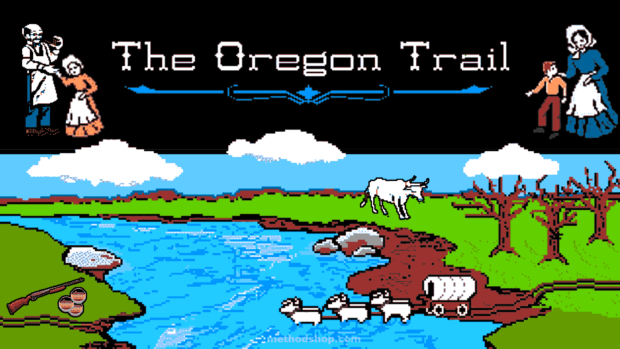
     Generation-X had the first personal computers in school, complete with dying on the Oregon Trail. They were kicked out of the house and told to stay outside and play until the street lights came on, yet when they got home they had a Nintendo game console waiting. They have been defined as lazy slackers as they got older yet have been at the forefront of entrepreneurial achievements. Defiant, independent, artistic, these characteristics all fit me and a majority of this generation to different degrees.

     A Millennial, also referred to as Generation-Y, is seen as the generation that directly followed Generation-X. Born roughly from 1981-2004 they are the generation currently stepping out on to the world’s stage in more important roles. They are seen as the group born into the time of technology. The current world of home computers, smartphones, GPS, self-parking cars, and the like are all just another part of the average Millennial’s life. They are a generation nearly double the size of Gen-X, rivaling the size of the Baby Boomer generation.


The original Super Mario Bros. on the NES (Paste Magazine.com)

     Millennials have been nurtured more than Gen-X, perhaps due to the changes seen in the world by the previous generation. The balance between staying outside to play and the lure of video games has shifted. Despite this fact Millennials are highly technologically savvy with their fingerprints all over smartphone apps and YouTube channels.

     Even though there are rough timelines of when Gen-X ended and Gen-Y began it is not reality to have a hard reset of the personality of a human. That being said there is bound to be some crossover of beliefs and traits of these two generations. Think of it as a Venn Diagram where the two circles bleed over into each other. This meeting of Gen-X and Gen-Y is the previously eluded to ‘micro generation,’ also called a ‘Xennial.’

     Seen as those born roughly between 1977-1983 a Xennial is a person who exudes traits of both generations. I first learned of this term from a USA Today article in December 2018. The idea of being somehow caught between the two generations is also referenced in a BuzzFeed.com piece from July 2013. It actually lists the characteristics of a Xennial. Only after reading this piece did I realize it described me to a T.

     For me personally I relate to absolutely loving the technological advances over the last few decades. Smartphones, streaming media, higher quality laptops, etc, however I am just as much at home grabbing my camera and finding a scenic area to take some pictures. That hearkens back to being a kid and being told to get outside during the summer and play and not to come back until it was dinner time. Granted the world is a different place today and many of the current younger generation probably wouldn’t be able to hours outside away from home so video games and other technology are a safer alternative.

80's Tech vs. Today (Wikimedia Commons, PxFuel)

     As a child of the 1980’s I feel a deep connection to that time period, yet actually came of age in the 1990’s. I like being seen as a Gen-Xer yet cannot deny the deep connection to the Gen-Y way of thinking. My biggest quirk when it comes to being a Xennial is the love of nostalgia while also being excited about what new technology is coming down the pipe. I have a soft spot for vinyl albums, Polaroid instant photos, VHS tapes, Super Mario Bros., Reading Rainbow, and 70’s/80’s television commercial jingles and mascots. Yet I also love being able to type a few words and instantly being able to research something that would have taken me hours and many trips to the library in high school. I love new smartphone apps that make life quicker and easier, I love being able to digitize old home movies on my laptop, and typing the address on a GPS and not having to think about where I’m going. I am a retro techno geek.

     So what about you? Are you a full-on Gen-Xer? Generation-Y(Millennial)? Or a Xennial like me? Check out the links below especially the Buzz Feed list, that might blow your mind like it did mine when I first read it.


     Links:

----------------------------------------------
My first eBook in 10 years, In Their Footsteps, featuring the interesting stories of Cape Cod's history, is on sale at Amazon.com. 

Sunday, July 26, 2020

In Their Footsteps: Cape Cod History - The Cape's Drive-Ins


     The drive-in movie theater was at one time a staple of American life. Being able to enjoy a film on a large outdoor screen from the luxury of the inside of your car was a cherished memory for so many over several decades. Even though in 2020 there are only approximately 321 remaining there are still some classic drive-in theaters left in the country. On Cape Cod for so long the Wellfleet Drive-In was the last remaining vestige of a bygone era. However that changed in the summer of 2020 when the former Yarmouth Drive-In was brought back to life more than three decades after initially closing.

     The story of the drive-in is long and storied and intertwined with the Cape. Though there were drive-ins of a sort as far back as the 1910’s the first true, patented drive-in theater debuted on June 6, 1933. The first proper drive-in theater was the brainchild of Richard Hollingshead. He took the existing idea of watching silent films outdoors on screens and added the ability for the wildly popular automobile to become a part of it. Hollingshead opened his creation in Camden, New Jersey with a showing of the British comedy Wives Beware. Tickets cost 25 cents per person and also 25 cents per vehicle. The Camden Drive-In had a capacity of 400 cars and 600 people attended that first night’s showing.

The screen at the Camden Drive-In (Cinema Treasures.org)


     His investment of $30,000 ($595,000 in 2020) spawned a new industry that would sweep the nation. Though primitive in the beginning, including not having the individual speakers for cars, the drive-in slowly began to catch on. In January 1938 plans were discussed for a potential drive-in near the Barnstable Airport in Hyannis. These discussions were brief as the potential of such an attraction was not seen as being an asset to the Cape.

     By the end of the 1930’s there were 18 drive-ins located in America. These included four in Massachusetts in Weymouth, Lynn, Shrewsbury, and Methuen. In 1948 that number had leaped to 820 total theaters. It was around this time that the drive-in was finally seen as a worthwhile investment for Cape Cod.

     In May 1949 building contractor Louis Segrini of Mansfield, Massachusetts was granted a permit to build the first drive-in on Cape Cod. This drive-in would be far more than a place to watch movies in your car though. The 70 acre plot located on Hokum Rock Road in Dennis, near Rt. 134, was at the time the largest drive-in in New England. It had a capacity of 1,000 cars and would also become the first fly-in theater. This distinction came from the fact that small airplanes and helicopters could land on a strip near the back end of the grounds and taxi their way to spots to watch the movies from inside the plane. In addition to being the largest theater and a fly-in theater the Dennis Drive-In included a dance pavilion, bottle warming service for young mothers, refreshment stands, and even 20 nearby cottages to rent.

The Dennis Drive-In, 1949 (Cinema Treasures.org)


     Opening night was Saturday July 16, 1949. The theater played the color film Barkleys of Broadway featuring Fred Astaire and Ginger Rogers. It was a near sellout close to 1,000 cars. Rather than rest on his laurels Segrini parlayed the success of the Dennis Drive-In to a second theater planned for near the Mashpee Rotary in 1950. These plans never materialized. Cape Cod had to wait six years for a second drive-in to open.

     It was in the 1950’s that the drive-in hit its apex as an entertainment attraction. This was the case on Cape Cod as well. Herman Rifkin opened the Cod Drive-In in the Teaticket section of Falmouth in 1955. This was followed quickly by the Hyannis Drive-In on Rt. 132. The Yarmouth Drive-In on Rt. 28 followed in 1956 and finally the Wellfleet Drive-In was built on Rt. 6 in 1957. This brought the total to five drive-ins on Cape Cod. In 1958 the total number of theaters in the United States hit its high of 4,063.
The drive-in had continued success throughout the 1960’s and into the 1970’s. However the tide slowly began to turn. An increase in land values, the advent of VCR’s, and the fact that drive-in shows had to begin late with summer sunset times started to eat into business. By 1980 there were just over 2,000 drive-ins left. The 1980’s saw the virtual end of the industry on Cape Cod.

     It began in 1980 when the Cod Drive-In closed. The land just off of Rt. 28 was owned for years by the Augusta Family who own the abutting Falmouth Lumber. In the spring of 2003 a 23.7-acre parcel of the former drive-in land was purchased by the Town of Falmouth. As of 2020 though nothing has been done with that property.

     Next to close was the Dennis Drive-In in 1984. The property was to be turned into a housing subdivision however as of 2020 much of the property remains overgrown. Upon walking over the former grounds one can find chunks of asphalt, concrete, former speaker stands, and wire littered about.

The Wellfleet Drive-In, for decades the last one standing until 2020. (Massachusetts Office of Travel and Tourism)


     The Yarmouth Drive-In initially closed in 1985. Throughout the years many ideas were bandied about as to what should become of the 22-acre site. A river walk consisting of trails and boardwalks leading along Parker’s River out to Seagull Beach had potential yet never materialized. In July 2020 it was resurrected by Innovation Arts & Entertainment. The new Yarmouth Drive-In has been updated for the 21st century with bright LED screens making daytime movies possible.

     In 1987 the Hyannis Drive-In became the fourth to close on the Cape in seven years. Though religious services took place on the grounds for a short time afterwards the property would eventually become home to Stop & Shop. It was also in 1987 where the total number of drive-ins dipped below 1,000 nationwide.

     The Wellfleet Drive-In for more than thirty years stood tall as the last beacon of a bygone era. It became a popular summer destination for those wishing for a slice of 1950’s nostalgia in a 21st century world. As of 2020 it remains a perfect family night out during the summer.

     The drive-in theatre for a time was the place to see new movies. It became as much a part of pop culture of a bygone generation as the movies themselves did. Though their numbers massively dwindled as the decades passed the drive-in is not finished yet. In a time where social distancing is the new normal there is a potential for a comeback of some of these beloved old school icons.

    So what became of Richard Hollingshead’s original Camden Drive-In? Partially due to high movie rental costs and lower than expected crowds Hollingshead sold his theater less than three years after opening it to a man who ‘moved’ the business to Union, New Jersey. It did not reopen. The final insult came when Hollingshead’s company was sued in 1950 and lost his patent on some of the designs of the drive-in, the large rush of new theaters came shortly thereafter.
---------------------------------------------


My first eBook in 10 years, In Their Footsteps, featuring the interesting stories of Cape Cod's history, is on sale at Amazon.com. 


Wednesday, July 22, 2020

In Their Footsteps: Cape Cod History - The Wellfleet Marconi Station


    On January 18, 1903 the first ever two-way wireless communication took place between President Theodore Roosevelt and England’s King Edward VII. It changed the landscape of communication forever and paved the way for radio and television to become a staple of life only a few decades later. The site for this historic milestone was not a big city. It was a remote section of beach in Wellfleet on Cape Cod. The man behind this newfound wonder was Guglielmo Marconi. This is the story of his wireless site that changed the world forever.

     Guglielmo Marconi was born in Bologna, Italy on April 25, 1874. He became a physicist and in 1894 first began experimenting with radio waves as a student at the Livorno Technical Institute in Rome. Basing his work on advancing the previous work of Henry Hertz and Oliver Lodge Marconi was able to develop a basic system of wireless telegraphy. From there he received his first patent in England in 1897.


The former pavilion at the Marconi Site from 2011


     After founding the England-based Marconi Telegraph Company in 1899 Marconi got started on perfecting his wireless telegraph. His first transmission traveled only a mile and a half but was a success. In March 1900 rumors circulated that perhaps a Marconi wireless station could be constructed on the Nantucket South Shoal Lightship.

     In order to assure a clear path between receivers Marconi looked for a companion site to his wireless station in Poldhu on England’s west coast. He found a perfect location in Wellfleet on Cape Cod. Plans for the construction of a wireless station at Wellfleet began in May 1901 with the money for the station being fronted by English capitalists and the work done by Boston contractors.

     The Wellfleet station was situated on eight acres of land, equipped with ten sets of two poles. Each pole stood nearly 100-feet tall and were set in a semi-circle fashion. The poles cost $2,900 ($88,000 in 2020) each to build. In June 1901 the long-rumored wireless station on the Nantucket Lightship was constructed, although this would only be connected to Sankaty Head Lighthouse approximately forty-eight miles away.

     Catastrophe came that November when the strongest storm in three years roared across Cape Cod. The Marconi station in Wellfleet was completely destroyed leaving vessels traveling between New York and Europe without the added aide.
Ironically it was only when the station was damaged by the storm that the people of Wellfleet discovered that it was owned by Guglielmo Marconi. It had been built in relative secrecy. Despite his great accomplishments in the field Marconi himself remained reserved, not wanting to seem boastful of how his invention was revolutionizing communication.


Guglielmo Marconi posing with his early wireless apparatus at the turn of the 20th century. (Smithsonian)


     In December 1901 a wireless station was built at Signal Hill in St. John’s, Newfoundland. This allowed Marconi to continue with his experiments with the technology while the Wellfleet station was being rebuilt. Signal Hill was about as close as North America could get to England being 900 miles closer to the Poldhu station than the Wellfleet location.

     It took more than a full year for the new wireless station to be finished in Wellfleet. In December 1902 it was completed with four 250-foot tall towers on a rectangular base replacing the original setup. Marconi himself arrived from Sydney, Australia to inspect the station marking the first time he had set foot on Cape Cod.
Not long after his arrival on the Cape Marconi and his assistant George S. Kemp got to work on what would be his greatest achievement to that point. The messages between the two world leaders was to be the grand reopening of the Marconi Wireless Station in Wellfleet. The Wellfleet station initially had the call letters CC (Cape Cod), this would change to MCC (Marconi Cape Cod), and finally to WCC when all eastern stations took the W prefix.

     As previously stated the date of January 19, 1903 was a landmark day in communication. It was on that date where the first two-way wireless conversation took place between President Theodore Roosevelt and King Edward VII.

     This accomplishment made it impossible for Guglielmo Marconi to remain in the shadows of success any longer. Within a week of the transatlantic conversation reporters from the leading newspapers and magazines of Boston and New York descended upon Wellfleet for a chance to find out about the man behind the invention. Marconi had high hopes of securing the rights to wireless communication basically everywhere in the world. He was referred to in some newspapers as a ‘wizard’ and his achievements were seen as more impressive by the fact that he was not even twenty-nine years old yet. Just as the fervor around the young inventor reached a fevered pitch Marconi left Cape Cod and returned to England by way of New York. He would return often to Cape Cod however.

     Marconi’s goal of commercializing wireless communication came true in September 1907. The messages were sent at a rate of twenty words per minute with the cost ranging from 10 cents a word for regular messages ($2.74 in 2020), and 5 cents a word for press related messages ($1.37 in 2020). In 1909 Marconi received the Nobel Prize for Physics sharing the prize with fellow wireless communication pioneer German physicist Karl Ferdinand Braun.

     A second wireless station was built by Marconi in Chatham overlooking Ryder’s Cove in 1914. The site was chosen for its relative isolation and was built for a total cost of $300,000 ($7.7 million in 2020). In 1920 the station became part of the Radio Corporation of America (RCA). It inherited the WCC call letters and became the busiest ship-to-shore station during much of the 20th century.


A postcard of the Wellfleet Marconi Site from 1905.


     When World War I came knocking for America the United States Navy took possession of the Wellfleet station as well as the Chatham site. In April 1917 the Wellfleet site fell under the command of J.W. Mullins, the chief electrician of the Navy. This proved to be the beginning of the end for the wireless station on the Outer Cape. After the war ended the station closed. The writing was on the wall from nature as well.

     The bluffs along the Outer Cape have been ravaged by erosion for many decades. Even a century ago the cliffs rapidly eroding to the point that the concrete bases closest to them were already being compromised before the station’s official closing. Despite rumors of the station possibly reopening late in 1919 nothing came to fruition. The closure of the Wellfleet Marconi station was a mixed blessing for the residents of the town. They were not completely upset with its demise due to the fact that while in operation the sparking of 30,000 watts supplied by the three-foot rotor could be heard up to four miles away.

     Guglielmo Marconi continued his research and experiments with wireless technology throughout the remainder of his life. Some later achievements included a mean system for long distance communication and experimentation with microwaves and the principles for developing radar. He received numerous honorary degrees and awards during his lifetime. After a few years of declining health Marconi died in Rome, Italy from a series of heart attacks on July 20, 1937 at the age of 63.

     His Wellfleet wireless station site would be wiped off the map entirely over time. It was dismantled in 1920. Between 1902 and 1972 the bluff in front of the station eroded 170 feet. Two of the concrete bases for the towers eventually fell to the sea. Camp Wellfleet was constructed on the grounds in 1942 and remained there until 1961 when after it was deemed unnecessary it became a part of the new Cape Cod National Seashore.

     In 1953 a plaque commemorating the conversation between Roosevelt and King Edward from 1903 was placed at the site. A shelter was constructed in 1974 housing a scale replica of the wireless site along with a bronze bust of Guglielmo Marconi. The beach below the cliffs was named Marconi Beach for the inventor.


An exposed base from the Marconi Wireless Site in 2011


     In a final piece of irony the eroding cliffs claimed the replica of the station as well. In July 2013 the replica and bust were removed and the shelter demolished. Incredibly only a short time before this a pair of the original concrete bases were exposed at the beach below. Sadly today the only remains of the original Marconi wireless station are bits of wood and brick gathered neatly in an area close to the eroding cliffs. Someday those will have to be removed as well.
----------------------------------------

My first eBook in 10 years, In Their Footsteps, featuring the interesting stories of Cape Cod's history, is on sale at Amazon.com.