Pages

Friday, September 2, 2022

In My Footsteps: When A Smell Sparks Up Nostalgia


    Have you ever had a certain scent stir up intense memories? I’ve had a lot of recent experiences, especially during the warmer months. It centers around pine. Pine trees, pine needles, maybe the sap, I don’t know, but it’s strong. It happened again today while I was walking from my car into a client’s house which led me to write this. The smell of the pine needles strewn across the ground, coupled with the dry, late-summer air made a perfect potpourri. So much so that I had to stop and take a moment to acknowledge the memories and emotion that was brought to the surface.

    Whether on a forest trail or a bike trail the past comes softly calling. It always sends me back to the same place, the same time. Age sixteen, 1994. Why is that? It’s easy yet complicated.

    1994 was likely the last time that I felt the warmth of innocence. I was a sophomore in high school, still living in the neighborhood that had molded my childhood like fresh clay. It was a time when the world was still there to be conquered, but there was no rush to make concrete plans. I had dreams, to be a writer, filmmaker, something that gave my creative spirit joy. But there was time.

The old tracks filled with pine trees.(2009)


    1994 was a time in life when everybody was still here. I had never experienced loss. I didn’t know the deep and permanent scars that can be left in your heart when you lose someone, whether just from your life or from this earth entirely. I sit back now and think about all that I didn’t know about the world and I wish I could go back there. I think about things I didn’t know about people, places, and things, and wish I could go back there.

    1994 was an innocent time. School was relatively easy albeit time-consuming. Life was cluttered with amazing friends. It was filled with fun times when fun times were so simple and basic and the worries were not real worries. Did I finish my homework? Does that girl like me? Do I have enough money to buy anything good at the corner store?

    I was lucky enough to live in an area that allowed me to walk through quiet streets, through some secluded wooded pathways, and to a tiny strip mall where my friends and I would buy soda, chips, and candy.

Quiet streets to walk.


    There were abandoned railroad tracks and sandy paths running under rows of power lines. We’d walk the tracks, or sneak onto the nearby golf course. I’d feel like I was on an adventure but never felt worried or threatened by life. The world was happy. The world was safe. Along those railroad tracks, along those sandy paths, along the golf course were untold numbers of pine trees, big and tall, or short and stubby. The joy I felt in those times, on those adventures, and in life in general, was captured and contained in the smell of the pine. While I was making those long-lasting positive memories the scent of the pine seeped into my subconscious.

    I didn’t notice it much until the last few years. Ironically they have been filled with loss and instability. The world doesn’t feel happy. The world doesn’t feel safe. I’ve lost countless family members and friends. I’ve faced adult choices and adult demons that make me long for the time-consuming school days of 1994.

    It feels like in the last few years the universe has known I’ve needed some peace of mind and thus the smell of the pine came to the forefront. I can be sitting at a park, walking the bike trail, or like today walking across a parking lot to someone’s house and I’ll catch a whiff. Suddenly it’s 1994 again.


    It’s 1994, I’m sixteen, and I can visit any of my grandparents whenever I want. I can pick up the phone and call friends and make plans to ‘hang.’ Or I could grab my bike and ride to someone’s house, or to the corner store, and bask in the fleeting feelings of youth. The future lay out before me like a sunny highway. Nothing seemed uncertain, nothing to fear. Dreams were larger than regret. Living the good old days we didn’t know were good yet.

    This is not an isolated experience. There are other scents that bring back other types of memories. But the pine is the most intense. It sparks a nostalgic flame that I welcome each time. It’s as if the scent of the pine was a fine wine I gathered back then to break out on special occasions.

    Sit back and think. What scents take your mind somewhere? Why do you think that is the case? If you’re wondering how something like memory-inducing scents happen check out this article.

Why Smells Trigger Such Vivid Memories - Discovery.com

----------------------------------------------------------------------

Previous Blog Posts:

Be sure to check out my website: Christopher Setterlund.com

Zazzle Store: Cape Cod Living


Thursday, September 1, 2022

In My Footsteps Podcast Episode 83: The Buried Treasure of Mabel Simpkins, Old School New England Convenience Stores, 90s Advertising Mascots, Road Trip Dennis MA(9-1-2022)


Friday, August 26, 2022

In Their Footsteps: Cape Cod History - Dorsie's Steak House, West Yarmouth


    This legendary establishment along the high-traffic Route 28 in Yarmouth had a dedication to great entertainment and terrific food. Its status as a place to be was in part thanks to the tireless efforts of its larger-than-life owner. For nearly two decades, George “Dorsie” Carey ran his eponymous steak house in two separate locations along Route 28, creating buzz around town with his entertainment and cuisine. 

    Carey had come to the Cape from Dorchester. And no, this was not how he got the nickname Dorsie. That nickname was bestowed on him by his niece while they were living in the same three-story building in the historic Boston neighborhood. She could not pronounce the name George, and as it usually came out “Dorsie,” the name stuck with him. Carey had another nickname that became the name of a restaurant—“Handlebar Harry”—due to his handlebar mustache. He opened Handlebar Harry’s in Plymouth with his wife, Louise Houston, in 1991.

Dorsie's when it was still the Gay Nineties.


    Dorsie’s began as a much smaller restaurant located at 183 Route 28 in West Yarmouth, near the iconic Mill Hill Club in 1974. Business took off over the next few years. The landlord of the property decided after the 1978 season to increase the rent for the property by 400 percent, from $8,500 per month to $35,000. This shocking increase set off a chain reaction that ended up taking Dorsie’s to new heights.

    Carey searched all along Route 28, from Hyannis to Bass River, in the hopes of finding a new location. One of his regular customers at the restaurant was, in fact, the owner of an establishment called the Gay Nineties located half a mile away on Route 28. After hearing of Carey’s plight, the owner sold the Gay Nineties building to him on a handshake. On the night of July 3, 1979, Carey, his staff, close friends, and some of the Yarmouth Police worked through the night and moved all of the equipment from the original Dorsie’s down the street and into its new home.

Inside Dorsie's


    “We were opened July Fourth,” Carey proudly reflected, “although there was no food service until July Fifth.”

    The hard work of finding the new location paid off.

    The new, larger Dorsie’s had a lot more space for patrons and entertainment. There were three unique function rooms at this location. There was the Cranberry Room, which was located over the main dining room. It was totally self-contained and seated 60 people. There was the Nineties Room, which had an 1890s motif as a nod to the former Gay Nineties Restaurant. This sat 200 people. Finally, there was the Waterwheel Room, which was the primary function room. It sat an impressive 350 people and was complete with its own banquet kitchen.

    There was always something going on as far as entertainment went at Dorsie’s, including an up-and-coming Jay Leno plying his trade in the Waterwheel Room. Leno had been contracted to play another legendary establishment in West Dennis called the Golden Anchor. However, that place was sold before he could perform, so Leno’s contract was given to Dorsie’s. He was given the gate while the restaurant kept what the bar brought in.

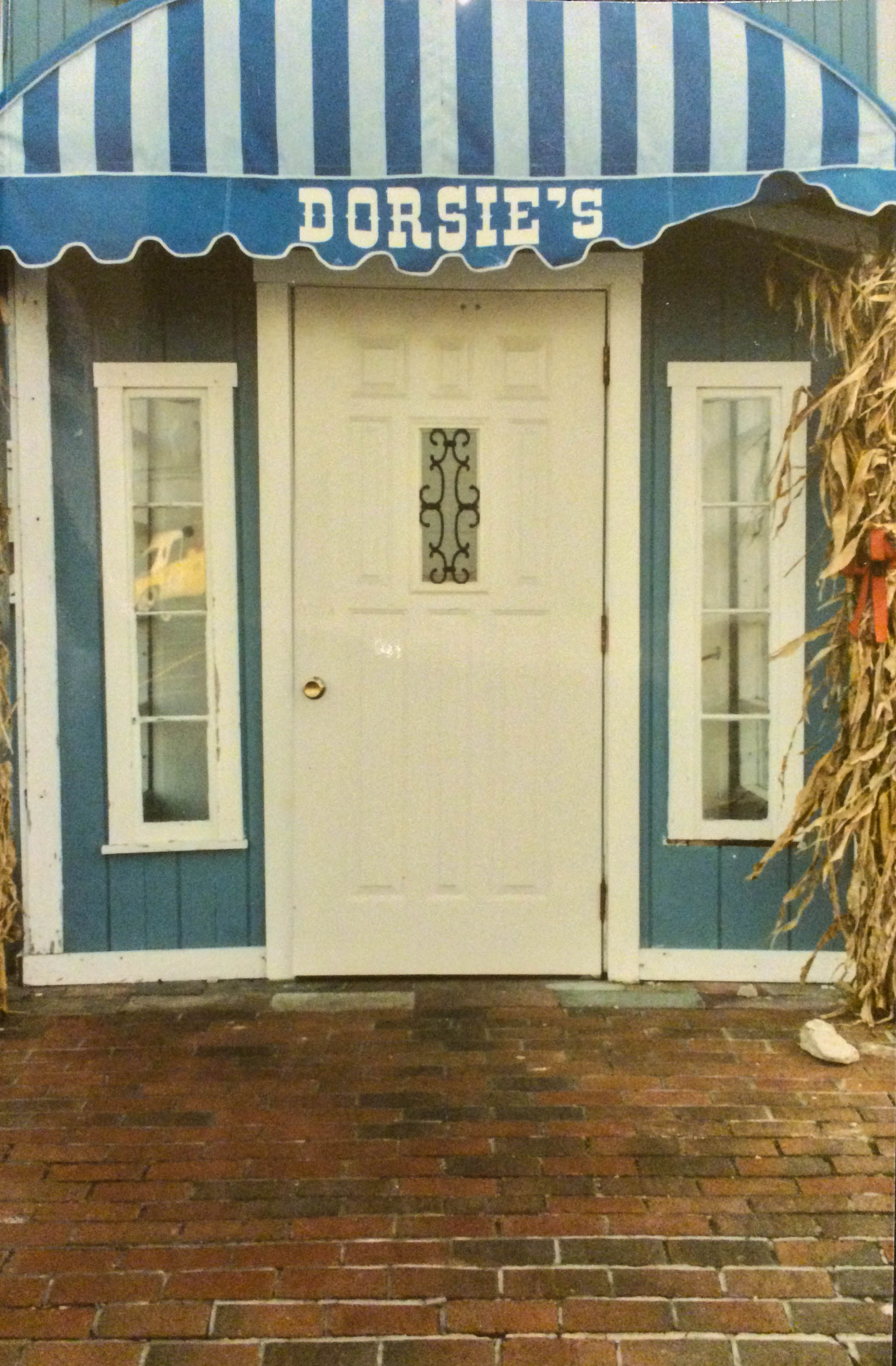
The front entrance


    Diane Dexter, who played piano and sang at Dorsie’s starting in 1981, has fond memories of her time playing there as well as the man behind it all.

    “I worked in their main lounge on a grand piano as a solo act,” she recalled, “playing and singing standards and pop/folk/country/rock songs that were popular at the time.”

    Dexter also recalls the Dorsieland Ragtime Review, a Dixieland band that played in the Gay Nineties Room and was a very popular attraction. As for Carey himself, Dexter remembered that he was “always very good with people.”

    The one thing that put Dorsie’s over the top was its affordably priced food. The establishment did a tremendous liquor business, which Carey wisely reinvested in his menu. Marinated steak tips, steak teriyaki, and prime rib were the biggest sellers, made even better by the fact that the meat would be cut and cooked at the Pit, right out in the dining room. Customers could watch while their food was prepared before their eyes. It only added to the uniqueness of Dorsie’s.

    After years of successfully running his mid-Cape complex, Carey yearned for a change. He got that chance when Cordage Park in Plymouth, which converted buildings into a mall in the 1980s, came calling. Carey sold Dorsie’s in 1990, and it became a Lambert’s Farm Market. In 1991, Carey opened Handlebar Harry’s, which became the anchor of the mall. It was tremendously popular in its own right and ran until 2003.

    Today, George “Dorsie” Carey is retired, but even more than thirty years after Dorsie’s closed its doors, he still has people coming up to him and wanting to reminisce about those good old days. As of 2022, Antiques Center of Yarmouth stands where Dorsie’s once did.

---------------------------------------------------------------------

Previous Blog Posts:

Be sure to check out my website: Christopher Setterlund.com

Zazzle Store: Cape Cod Living

Thursday, July 28, 2022

Searching for the Lady of the Dunes


I'm really excited to share this sort of trailer video for the Lady of the Dunes documentary and book. I've been wanting to do something to help explain more about the doc, book, and the case itself. There is some more information about everything in this video, but I also worked hard not to spoil much for those waiting to see the film or read the book. I hope you all enjoy it!

Saturday, July 23, 2022

In Their Footsteps: Cape Cod History - The First Cape Cod Canals


In 1914 the Cape Cod Canal opened and changed maritime travel in New England and beyond forever. The man-made waterway that connected Buzzards Bay to Cape Cod Bay had its construction begun June 1909. It was created by joining the Scusset River and the Manomet River. For over a century the Cape Cod Canal has been a well-traveled waterway. However did you know that the Cape Cod Canal was not the first attempt at created a cut-through around the Cape? What follows is the story of two other canal attempts in the decades before the current Cape Cod Canal was constructed.

The first attempted man-made cut through Cape Cod came two centuries ago much further east than the current canal location. ‘Jeremiah’s Gutter’ was the name of this waterway. ‘Gutter’ is another word for a channel or waterway. The name ‘Jeremiah’ comes from Jeremiah Smith who came from a founding Eastham family of the late 17th century.

On April 26, 1717 a strong nor’easter battered Cape Cod. It was in this storm that the famed pirate ship Whydah sank with all of its treasure aboard. This storm also carved a channel of varying depths running roughly from Town Cove in Orleans west to what is today Boat Meadow Beach in Eastham. The channel was used by British vessels trying to recover the sunken Whydah treasure in 1717. Afterwards it began to close up due both to nature and locals filling it in manually. The marshlands surrounding the channel, which stretched across the Cape from bayside in Eastham to oceanside in Orleans, often flooded causing the channel to be resurrected in a shallow form over the next several decades.

In 1804 it was decided to widen and deepen the passageway out along the previously created channel which ran over a mile and a half, nearly congruent with the Eastham/Orleans town line. The canal was named Jeremiah’s Gutter to honor Jeremiah Smith as it was much of his property that the waterway ran across.

Despite Jeremiah’s Gutter being widened and deepened it was barely used for nearly a decade. This changed during the War of 1812. It was during the second war with the British that the canal was used as a passageway by American ships carrying salt to avoid England’s blockade of Provincetown. This was the Gutter’s largest claim to fame.

c. Google Maps


Due to the large system of sandy tidal flats along Cape Cod Bay stretching from Brewster to Eastham the bay-side entrance to the canal often became choked with silt making that entrance way unreliable at low tide. It again was sparsely used by traveling vessels and would not be maintained. Jeremiah’s Gutter fell into disrepair and ceased to be used as a passageway for boats, although as late as 1844 large enough storms and tides would push water through making the canal whole again for a brief time.

Though it had begun fading into history the canal would have one more brush with fame when author Henry David Thoreau would mention Jeremiah’s Gutter in his iconic 1865 book Cape Cod. After that the eyes of the Cape would begin searching for a different location to create a more dependable canal. The idea of a new canal became more pressing during the late 1880’s when shipwrecks along Cape Cod’s coast occurred once every two weeks.

This is where the second canal comes into play. Jeremiah’s Gutter was a somewhat functioning canal. The new canal idea migrated west to Bass River. This was another natural waterway stretching from Nantucket Sound, up Bass River, and into Follins Pond.

Though ideas for another canal on Cape Cod had been bandied about for decades the proposed Bass River Canal first came to light in early 1887. It was the brainchild of longtime local shipping merchant Thomas Bacon. He had several good reasons why a man-made waterway would work at Bass River. First off it would save lives as the rough waves and shoals along the Atlantic Ocean side of Cape Cod had proven to be extremely dangerous for ships for centuries. In addition to being roughly ¾ finished already thanks to nature Bacon determined there would only be roughly two miles of excavation necessary between Follins Pond and Cape Cod Bay.

The original Bass River Bridge in the mid-1800's.(Historical Society of Old Yarmouth)


The natural waters were an average of ten-feet in depth. Bacon desired that the proposed canal be closer to sixteen-feet on average. The assumption was that the canal would empty into Cape Cod Bay through the flats between Bass Hole and Chapin Beach. Bass River was about 175-feet wide at its narrowest with its gravelly shores leaving little work to be done. Bacon’s plan was received well by those in the shipping industry. He enlisted the help of the newfound Cape Cod Ship Canal Co. to work with him on getting the project financed and underway.

Early estimates by Bacon had approximately two years of work needed to fully construct the Bass River Canal. He told a Boston Herald reporter in March 1887 that such a project would cost somewhere around $2.5 million($78 million in 2022). Throughout the spring of 1887 support grew for the canal with opposition being surprisingly low. Things progressed so well in fact that by November 1887 engineer Charles Thompson was surveying the proposed canal route.

Shockingly despite there seeming to be little reason why not to construct the Bass River Canal it was unanimously voted down by the committee on harbors and public lands in April 1888. Bacon was undeterred and the project was once against submitted to State Legislature in October 1888. His petition was ultimately withdrawn in January 1889.

It appeared as though the growing interest in building a canal between Bourne and Sandwich was making Bacon’s Bass River location less appealing. In addition Thomas Bacon had grown impatient with the efforts, or lack thereof, of the Cape Cod Ship Canal Co. to get the Bass River Canal project moving. In December 1890 Bacon petitioned to have the company removed from the project so that he could move on and find a more suitable finance partner. He then created the Bass River Canal Co.

In the court of public opinion it was a battle between the Bass River route and the Bourne-Sandwich route. The locals wanted a canal and were less interested in the bureaucratic battles behind the scenes between Bacon and the Cape Cod Ship Canal Co.

Thomas Bacon and his backers continued to petition the committee of harbors and public lands in 1891. There were conditions on the route’s width and depth, with provisions that a certain amount of capital($1 million) needing to be raised first before construction could begin. Several meetings were held with locals giving their two cents of the pros and cons of the canal.

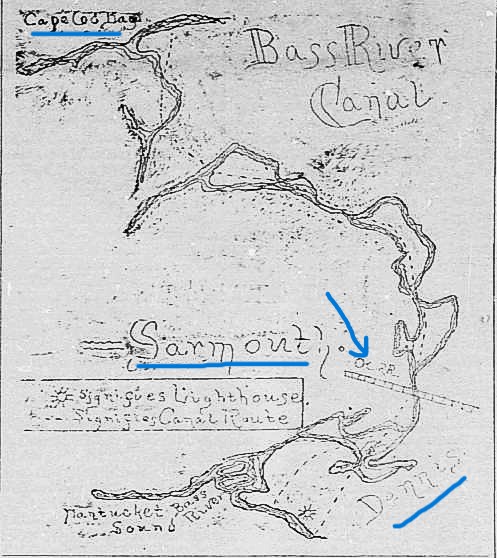
As momentum grew for a canal connecting Buzzards Bay to Cape Cod Bay Thomas Bacon’s Bass River project was continuously pushed down the road. Meetings and petitions were delayed and postponed repeatedly. In December 1891 things seemed to gain traction when civil engineer A.H. Knowles completed a thorough survey of the proposed route including a hand-drawn map.

The 1891 Bass River Canal map. The arrow points to where the Bass River Bridge was.


The Bourne-Sandwich canal was still seen as less feasible which gave the Bass River Canal hope in 1893 when it was yet again submitted as a petition. In June 1894 the Massachusetts House voted in favor of the Bass River Canal, and a year later the company secured a charter. Plans were in place to begin construction which was estimated to last two years and cost between $5-8 million ($176-282 million).

Sadly this is where the project died a death. After four years the charter had been dissolved and no work was ever done on the proposed Bass River Canal. In 1899 the charter for building a canal was granted to the Boston, New York, and Cape Cod Co. which intended to build the canal between Bourne and Sandwich.

For several years after the Bass River Canal Co. attempted to regain their own charter for their canal. Finally in May 1904 the Massachusetts State Senate dealt the company its death blow by flat out rejecting the Bass River Canal proposal. The doorway was open and in 1904 August Belmont purchased and reorganized the Boston, New York, and Cape Cod Co.

Sunset at the Cape Cod Canal.


The rest is history. Work began on the Cape Cod Canal as we know it on June 19, 1909, opening on July 29, 1914. The Bass River Canal idea, much like Jeremiah’s Gutter before it, faded into history. Or did it?

In 1966 rumblings began of a potential look into the feasibility of a Bass River canal. There was even a proposal in February 1966 for $15,000 for a study into whether such a project could be done. However, nothing came from it.

In the end Jeremiah’s Gutter actually was used by boats. The Bass River Canal spent decades locked in legislation before being dissolved without even a spoonful of dirt being shoveled. It is interesting though to think of what Cape Cod would look like today with a Bass River Canal and the Scusset and Manomet Rivers still intact in Bourne and Sandwich.
-------------------------------------------------------------------------