I'm really excited to share this sort of trailer video for the Lady of the Dunes documentary and book. I've been wanting to do something to help explain more about the doc, book, and the case itself. There is some more information about everything in this video, but I also worked hard not to spoil much for those waiting to see the film or read the book. I hope you all enjoy it!

The blog of In My Footsteps Podcast host and author Christopher Setterlund. It contains a buffet of topics. The wackiness of daily life with Initial Impressions 2.0. There is a link to the weekly In My Footsteps Podcast. Poetry collections, life topics, some history, and more. There is something for everyone here much like with the podcast.
Thursday, July 28, 2022

Saturday, July 23, 2022
In Their Footsteps: Cape Cod History - The First Cape Cod Canals
In 1914 the Cape Cod Canal opened and changed maritime travel in New England and beyond forever. The man-made waterway that connected Buzzards Bay to Cape Cod Bay had its construction begun June 1909. It was created by joining the Scusset River and the Manomet River. For over a century the Cape Cod Canal has been a well-traveled waterway. However did you know that the Cape Cod Canal was not the first attempt at created a cut-through around the Cape? What follows is the story of two other canal attempts in the decades before the current Cape Cod Canal was constructed.
The first attempted man-made cut through Cape Cod came two centuries ago much further east than the current canal location. ‘Jeremiah’s Gutter’ was the name of this waterway. ‘Gutter’ is another word for a channel or waterway. The name ‘Jeremiah’ comes from Jeremiah Smith who came from a founding Eastham family of the late 17th century.
On April 26, 1717 a strong nor’easter battered Cape Cod. It was in this storm that the famed pirate ship Whydah sank with all of its treasure aboard. This storm also carved a channel of varying depths running roughly from Town Cove in Orleans west to what is today Boat Meadow Beach in Eastham. The channel was used by British vessels trying to recover the sunken Whydah treasure in 1717. Afterwards it began to close up due both to nature and locals filling it in manually. The marshlands surrounding the channel, which stretched across the Cape from bayside in Eastham to oceanside in Orleans, often flooded causing the channel to be resurrected in a shallow form over the next several decades.
In 1804 it was decided to widen and deepen the passageway out along the previously created channel which ran over a mile and a half, nearly congruent with the Eastham/Orleans town line. The canal was named Jeremiah’s Gutter to honor Jeremiah Smith as it was much of his property that the waterway ran across.
Despite Jeremiah’s Gutter being widened and deepened it was barely used for nearly a decade. This changed during the War of 1812. It was during the second war with the British that the canal was used as a passageway by American ships carrying salt to avoid England’s blockade of Provincetown. This was the Gutter’s largest claim to fame.
 |
| c. Google Maps |
Due to the large system of sandy tidal flats along Cape Cod Bay stretching from Brewster to Eastham the bay-side entrance to the canal often became choked with silt making that entrance way unreliable at low tide. It again was sparsely used by traveling vessels and would not be maintained. Jeremiah’s Gutter fell into disrepair and ceased to be used as a passageway for boats, although as late as 1844 large enough storms and tides would push water through making the canal whole again for a brief time.
Though it had begun fading into history the canal would have one more brush with fame when author Henry David Thoreau would mention Jeremiah’s Gutter in his iconic 1865 book Cape Cod. After that the eyes of the Cape would begin searching for a different location to create a more dependable canal. The idea of a new canal became more pressing during the late 1880’s when shipwrecks along Cape Cod’s coast occurred once every two weeks.
This is where the second canal comes into play. Jeremiah’s Gutter was a somewhat functioning canal. The new canal idea migrated west to Bass River. This was another natural waterway stretching from Nantucket Sound, up Bass River, and into Follins Pond.
Though ideas for another canal on Cape Cod had been bandied about for decades the proposed Bass River Canal first came to light in early 1887. It was the brainchild of longtime local shipping merchant Thomas Bacon. He had several good reasons why a man-made waterway would work at Bass River. First off it would save lives as the rough waves and shoals along the Atlantic Ocean side of Cape Cod had proven to be extremely dangerous for ships for centuries. In addition to being roughly ¾ finished already thanks to nature Bacon determined there would only be roughly two miles of excavation necessary between Follins Pond and Cape Cod Bay.
 |
| The original Bass River Bridge in the mid-1800's.(Historical Society of Old Yarmouth) |
The natural waters were an average of ten-feet in depth. Bacon desired that the proposed canal be closer to sixteen-feet on average. The assumption was that the canal would empty into Cape Cod Bay through the flats between Bass Hole and Chapin Beach. Bass River was about 175-feet wide at its narrowest with its gravelly shores leaving little work to be done. Bacon’s plan was received well by those in the shipping industry. He enlisted the help of the newfound Cape Cod Ship Canal Co. to work with him on getting the project financed and underway.
Early estimates by Bacon had approximately two years of work needed to fully construct the Bass River Canal. He told a Boston Herald reporter in March 1887 that such a project would cost somewhere around $2.5 million($78 million in 2022). Throughout the spring of 1887 support grew for the canal with opposition being surprisingly low. Things progressed so well in fact that by November 1887 engineer Charles Thompson was surveying the proposed canal route.
Shockingly despite there seeming to be little reason why not to construct the Bass River Canal it was unanimously voted down by the committee on harbors and public lands in April 1888. Bacon was undeterred and the project was once against submitted to State Legislature in October 1888. His petition was ultimately withdrawn in January 1889.
It appeared as though the growing interest in building a canal between Bourne and Sandwich was making Bacon’s Bass River location less appealing. In addition Thomas Bacon had grown impatient with the efforts, or lack thereof, of the Cape Cod Ship Canal Co. to get the Bass River Canal project moving. In December 1890 Bacon petitioned to have the company removed from the project so that he could move on and find a more suitable finance partner. He then created the Bass River Canal Co.
In the court of public opinion it was a battle between the Bass River route and the Bourne-Sandwich route. The locals wanted a canal and were less interested in the bureaucratic battles behind the scenes between Bacon and the Cape Cod Ship Canal Co.
Thomas Bacon and his backers continued to petition the committee of harbors and public lands in 1891. There were conditions on the route’s width and depth, with provisions that a certain amount of capital($1 million) needing to be raised first before construction could begin. Several meetings were held with locals giving their two cents of the pros and cons of the canal.
As momentum grew for a canal connecting Buzzards Bay to Cape Cod Bay Thomas Bacon’s Bass River project was continuously pushed down the road. Meetings and petitions were delayed and postponed repeatedly. In December 1891 things seemed to gain traction when civil engineer A.H. Knowles completed a thorough survey of the proposed route including a hand-drawn map.
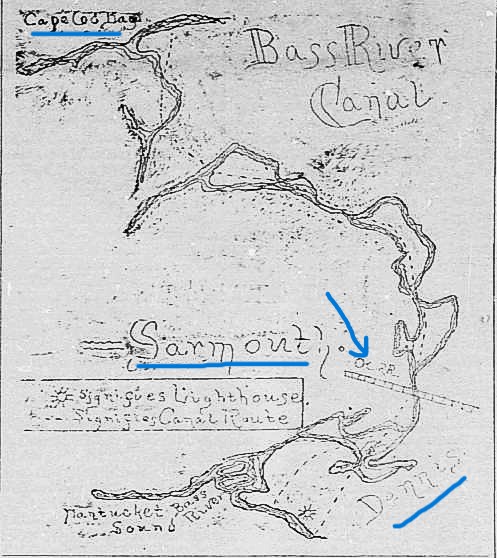 |
| The 1891 Bass River Canal map. The arrow points to where the Bass River Bridge was. |
The Bourne-Sandwich canal was still seen as less feasible which gave the Bass River Canal hope in 1893 when it was yet again submitted as a petition. In June 1894 the Massachusetts House voted in favor of the Bass River Canal, and a year later the company secured a charter. Plans were in place to begin construction which was estimated to last two years and cost between $5-8 million ($176-282 million).
Sadly this is where the project died a death. After four years the charter had been dissolved and no work was ever done on the proposed Bass River Canal. In 1899 the charter for building a canal was granted to the Boston, New York, and Cape Cod Co. which intended to build the canal between Bourne and Sandwich.
For several years after the Bass River Canal Co. attempted to regain their own charter for their canal. Finally in May 1904 the Massachusetts State Senate dealt the company its death blow by flat out rejecting the Bass River Canal proposal. The doorway was open and in 1904 August Belmont purchased and reorganized the Boston, New York, and Cape Cod Co.
 |
| Sunset at the Cape Cod Canal. |
The rest is history. Work began on the Cape Cod Canal as we know it on June 19, 1909, opening on July 29, 1914. The Bass River Canal idea, much like Jeremiah’s Gutter before it, faded into history. Or did it?
In 1966 rumblings began of a potential look into the feasibility of a Bass River canal. There was even a proposal in February 1966 for $15,000 for a study into whether such a project could be done. However, nothing came from it.
In the end Jeremiah’s Gutter actually was used by boats. The Bass River Canal spent decades locked in legislation before being dissolved without even a spoonful of dirt being shoveled. It is interesting though to think of what Cape Cod would look like today with a Bass River Canal and the Scusset and Manomet Rivers still intact in Bourne and Sandwich.
-------------------------------------------------------------------------
Previous Blog Posts:
Be sure to check out my website: Christopher Setterlund.com
Zazzle Store: Cape Cod Living
Friday, June 10, 2022

Sunday, June 5, 2022

Thursday, May 26, 2022

Sunday, May 22, 2022
In Their Footsteps: Do You Remember These Restaurant Chains on Cape Cod?
A chain restaurant is an establishment with many locations under the same company’s ownership. A similar business model is that of the franchise where the overall restaurant concept is sold to different owners. In America there are countless famed chain and franchise restaurants from fast food juggernauts like McDonald’s, Wendy’s, and Burger King, to casual sit-down eateries like Applebee’s, Olive Garden, and Chili’s.
Cape Cod in the last half century has seen a greater influx of the chain and franchise restaurants after spending much of the previous half century relying on single-location ‘mom and pop’ type establishments. Today there are well-established chains on the peninsula like McDonald’s, 99 Restaurants, and Olive Garden.
Looking back though there have been some famous chains and franchises that once called Cape Cod home. A few were here recently, a few closed long ago. Do you remember when Cape Cod housed these former iconic chains? Here is a list of some of them that once resided on the Cape.
Howard Johnson’s

Charles Hathaway/Flickr
Est. 1925 – around 1,000 locations at peak This was the original chain/franchise. It opened its very first location in Wollaston, Massachusetts. It was known for its bright orange roof. Owned by Howard Deering Johnson the burgers and ice cream establishment opened its first franchise in Orleans at the junction of Rt. 6A and Rt. 28. Later there would be locations in West Dennis, Hyannis, Bourne, and Falmouth. As of 2022 only one Howard Johnson’s remains in Lake George, New York.Burger Chef
 Est. 1954 – 1,050 locations at peak For a time in the 1970’s Burger Chef was the #2 fast food restaurant in America behind only McDonald’s. The first location was opened in Indianapolis, Indiana. Known for signature items like the Big Shef and Super Shef burgers as well as being the originator of the kid’s meal, Burger Chef made its way to Cape Cod in the late 1960’s. Their one location was on Rt. 28 in West Yarmouth and lasted until the early 1980’s. It was in 1982 when Burger Chef was sold, with most locations being converted to Hardee’s, or simply closed down.
Denny’s

Est. 1953 – 1,487 locations in 2021 Denny’s is a powerhouse in the sit-down breakfast restaurant business. Their Grand Slam breakfast is well-known across America. It was originally founded in Lakewood, California by Harold Butler and Richard Jezak. For nearly the entirety of its existence Denny’s has been rivaled by the International House of Pancakes(est. 1958). This came to be on Cape Cod as well when Denny’s opened its only location on Rt. 132 in Hyannis in 1983. IHOP was and still is located a half-mile down the road. Denny’s only lasted a few years before being shuttered on the Cape though. The nearest Denny’s to Cape Cod is currently in Fall River.Mr. Donut

Mister-Donut.com
Est. 1955 – around 550 locations at peak This spot is shockingly bigger than ever, despite only having one remaining location in America. It was established in 1955 by Harry Winkour. He had worked with his brother-in-law William Rosenberg who had established Dunkin’ Donuts in 1950. Mr. Donut had a pair of Cape Cod locations in Hyannis on Rt. 28 and West Main Street from the late 1970’s through the early 1990’s. As of 2022 there is only one Mr. Donut remaining in the United States, that being in Godfrey, Illinois. However in total there are roughly 5,500 Mr. Donut locations worldwide, with the majority being in Asia.Old Country Buffet

Est. 1983 – around 500 locations at peak A more recent entry this family-style buffet spot was a staple for decades peaking at about 500 locations in 36 states. In Hyannis this establishment was located in the Festival shopping plaza from 1995-2010. It was a popular and low-cost spot for family meals and gatherings for local sports teams after games. Three bankruptcy filings came, combined with an increasing worry over obesity by many Americans. This spelled the slow decline of the buffet chain. As of 2022 the number of Old Country Buffet restaurants left in the U.S. stood at 17 and shrinking.Arthur Treacher’s Fish and Chips

Nicholas Eckhart/Flickr
Est. 1969 – over 800 locations at peak This chain was named for English character actor Arthur Treacher who had roles in Mary Poppins and was a butler in several Shirley Temple films. The classic seafood fare restaurant began in Columbus, Ohio in 1969 with Wendy’s founder Dave Thomas as one of the principal owners. By the late-1970’s it grew to its peak of over 800 locations. This included 2 locations on Cape Cod. One was on Rt. 28 in South Yarmouth where the Lighthouse Landing strip mall is, which opened in May 1977. The other on North Street in Hyannis opened in 1978. They both last only a few years. As of 2022 there is only one Arthur Treacher’s left in America in Cuyahoga Falls, Ohio.Jack In the Box

Est. 1951 – 2,228 locations as of 2021 The largest active chain on this list Jack In the Box is firmly established throughout the south and west of the United States. Whether for the unique mascot ‘Jack’ or it’s eclectic menu including traditional burgers and fries but also tacos this chain has been a staple for more than 70 years. It was originally founded by Robert Peterson in San Diego, California and sports more than 2,200 locations as of 2022. On Cape Cod Jack In the Box had its one and only location debut inside the Cape Cod Mall upon the shopping center’s grand opening in 1970. It survived for a decade before closing. Today the closest Jack In the Box locations are in North Carolina.Hooters

Hooters.com
Est. 1983 – 311 locations as of 2021 Another recent entry, Hooters had a location on Main Street in Hyannis. Founded in 1983 in Clearwater, Florida this sports bar type establishment is known as much for its servers known as ‘Hooters Girls’ as it is for its actual cuisine. The Cape Cod location opened in 2003 despite major opposition. It only last a few years before shuttering in 2007. The former location is currently home to Kkatie’s Burger Bar. If you’re craving Hooters wings the nearest one is in Warwick, Rhode Island.Sambo’s

Est. 1957 – over 1,100 locations at peak This once-popular chain, with a controversial name, was founded in Santa Barbara, California by Sam Battistone Sr., and Newell Bohnett. The name was a mash-up of the owners names, however it also was a highly derogatory slur used toward African-Americans. The restaurant was a diner-style chain promoting everything from pancakes to steak and more. By the time Sambo’s came to Cape Cod in 1978 there were already loud cries for the company to change its name. It opened near the Airport Rotary in Hyannis in the same building that would eventually hold Denny’s and Pizzeria UNO among others. In 1981 it changed its name to No Place Like Sam’s before closing in late 1982. The company filed for bankruptcy in late 1981 with all but one of the restaurants closing or changing their names within a year. The last Sambo’s, owned by Battistone’s grandson, finally changed its name to ‘Chad’s’ in 2020.Lum’s

Dr. Neil Gale/Blogspot.com
Est. 1956 – around 450 locations at peak This classic American cuisine chain was founded in Miami Beach, Florida in 1956. Their signature item was hot dogs steamed in beer. A rapid expansion of the chain led to two Lum’s on Cape Cod opening in Hyannis and Falmouth in 1972. During this same time the chain gained national attention with famed comedian Milton Berle as their spokesperson. Both Cape locations were closed by 1980 as the rapid expansion had stretched the chain thin. By 1982 Lum’s had filed for bankruptcy. The last remaining Lum’s in Bellevue. Nebraska closed in 2017.




-------------------------------------------------------------------------
Previous Blog Posts:
Be sure to check out my website: Christopher Setterlund.com
Zazzle Store: Cape Cod Living
Sunday, May 15, 2022
In Their Footsteps: Cape Cod History - The Cape's Worst Wildfire
When one hears the word ‘wildfire’ it typically refers to tragic events that commonly occur in California. The routinely dry conditions, which give the state some of the most desirable weather in the country, also leave it vulnerable to fires. The largest wildfire, in August 2020, burned more than one million acres of land in six counties and destroyed 935 structures. In comparison the entirety of the Cape Cod National Seashore is 43,607 acres.
Despite it not being as serious a threat to the Cape as hurricanes and blizzards are, wildfires have occurred more often than you would think. The worst fire in Cape Cod history happened over seventy-five years ago and this is the story of the perfect storm that led to it.
The seeds of the worst forest fire in Cape Cod history were sown beginning eighteen months prior. The Great Atlantic Hurricane struck New England on September 15, 1944 with heavy rain and strong winds. Needless to say the winds toppled countless trees. By the time the spring of 1946 arrived there were still plenty of those dead trees lying where they fell.
The late-winter and early-spring of 1946 were particularly dry. The threat of potential wildfires was so high that in March State Deputy Fire Warden Ormand Dottridge Jr. warned residents of what could happen. Regulations were put into place for burning leaves and people were implored to be careful and not start anything they couldn't finish.
Watch-tower service and forest fire patrols were put into service. Despite this there were small fires that began breaking out in late March. These were a precursor of what was to come.
Early on April 19, 1946 fire broke out in Sandwich in the area near the Bourne Bridge. Northwest winds gusting up to 35mph combined with the relatively dry conditions were a terrible combination. The fire pushed south and east through the Shawme-Crowell State Forest and toward Camp Edwards(Otis AFB).
 |
| The Bourne Bridge, near where the fire originated. |
Firefighters temporarily got the fire in check by building several backfires a mile from Sandwich center. This was only brief though and by 9pm on April 20th a 15-square mile area of Sandwich and Mashpee was burning or charred. Governor Maurice Tobin closed all public forest land in Southeastern Massachusetts. He also went to the Cape to help direct operations. There was still a few days before a chance of rain and the situation was extremely serious.
 |
| Barnstable County Brush Breaker c.1942(CapeCodFD.com) |
Sandwich, Bourne, and West Barnstable were temporarily left without power as fire scorched the wires. The fire jumped across Route 130 and seemed to be on a collision course with West Barnstable and possibly Hyannis. More than 3,000 firefighters came from fifty-two different communities and worked nonstop building backfires, digging trenches, and working the fire hoses. They were led by John Stokes, the state commissioner of public safety, who left Boston to help. The group set up headquarters the East Sandwich Grange Hall on Old County Road.
At midday on April 21st the fire could be seen and smelled in Hyannis. It was only six miles west of the airport. The State Police barracks in South Yarmouth expressed their concern if the winds did not subside. The flames got to within a quarter-mile of forty homes in Sandwich. Much of Rt. 130 and parts of Route 6A(then Old Kings Highway) were closed to all but fire vehicles. Trains from Boston to Hyannis were diverted to Woods Hole with passengers then being shuttled by bus the rest of the way.
Late in the afternoon of April 22nd the blaze had finally been contained. What turned the tide was the firefighters burning a 1,000-foot wide hollow square around the fire.

The Sandwich Fire Tower that was a big part of the event.(CapeCodFD.com)
When all was said and done authorities estimated 30-35,000 acres of Cape Cod land had burned, though the official number is likely closer to 15,000. More than twenty-five structures were lost and over one hundred people had been evacuated from their homes. The fire traveled a total of 8 ½ miles east from the Bourne Bridge. The price tag of damage was said to be more than $1 million($14.74 million in 2022). It took another 24-48 hours to fully extinguish the fire. In the immediate aftermath it was described as the worst forest fire in Massachusetts history.
The worst part of the entire ordeal was the fact that these fires appeared to have been deliberately set. They were a series of small fires that came together to wreak havoc on the Upper Cape.
On April 26th two Falmouth men, Theodore Andrade and Ruby Antone, were arrested in connection with the fires. Local authorities said that up to twelve fires had been set and that they thought there were more than two people responsible. The two men claimed that they had spotted one of the fires and had stopped to try to put it out.
The dry weather did not subside and less than two weeks later two more massive fires broke out. The fires that occurred on May 7th centered in Yarmouth and West Barnstable ended up destroying 8,000 more acres. Unbelievably officials believed these fires to be deliberately set as well.
In October 1946 Andrade and Antone faced a Grand Jury for their possible roles in the fires. Before they even went to trial they were found guilty for receiving stolen goods and sentenced to six months in jail. That charge was later overturned and the Grand Jury dismissed the charges pertaining to the fires. No other suspects were ever arrested.
The most devastating forest fire on Cape Cod was actually captured on film. The Massachusetts Department of Conservation and Recreation is responsible for the filming and it is broken up into two parts on YouTube. You can see the terrible damage caused and also the tireless work of the brave firefighters who fought to put it out.
Cape Cod Brush Fire 1946 Part 1
Cape Cod Brush Fire 1946 Part 2
-----------------------------------------------------------------------------------------------------
Previous Blog Posts:
Be sure to check out my website: Christopher Setterlund.com
Zazzle Store: Cape Cod Living
Subscribe to:
Posts (Atom)