March 4, 2018, Winter Storm Riley tore through Cape Cod with winds gusting over 90 mph. Even worse was the storm surge and erosion.
I went live on Facebook on location at Nauset Beach in Orleans during the storm's peak.
My phone's battery died during the stream, and I could not find the footage on Facebook. Since I never officially 'ended' the stream, I figured it was not saved and, therefore, lost.
I looked many times over the years with no luck. Then this week by happenstance I was looking for a different post when lo and behold I found the raw footage in my archives.
What we have here is that livestream footage of Winter Storm Riley at its peak forever changing one of Cape Cod's most iconic locations.
I did my best to remaster the video, fix the audio due to the intense winds, and even add captions where I could to make the viewing experience as good as it could be.
To listen to episodes of the In My Footsteps Podcast click here: https://inmyfootstepspodcast.buzzsprout.com/
Become A Subscriber to the Podcast on Patreon: patreon.com/InMyFootstepsPodcast

The blog of In My Footsteps Podcast host and author Christopher Setterlund. It contains a buffet of topics. The wackiness of daily life with Initial Impressions 2.0. There is a link to the weekly In My Footsteps Podcast. Poetry collections, life topics, some history, and more. There is something for everyone here much like with the podcast.
Showing posts with label nauset. Show all posts
Showing posts with label nauset. Show all posts
Monday, March 10, 2025

Wednesday, May 10, 2023
In My Footsteps: Hiking Cape Cod
With spring and summer comes the increased desire to get out and enjoy the beautiful weather. Living on Cape Cod there is no shortage of places to see and explore. Hiking is a fantastic way to get out into nature, get some exercise, and explore the great outdoors. However, hiking can also be dangerous if you're not prepared or don't take the necessary precautions.
What I am going to do here is share some amazing places to go exploring on Cape Cod and also give some tips on how to enjoy hiking outdoors safely.
1. Plan your route: Before you start your hike, it's essential to plan your route. Luckily Cape Cod is a peninsula and the odds of getting lost in somewhere truly inhospitable are small. However, it is important to have a general sense of where you are and where you are going. Doing a little research won’t hurt. Choose a trail that is suitable for your fitness level and experience. For the most part, Cape Cod is a series of beginner to moderate hiking trails.
2. Bring the right gear: This is a given. Make sure you have appropriate footwear that provides good support and traction. Wear comfortable clothing that is appropriate for the weather conditions. If the hike is long enough bring a backpack with essential items such as water, snacks, sunscreen, a hat, and maybe a first aid kit. There are plenty of short hikes on Cape Cod, but there are also some that can be up to ten miles or longer.
3. Check the weather forecast: This is true for any time of year. Hiking is fun, but hiking in the pouring rain, wind, or snow is not. That’s not to say that some inclement weather can’t make for a fun adventure. The main point is to think ahead. A little drizzle or hot temperatures might not ruin a hike, but a downpour can change the complexion of a trail turning packed dirt to slippery muck.
4. Hike with a buddy: It's always a good idea to hike with a buddy or a group of people. Not only is it more fun to hike with others, but it's also safer. If you get lost or injured, you'll have someone there to help you.
5. Stay on the trail: When hiking, always stay on the trail. Don't wander off the path, as you can damage the environment and get lost. There is also a prevalence of ticks that can cause Lyme Disease. Most trails are crafted to make sure you get the best experience so diverting from it shouldn’t be necessary.
6. Pace yourself: Hiking can be physically demanding. Don't push yourself too hard and listen to your body. If you feel tired or lightheaded, take a break and have a snack or drink some water. It also gives you ample time to take in the scenery and even snag a couple amazing photos.
7. Respect wildlife: Remember when hiking, you’re in nature’s house. Keep your distance from animals and don't disturb their natural habitat. Don't feed animals or leave food out, as this can attract wildlife and create dangerous situations.
8. Leave no trace: This is most important. Don't leave anything behind, and don't damage the environment by carving your name into trees or rocks. Take out what you take in. We only have one environment and it is important to leave its beauty for future generations.
That’s a pretty comprehensive list, but it’s all common sense stuff. Be smart, be respectful, and be prepared. Now that you know how to properly enjoy a good hike on Cape Cod it’s time to share a few places to implement the tips. They will also be designated as easy, moderate, or difficult so that all experience levels can find somewhere incredible to visit.
1. Great Island Trail: Wellfleet – Moderate: This trail can be easy or moderate depending on the path you take. It is anywhere from 3.9 – 8.8 miles in total length. There are spectacular views of Cape Cod Bay and Jeremy Point. The uplands take you past the 17th Century Samuel Smith Tavern Site.
 |
| Great Island Trail |
2. Nauset Marsh Trail: Eastham – Easy/Moderate: This trail can be easy or moderate as well. There is a marsh loop trail that is 1.2 total miles but for more of a challenge you can add in the Nauset Bike Trail to bump the total distance up to 4.1 miles. You circle Salt Pond and can venture out to Salt Pond Bay. The bike trail leads you all the way out to the iconic Coast Guard Beach as well.
 |
| Nauset Marsh Trail |
3. Long Point Lighthouse Trail: Provincetown – Moderate: One of the most visible yet least traversed trails on Cape Cod. The approximately 5.9 total mile hike begins with a somewhat challenging walk across Provincetown’s West End Breakwater. It continues with a sandy stroll out onto Long Point to the eponymously named lighthouse. The views of Provincetown’s waterfront along with the boats that dock on Long Point make this a wonderful way to spend a day.
 |
| Long Point Lighthouse |
4. Waquoit Bay Trail: Mashpee – Easy: A beautiful out-and-back walk along South Cape Beach leads you from the parking area to the shores of Waquoit Bay. At a little over 2 miles, it is a relatively easy hike although some soft sand can slow your progress down at times.
 |
| South Cape Beach State Park |
Wing Island Trail: Brewster – Easy: Be sure to keep an eye on the tides before you go. Once the timing is right though this is an easy hike with a panoramic view of Cape Cod Bay at the end. It can be anywhere from 1.5 miles to slightly longer depending on how much of the beach you choose to explore.
 |
| Wing Island Trail |
These are but a few of the incredible hikes on Cape Cod. There are so many hidden gems, not to mention more than one hundred miles of paved bike trails. Whether you choose to explore one of the mentioned trails, or you choose your own adventure, be sure to have fun and be safe!
Wednesday, February 3, 2021
In Their Footsteps: Cape Cod History - The Three Sisters of Nauset
Lighthouses are invariably connected to the sea. They overlook the water helping to guide vessels safely. However there are three fascinating little lighthouses in Eastham that are not even within sight of water. Sitting quietly in a field 1/3 of a mile from the ocean's waves are the Three Sisters of Nauset. How did they get there? This is their story.
The history of the Three Sisters began nearly 200-years ago when the Town of Eastham petitioned to have a beacon built along the shore to protect passing vessels after there had been so many shipwrecks. The proposal was approved on March 3, 1837 with $10,000($271,000 in 2021) being appropriated for construction of the new light station. However instead of there being one lighthouse it was decided that there would be three. The reasoning was to help vessels differentiate the Eastham lights from the single Highland Light to the north in Truro, and the twin lights of Chatham to the south. The fifteen-foot tall brick structures were constructed by local builder Winslow Lewis and his team who had put in the lowest bid.
The triplet lighthouses were hastily built by Lewis and his crew, 150-feet apart on 5 acres of land that had been bought for $150. In all it took a mere 38 days for construction. The crew did not even abide by the markers for the three beacons that had been laid out. The project was seen afterward to have been cursed as work on the beacons had occurred routinely on Sundays which was seen still at the time as a desecration of the Sabbath. On July 30, 1838 the Eastham lighthouses were lit for the first time.
The three towers which were initially referred to as 'the line lights,' due to the fact that they were constant and not flashing, soon gained the ‘Three Sisters’ nickname. Legend has it that vessels passing by remarked that they resembled three ladies in white dresses wearing black hats. Iconic author Henry David Thoreau came upon them during one of his visits to Cape Cod in the mid 19th century. He was less than impressed, calling the beacons 'shiftless and costly.' Another harsh criticism came from a report from Lt. Edward Carpender when inspecting the site in 1858. He saw the Three Sisters as serving no purpose as they did not help to guide vessels into any nearby harbor. Carpender also stated that the job of the three could just as easily be done by one beacon, preferably with a red-colored lantern.
Despite less than favorable opinions by some the lighthouses did their job for decades until shoreline erosion threatened them. Today when a lighthouse is threatened measures are taken to save them by moving them safely away from the eroding cliffs. In the late 1800’s though the three brick towers were simply allowed to succumb to nature and fall into the sea. They were replaced in 1892 by three new ‘Sisters’ standing twenty-two feet tall and 150-feet apart. These new wooden towers with brick foundations were positioned thirty-feet back from where the original towers had fallen.
 |
| The Three Sisters watching over the Eastham bluffs. (Eastham Historical Society) |
The relentless hand of nature continued to eat away at the cliffs of present day Nauset Light Beach. In less than twenty-years the shoreline had eroded to the point that it was within eight-feet of one of the towers. Finally in 1911 it was decided that a single flashing lighthouse would be the best course of action going forward and the Three Sisters were decommissioned. Only the center tower would remain as a solo beacon attached to the lighthouse keeper’s house. The two discontinued lights were sold to B.J. and Helen Cummings in 1918 for $3.50 ($60.37 in 2021) each. They were moved in 1920 to Cable Road after some repairs, joined together by a room, and renamed the ‘Twin Lights Cottage.’ The beacons were used, one as a pair of bedrooms, the other as a kitchen, as the cottage also saw use as a gift shop and dance studio.

'Twin Lights Cottage' (Eastham Historical Society)
The career of the remaining Sister along the shore was short-lived. By 1923 it has also fallen into disrepair. Rather than fixing it up it was decided that it would be decommissioned and replaced. It would be sold to Albert and Mary Hall for 50 cents($7.62 in 2021) and turned into a cottage much like the other two Sisters, named 'The Beacon.'

'The Beacon' cottage. (Eastham Historical Society)
A perfect substitute to take command of protecting Eastham’s coastal waters sat thirteen miles to the south in Chatham. It was there at the Coast Guard Station where another recently decommissioned lighthouse, one of the Chatham Twin Lights, resided. The forty-eight foot tall cast iron tower was moved to Eastham. Nauset Lighthouse was born, although it did not get its partial coat of red paint until 1940.
After the formation of the Cape Cod National Seashore in 1961 the lighthouse cottages were grandfathered in. In 1965 the Twin Lights Cottage on Cable Road was purchased by the National Park Service. The center tower cottage was purchased ten years later in 1975. It was reunited with its other Sisters, being placed in its former spot between them for the first time in over 50 years. After extensive renovations in the 1980's the Three Sisters were opened for tours with a formal dedication of the site taking place on May 16, 1990.

The Three Sisters as they appear today.
Around the turn of the 21st century the Three Sisters caused a bit of a stir along the shore. It is just off shore at Nauset Light Beach that a circular brick foundation was unearthed by the shifting sands. It was determined to be a foundations of one of the Three Sisters that had fallen over the bluff. Though it's been basically covered back up in the years since every so often it becomes exposed again and when the tide is low enough one can walk right out and touch it.
Lighthouses are a part of the fabric of Cape Cod and have been for centuries. Some have simple stories, some have complex stories, it is likely though that none have a story as unique as that of the Three Sisters.
-------------------------------------------------------------
Previous Blog Posts:
Be sure to check out my website: Christopher Setterlund.com
Zazzle Store: Cape Cod Living
Thursday, June 4, 2020
In Their Footsteps: Cape Cod History - The Journey of the Three Sisters of Nauset
Lighthouses
are as much a part of Cape Cod’s history and allure as its miles of
beaches, quaint villages, and fabulous shops. There are eighteen
lighthouses on Cape Cod. Some of them are more universally known,
such as Chatham Light, Nauset Light, Race Point Light, Highland
Light, and Nobska Light. There are a few lesser known like Cleveland
Ledge Light, Wings Neck Light, and Point Gammon Light, yet all of the
structures have one common thread, they are located on the water.
However there are three lighthouses in Eastham that are not even
within sight of water. In fact they sit quietly in a field on Cable
Road more than 1,800-feet from the ocean. These are the Three
Sisters of Nauset and their story is one of the most fascinating in
Cape Cod history. It is a story that is still going on to this day.
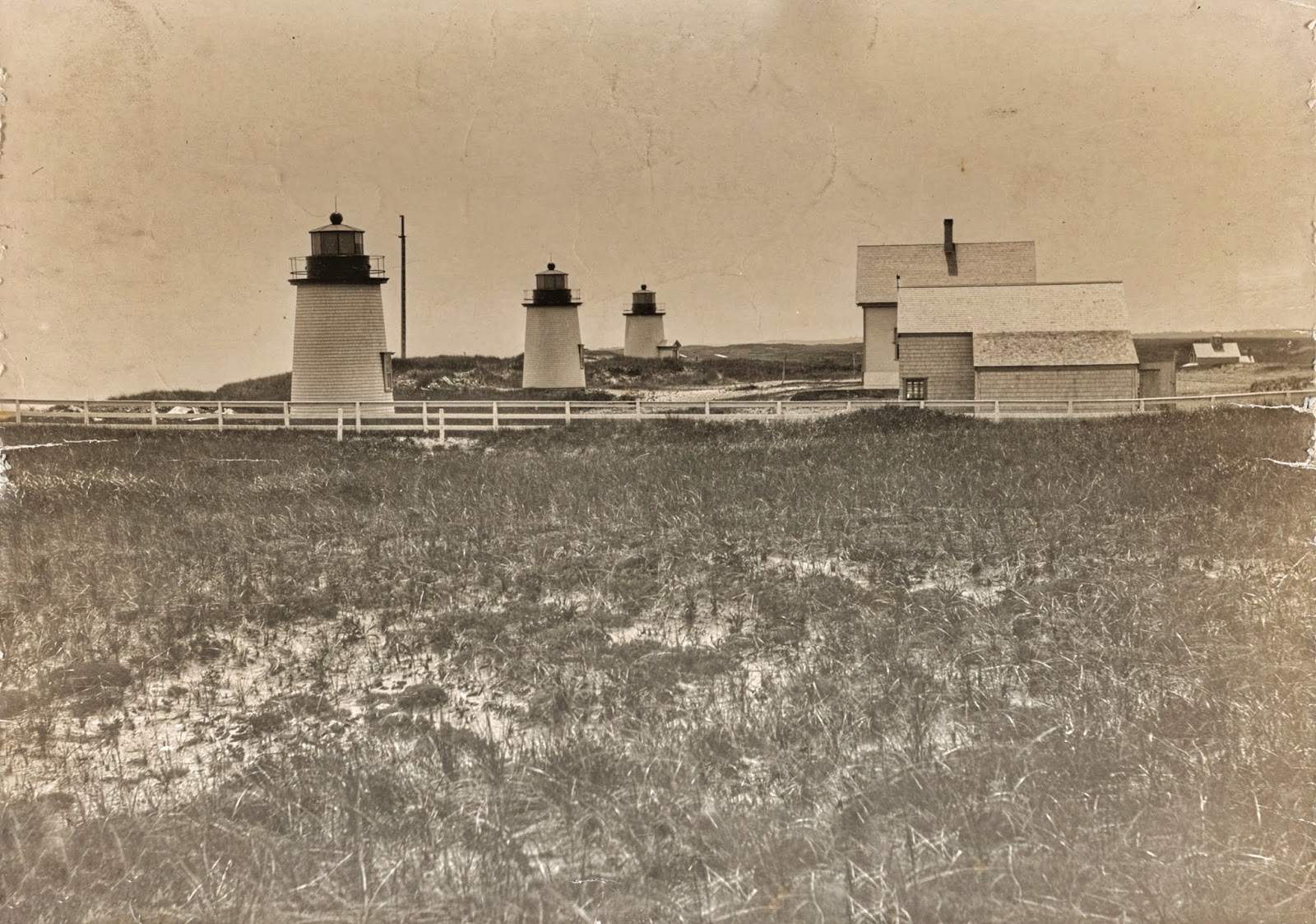 |
| The Three Sisters at the turn of the 20th century. Eastham Historical Society |
The
history of these structures begins nearly 200-years ago when the Town
of Eastham petitioned to have a beacon built along the shore to
protect passing vessels after there had been so many shipwrecks. The
proposal was approved in 1836. However instead of there being one
lighthouse it was decided that there would be three. The reason for
the three was to help vessels differentiate the Eastham lights from
the single Highland Light to the north in Truro, and the twin lights
of Chatham to the south. The idea of the three lights was that of
Captain ‘Mad Jack’ Percival.
The
fifteen-foot tall brick structures, placed 150-feet apart, were
constructed by local builder Winslow Lewis and his team who had put
in the lowest bid of $6,549 ($180,500 in 2020) on May 26, 1838. The
towers took only 38 days to complete. Legend has it that the
construction and layout was rushed and careless with the construction
supervisor David Bryant even initially refusing to sign the
completion certificate. The three beacons were seen as being too
much at the site, even being referred to as ‘shiftless and costly’
by legendary author Henry David Thoreau upon a visit.
Originally
referred to as ‘the line lights’ by passing vessels the three
towers soon gained the ‘Three Sisters’ nickname. Legend has it
that vessels passing by remarked that they resembled three ladies in
white dresses wearing black hats. The lighthouses did their job for
decades until shoreline erosion threatened them. Today when a
lighthouse is threatened measures are taken to save them by moving
them safely away from the eroding cliffs. In the late 1800’s
though the three brick towers were simply allowed to succumb to
nature and fall into the sea. They were replaced in 1892 by three
new ‘Sisters’ standing twenty-two feet tall still 150-feet apart.
These new wooden towers with brick foundations were positioned
thirty-feet back from where the original towers had fallen. These
towers were easier to move back from the cliffs if necessary.
The
relentless hand of nature continued to eat away at the cliffs of
present day Nauset Light Beach. It was decided in 1911 that the
Three Sisters would be decommissioned as the shoreline had eroded to
the point that it was within eight-yards of the north tower. Only
the center tower would remain as a solo beacon attached to the
lighthouse keeper’s house.
 |
| The Towers Eastham Historical Society |
The
two discontinued lights, minus their lanterns, were sold to Patrick
and Helen Cummings of Attleboro in 1918 for $3.50 each ($59.43 in
2020). The couple had visited Eastham via automobile while the Three
Sisters were still hovering above the eroding cliffs. They were
approached by a man at the beach and ironically were offered a cabin,
stable, and roughly 20 acres of land in exchange for their vehicle.
After
making the deal the pair of lighthouses needed to be removed from the
cliffs within ten days. In order to make it work the Cummings’ had
them moved via oxen and rollers to a site near the old French Cable
Station in Orleans. The Cummings family spent a pair of summers in
those towers before finally having them moved to Cable Road in
Eastham in 1920 where the 26x28-foot dwelling they had purchased sat.
The former Sisters became bedrooms on either side of the home. The
summer home became known as the ‘The Towers.’
The
career of the remaining Sister along the shore was short-lived. By
1923 it had also fallen into disrepair. Rather than fixing it up it
was decided that it would be decommissioned and replaced. It was
sold to Albert Hall of Hyannis at auction in 1924 for $.50 ($7.50 in
2020) and turned into a cottage much like the other two Sisters. His
was known as ‘The Beacon.’
 |
| The reunited Three Sisters facing north. Christopher Setterlund |
A
perfect substitute to take the reins of protecting Eastham’s
coastal waters sat thirteen miles to the south in Chatham. It was
there at the Coast Guard Station where another recently
decommissioned lighthouse, one of the Chatham Twin Lights, resided.
The forty-eight foot tall cast iron tower was moved to Eastham and
the top third was painted red. Nauset Lighthouse was born.
The
Towers summer home began to allow renters after the 1932 season. In
time it also had a gift shop and a dance studio. The Cummings family
sold the property to James Kingsland who in turn sold it to the
National Park Service in 1965. Ten years later, in 1975 the Beacon
was sold to the NPS by Albert Hall’s son Harold. A $510,000
restoration of the three lighthouses was completed in 1989. In 1990
the Three Sisters were reunited for the first time in nearly 80 years
on Cable Road. They were placed in the same order and spacing as
they once were overlooking the Atlantic Ocean.
In
recent years a ghost of the original Three Sisters reappeared. It
was just off of Nauset Light Beach that a circular brick foundation
was unearthed by the waves. When the tide is low enough one can walk
right out and touch it. The foundation was likely that of the center
Sister that became the ‘Beacon.’ It was
not the first time though that the foundation has been exposed by the
elements as it was also exposed
in 1999.
 |
| The foundation of the center Sister in 1999. National Parks Service |
Lighthouses
are a part of the fabric of Cape Cod and have been for centuries.
Some have simple stories, some have complex stories, it is likely
though that none have a story as unique as that of the Three Sisters.
---------------------------------------------
My 5th book, Cape Cod Nights, is on sale at Amazon.com and through Arcadia PublishingView my previous blog posts: In Their Footsteps: Cape Cod History - The Pacific Guano Company
Be sure to check out my website: Christopher Setterlund.com
Thursday, April 16, 2020
In Their Footsteps: Cape Cod History - Deacon John Doane
In
1644 seven men and their families left Plymouth for Cape Cod. They
arrived in an area known as Nauset for the tribe of Native Americans
that lived there. The town they founded was called Eastham and at
the time included present-day Orleans and Wellfleet. The men who
became the town’s founders included: Thomas Prence, Nicholas Snow,
Edward Bangs, Richard Higgins, Josiah Cook, and John Smalley. The
final founder was Deacon John Doane, my 9th-great grandfather, and
this his story and legacy on Cape Cod and in America.
The
man who would be Deacon has beginnings shrouded in mystery and
obscured by time. The Doane Family Association of America has been
working for decades to discover John Doane’s English roots. The
story of his beginnings with the highest probability is as follows.
John
Doane (spelled Done by the man himself) was possibly born in the
small village of Alvechurch in the Bromsgrove district of
Worcestershire, England, on May 28, 1592. He was the son of Nicholas
Done, and cousin to another John Done, this one a ‘whitebaker’ (baker of bread) from London.
 |
| Alvechurch, Worcestershire, England where John Doane was likely born. (Lee J. Andrews/Creative Commons) |
The
young John Doane likely found work as a cordwainer, a shoemaker that
crafted footwear out of new leather. He likely moved to London in
the time leading up to his departure for America.
In
1628 a Bill of Complaint was brought against John Doane and others by
Agnes Done, the widow of his cousin John the whitebaker, in the Court
of Chancery. The complaint claimed that those named were trying to
defraud Agnes Done out of her inheritance from her husband’s will.
John
Doane appeared in court on April 30, 1630 requesting that the estate
of his cousin John the whitebaker be awarded to him. He was granted
his request on May 6th after Agnes was excommunicated for
failure to respond to a summons to attend the court.
On
August 10, 1630 the ship ‘Handmaid’ set sail for America likely
with John Doane, his wife Ann, and eldest daughter Lydia aboard.
This was the last of the Pilgrim ships to leave for America during
the time of the Puritan Great Migration from 1620-1640. The ship
arrived in Plymouth in October after 12 weeks at sea.
Upon
his arrival in the new world it was apparent that John Doane was seen
as an important man. He was one of the few who bore the title of
‘Mr.’ which was a rarity the Pilgrims did not bestow upon those
deemed unworthy. In Plymouth the General Court, comprised of all the
freemen in the colony, was in charge of the laws and government. The
men of highest rank were elected to the Council of Assistants to the
Governor. The first records of the General Court appear from 1633.
Governor was Edward Winslow and the Council was made up of seven men:
Capt. Myles Standish, William Bradford, Stephen Hopkins, William
Gilson, John Alden, John Howland, and John Doane. Doane was also
made a Deacon of the Plymouth church in 1634. As he preferred that
role to the role of government council his change in title began the
Plymouth policy of separating Church and State.
During
his early years in Plymouth John Doane and Ann had four more
children: Abigail, John, Daniel, and Ephraim. As the 1630’s ended
there was a weariness by some families of life in Plymouth. A few
families even wished to move the entirety of the church to Cape Cod,
specifically the Nauset area where the Pilgrims had originally landed
in 1620.
A scouting mission was held to find out about the potential
sustainability of a colony at Nauset. It was determined that it
would not be possible for a large population to move there. In the
end seven families, mentioned earlier, chose to leave Plymouth for
the relative unknown of a new, smaller settlement. Deacon John
Doane, who had only recently built a house on present-day Wapping
Road in Kingston, was among those who departed Plymouth in the spring
of 1644. The highly influential Doane was more than 50 years old
when he left Plymouth.
 |
| John Doane's house on Wapping Rd., Kingston c.1644 (Public Domain) |
Nearly
50 settlers, more than 30 of them children, sailed across Cape Cod
Bay. They purchased a large tract of land from the Native Americans
upon which to begin. The small number of adults at first made it
wise to begin the settlement as one large unit. Deacon John Doane
and his family lived in a small home on 200-acres of farmland around
Salt Pond extending to present-day Pinecrest Drive in Eastham. The
home was located a few hundred feet east of what is known today as
Doane Rock.
 |
| The site of the Doane Family homestead in Eastham. (Christopher Setterlund) |
Nauset
was incorporated as a town in 1646. It officially became known as
Eastham in 1651. The following year land in the town was made
available to individuals after being one large lot for eight years.
During the formative years of Eastham Doane’s duties were similar
to those he held in Plymouth. He was Deacon of the Church, Deputy to
the Court, as well as Selectman. Doane was also part of committees
which lay out land boundaries and settled land disputes.
In
the mid-1660’s Deacon John Doane seemingly retired from
town-related duties as he was by then in his mid-70’s. The
Deacon’s children had all grown and began cultivating their own
lives. Daughter Lydia married Samuel Hicks in 1645 and would end up
living in Dartmouth by the 1660’s. Son John married Hannah Bangs
and remained close to his father. Daniel married and moved south of
Town Cove, succeeding his father as Deacon of the Eastham Church.
Ephraim married Mercy Knowles and moved north to what would become
Wellfleet. Daughter Abigail remained with her parents, likely
becoming caretaker of her elderly father after her mother’s death.
Deacon
John Doane crafted his will in May 1678 among other things he deeded
his home and the surrounding 12 acres to daughter Abigail. He died
February 21, 1685 just shy of his 93rd birthday. A few
years after his passing Abigail married Samuel Lothrop and moved to
Norwich, Connecticut. John Doane was laid to rest in the Cove
Burying Ground in Eastham. His exact resting place is unknown though
so in 1907 his descendants placed a six-ton boulder adorned with a
commemorative plaque close by to the grave of his son Daniel.
 |
| The boulder at Cove Burying Ground in Eastham (Christopher Setterlund) |
The
legacy of Deacon John Doane is immense in terms of Cape Cod,
Massachusetts, and New England history. His fingerprints were all
over the early years of Plymouth and more so the early years of
Eastham. The homestead where he first lived on Cape Cod is marked
with signs and monuments. Many Cape Codders with long ties to the
peninsula can trace their history back to Deacon John Doane one of
early Cape Cod’s most influential people.
References:
------------------------------------------------------------------
My 5th book, Cape Cod Nights, is on sale at Amazon.com and through Arcadia Publishing
View my previous blog posts: Historic Nightlife of Cape Cod: Rainbow Ballroom and Rollerdome
Thursday, February 6, 2020
In Their Footsteps: Cape Cod History - The Wreck of the Montclair
Cape Cod has seen
countless shipwrecks over the centuries. Its shifting shoals and
sand bars have always been hazardous to passing vessels especially on
the Atlantic Ocean facing coastline. Between Race Point Beach in
Provincetown and the southern tip of Monomoy Island in Chatham is
nearly fifty miles of some of the most dangerous waters in the world.
Estimates by the National Parks Service say there are upwards of
1,000 lost vessels in what is common referred to as an ‘ocean
graveyard.’ Legendary wrecks include the 17th century
Sparrowhawk, the 18th century Whydah pirate ship, the 19th
century Portland, and 20th century Pendleton. Even
vessels as large at the 473-foot Eldia, which was grounded on Nauset
Beach in 1984, have not been able to escape the pull of the Cape’s
sand bars.
Some of these
vessels, like the Sparrowhawk, have been revealed due to the shifting
sands and had their wooden carcasses removed and put on display in
local museums. One wreck that has been appearing and disappearing
over the last decade is that of the Montclair. Located on southern
Nauset Beach it is a glimpse into history and an adventure to
explore. However it is a real ship and a real tragedy with numerous
lives lost which happened nearly a century ago. This is the story
behind the remains that have been photographed and shared throughout
social media over the last several years. This is the story of the
wreck of the Montclair.
 |
| The Orleans Lifesaving Station circa 1900, courtesy of Sam's Scrapbook.com |
The vessel known as
the Montclair was a three-masted schooner. The 371-ton wooden ship
was built in Yarmouth, Nova Scotia, Canada in 1918 and designated a
transport vessel. It was owned by Captain C.B. Martin of Partridge
Island, Nova Scotia.
On Tuesday March 1,
1927 the 142-foot Montclair set sail from Halifax, Nova Scotia en
route to New York City with a cargo of 2.5 million wood laths. It
was headed by Captain William McLeod with a total crew of seven men.
That same day a British vessel, the Frederick H., also left Nova
Scotia with New York as its destination. Neither would reach its
destination. The very next day the vessels began to feel the effects
of a strong late-winter storm raging in from the southwest. Winds of
up to 60 mph tore at the ships as they rounded Provincetown and
headed down through the shoals of the Atlantic side of Cape Cod on
March 3rd. McLeod had the utmost confidence in his vessel and
pressed on south.
The wind and waves
pounded the Montclair and began pushing it in toward the shore as it
headed past Nauset Beach. The ship lost two of its three masts, the
fore and mizzen masts. Unable to control the vessel they could only
hang on as it was pushed into the sandbars roughly a mile off shore
just south of Nauset Beach. It was at this point, early on March
4th, that the peril of the Montclair awakened Captain
Edward L. Clark. Clark was part of a skeleton crew of three men at
Coast Guard Station #40 located just east of Little Pochet Island,
two and a half miles south of the current Nauset Beach parking lot.
The station had been designated inactive in the early 1920’s
ironically due to the fact that there had not been any shipwrecks in
the area for decades.
 |
| The wreck of the Montclair in 1927, courtesy of the William Quinn Collection |
Clark notified the
Provincetown and Old Harbor (Chatham North Beach) Coast Guard
stations and people rushed to the scene. After one last attempt to
swing the Montclair clear of the shoals it was tossed up on to the
sand where it was beaten by the waves of the high rising tide. The
brave Coast Guard crews headed out into the wind and waves for an
attempted rescue even managing to shoot three weighted lines over the
stern of the crippled ship. Five members of the ship’s crew
grabbed on to one line while the other two men grabbed another before
the Montclair was broken in half near the middle. The five crew
members including Captain McLeod were washed overboard while the
other two men were picked up and brought back to shore.
The splintered ship
was eventually lifted off the sandbar by the tides and brought to
shore where it was tossed up onto the sands of Nauset Beach. Its
cargo of wood laths scattered for miles along the sand. The two
survivors of the wreck Nathan Bagg and Gartland Short were treated
for hypothermia and hysteria at the Coast Guard station. The body of
Captain McLeod was quickly recovered while three of the other four
missing were also quickly pulled from the water as the storm subsided
and the sea calmed. The fifth and final deceased member of the
Montclair’s crew would be discovered on March 15th on
North Beach in Chatham by Wesley Eldredge mostly buried under the
sand.
 |
| The remains of the Montclair today |
Much like with the
grounding of the Eldia decades later countless residents came out to
see the wreck of the Montclair with some helping themselves to some
of the unbroken wood laths that had been deposited for a half-mile
along the coast. Considered to be the worst maritime disaster on the
Cape in more than twenty-five years questions were raised after as to
whether more lives could have been saved if the Orleans Coast Guard
station had been active.
The Frederick H.,
which had left Nova Scotia the same day as the Montclair, also ran
into the destructive storm as it sailed around Cape Cod. Badly
damaged as well it managed to limp its way into Vineyard Haven only
thanks to constant pumping of the water from the hold and galley of
the vessel by the crew.
Along the coast of
Cape Cod at the same time author Henry Beston was residing at his
‘Fo’castle’ beach shack, writing his soon-to-be classic ‘The
Outermost House.’ The news of the wreck of the Montclair made its
way to Beston who immortalized the disaster in his book’s sixth
chapter. Deputy Collector Thomas Finnegan reported to the scene from
New Bedford with a team of eight men as the Montclair had been a
suspected rum-running vessel. He questioned the two survivors but
did not secure any useful information. One blessing from the
disaster of the wreck was that the Orleans Coast Guard station was
restored to full strength after it happened.
 |
| The remains of the Montclair today |
The shifting sands
have buried and uncovered the remains of the Montclair several times
over the decades. In the 2010’s it was revealed repeatedly, each
time slightly more decayed than before. The wood is soft and rotting
away, while the iron is rusty and gives the ship a ghostly skeletal
appearance currently. It is nearly a two and a half miles walk over
the sand to reach the remains of the Montclair.
Though an
interesting adventure taking the walk out to find its remains it is a
somber and solemn reminder of the dangers of the sea. It is
important to remember the five men who lost their lives aboard the
Montclair as well: William Downing, William Stewart, George Cains,
Jerome Butler, and Captain William McLeod.
View my previous blog posts: In Their Footsteps: Cape Cod History - Storyland Amusement Park, Hyannis
Thursday, December 12, 2019
In My Footsteps: My Cape Cod Roots
I am a 12th generation Cape Codder, my roots are that of the Doane family. Deacon John Doane, one of the founders of the town of Eastham is my paternal 9th-great grandfather. My maternal grandfather ran his own successful business, Sullivan's Donut Shop in Hyannis for two decades. My family is deeply rooted in the history of the Cape, although throughout my childhood I don't think I appreciated where I lived. Looking back now though I realize how specials those times and the days since have been.
I feel that I was born at the absolute best time to appreciate Cape Cod for all that it is and was. I am old enough to remember things ‘the way they used to be’, yet young enough to enjoy the way things are. For those who are dying to know, I was born in 1977. I straddle the line between generations that gives me insight into two worlds. I am of the age where I was able to see and experience a little bit of Olde Cape Cod and watch as my home changed and adapted with the times.
I feel that I was born at the absolute best time to appreciate Cape Cod for all that it is and was. I am old enough to remember things ‘the way they used to be’, yet young enough to enjoy the way things are. For those who are dying to know, I was born in 1977. I straddle the line between generations that gives me insight into two worlds. I am of the age where I was able to see and experience a little bit of Olde Cape Cod and watch as my home changed and adapted with the times.
During my childhood landline telephones and phone booths were common. I remember waiting for friends to call, and actually having to remember people’s phone numbers. Yet as an adult I love the convenience and technology of smartphones. I do not believe I could recite anybody’s phone number today. However I could still rattle off my old home phone number, my Nana’s number, and a few friends from middle school as well.
Throughout my childhood I would be tossed outside by my mother during summer to go off and play with my friends, only coming home when it was almost dark. I do not believe we ever feared being abducted, though I am sure the bad people were not something invented in the last twenty years. The Cape seemed more innocent though I am sure that it was not.
I was born at a time when vinyl albums were mainstays. I had a collection as a seven-year old that might shock people today with artists like Ratt, Twisted Sister, Quiet Riot, Van Halen, and Motley Crue lining my shelves. Of course I had the first pressing of Michael Jackson’s Thriller as well and used to play it loudly out of my window on my Fisher-Price record player so all of the neighborhood kids could dance in the yard. I had young hip parents which influenced my style growing up. However as much as I loved making cassette mixtapes off of stations like Cape 104 and 96.3 The Rose I can honestly say I prefer MP3’s and iTunes to Maxell and Memorex.
I am old enough to remember walking, or driving, to the video store to rent VHS tapes. Yet I am young enough to fully enjoy Netflix and Hulu and the instant gratification they provide. Sure I played Atari 2600 and the original Nintendo but they were bit parts of my childhood. Admittedly I did spend a good amount of time at the arcade but Rampage wasn’t going to beat itself! It was a time when walking seemed more common, like after family meals on holidays. There was always a place to walk as a family.
I am old enough to have seen the first two schools I attended close. I went to South Yarmouth Elementary School on Route 28 with Laurence MacArthur as my principal. The school would eventually bear his name before being closed in 2013 and reopening as a campus for Bridgewater State University in 2015. I then attended John Simpkins Elementary located on the same plot of land. It served as the town’s first high school before Dennis-Yarmouth opened in 1957 and housed Grades 3-5 after. It closed in 2006 and was transformed into the Simpkins School Residences, senior housing, opening in 2014.
 |
| The former John Simpkins Elementary in South Yarmouth |
I am old enough to remember the Cape Cod Mall in the days before it expanded. In those days it was anchored by Woolworth, Filene’s, and Jordan Marsh and had a separate cinema on the property. I remember spending Friday evenings searching Record Town and Tape World for my next musical interest. However I am also young enough to enjoy the convenience of what the expanded Mall has brought with so many stores under one roof.
 |
| The Cape Cod Mall entrance circa 1995 |
I am old enough to remember Cape Cod icons such as Thompson’s Clam Bar, Mildred’s Chowder House, Joe Mac’s, and Mill Hill Club. There were fewer Shaw’s and Stop & Shop’s and more Angelo’s, Purity Supreme, and A&P’s. I frequented Bassett’s Wild Animal Farm in Brewster and visited the legendary Cape Cod Coliseum, although it was to see Sesame Street On Ice.
I am old enough to remember the grounding of the 473-foot freighter Eldia at Nauset Beach in March 1984 and not believing how big it was. I saw the breach of North Beach in Chatham in January 1987 and am amazed at seeing it healing itself. In 1991 Hurricane Bob in August and the ‘Perfect Storm’ of October made me appreciate the wonders of electricity after losing power for many days.
 |
| The Eldia aground on Nauset Beach in March 1984 |
My childhood was a time when drive-in theaters were still the norm. At their peak there were nearly 4,000 drive-in theaters in the United States, as of 2017 that number has dwindled to 338. The Wellfleet Drive-In is all that remains of their legacy on Cape Cod. However I have fond memories of being elementary school aged and visiting the Yarmouth Drive-In across from Captain Parker’s Pub. I was lucky enough to see movies like E.T., Return of the Jedi, and Flash Gordon in the warm summer air. Other drive-in theaters in Dennis, Hyannis, and Falmouth once dotted the Cape decades ago as well.
I remember there being more salamanders and fewer turkeys and coyotes. I was warned about jellyfish stings when stepping into the ocean, Great White sharks not so much. I remember the noon whistle in Yarmouth scaring me on numerous occasions. I remember more Friendly’s and fewer Dunkin’ Donuts, Bradlees instead of Walmart. Cape Cod seemed much larger then. A family trip to Edaville Railroad in Carver felt like a drive across the country. Today Chatham, Provincetown, and Falmouth feel an arm’s length away.
Amazingly for all of the changes I have seen in my time there are some things which remain the same. The scent of Cape Cod Potato Chips cooking as you pass along the Mid-Cape Highway between Exits 6 and 7. 106 WCOD on the radio. Delicious ice cream during the summer from places like Four Seas, Lil’ Caboose, and Ice Cream Smuggler. Kids and families sledding on the golf courses during winter. The Barnstable County Fair in July, the Cranberry Festival in Harwich in September, the Yarmouth Seaside Festival in October.
Then there is the natural beauty of Cape Cod. It is everywhere. The National Seashore is as close as one can get to how the Cape must have looked when it was first discovered. Summer drives along the shore routes in Eastham up through Provincetown are heavenly. Route 6A is a blast to the past with its historic homes and tree shaded scenery, just like I remember as a child.
Yes I feel I was born as the absolute perfect time when it comes to the history of Cape Cod. I have watched the Cape change in some ways and stay the same in others. This is only my story though, what things do you remember about Cape Cod as children? What changes have you enjoyed? What changes have you not liked? Thanks for reading.
Sunday, December 15, 2013
In My Footsteps: Cape Cod - Doane Rock & Doane Memorial
My first book, In My Footsteps: A Cape Cod Travel Guide, is now available at SchifferBooks.com, BarnesandNoble.com, and Amazon.com, and stores everywhere! Follow me on Twitter and YouTube for more on In My Footsteps.

Subscribe to:
Posts (Atom)